
What Size Are Standard Business Cards? Dimensions, Bleed & Setup Explained
The standard business card size in Canada is 3.5 x 2 inches (88.9 x 50.8 mm), but bleed, safe zones, and stock thickness are what actually make a card print clean. Here are the exact dimensions in inches, mm, and pixels, plus the setup specs we use in our Ottawa shop.
A realtor walked into our Ottawa shop last spring holding a card she'd designed herself in Canva. It looked great on her screen. The problem showed up the moment we opened the file: her phone number ran right up against the bottom edge, and there was no bleed at all, just a hard white border where she'd meant a full navy background. If we'd printed it as-is, half the stack would have come off the cutter with her number clipped and a thin white line down one side.
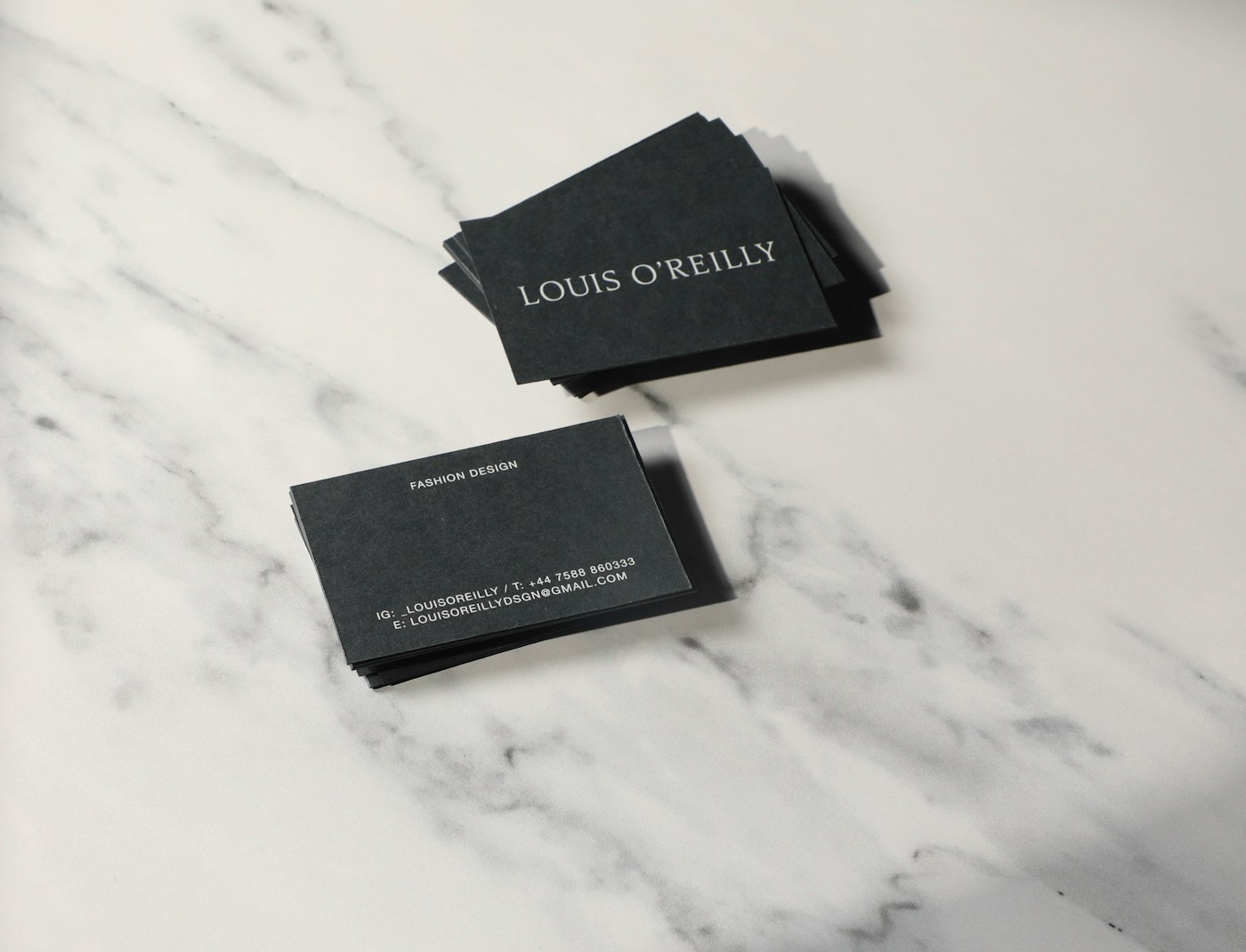
We fixed it in ten minutes because the underlying dimensions were right — she just didn't know about bleed and safe zones. That's the thing about business cards: the standard business card size is dead simple, but the setup around it trips up almost everyone the first time.
So here's the whole picture. What size a standard business card actually is (in inches, millimetres, and pixels), the bleed and safe-area margins that keep your artwork from getting cut, how thick the card should be, and how to hand us a file that prints clean the first time.
What size is a standard business card?
In Canada and the US, the standard business card size is 3.5 x 2 inches, or 88.9 x 50.8 mm. That works out to an aspect ratio of 1.75, and it's the shape every North American wallet, cardholder, and business-card scanner is designed around. When someone in Ottawa asks us for "regular" business cards, this is what they mean, and it's what we print by default.
There isn't actually a single global standard, though. If you look at standard business card dimensions by region, you'll find the common Western-European card is 85 x 55 mm (3.346 x 2.165 in) and credit-card-style cards follow ISO 7810 ID-1 at 85.6 x 53.98 mm. If you're printing for a European audience or want a card that slots into a credit-card wallet sleeve, those specs matter. For a business operating in Ottawa, 3.5 x 2 in is the safe choice every time.
Standard business card sizes in inches and mm
Here are the sizes we get asked for most, with the trim size (the finished card) and the full-bleed document size you actually build your file at. Add 3 mm of bleed on every side to get from trim to document size.
| Card | Trim (in) | Trim (mm) | With bleed (in) |
|---|---|---|---|
| North American (standard) | 3.5 x 2 | 88.9 x 50.8 | 3.75 x 2.25 |
| Western European | 3.35 x 2.17 | 85 x 55 | 3.58 x 2.4 |
| Credit-card (ISO 7810 ID-1) | 3.37 x 2.13 | 85.6 x 53.98 | 3.6 x 2.36 |
| Square | 2.5 x 2.5 | 63.5 x 63.5 | 2.75 x 2.75 |
| Mini / skinny | 3.5 x 1 | 88.9 x 25.4 | 3.75 x 1.25 |
| Folded (flat size) | 3.5 x 4 | 88.9 x 101.6 | 3.75 x 4.25 |
A quick note on the specialty shapes. Rounded-corner cards are still 3.5 x 2 in — the corner radius (usually a quarter inch) is applied by the cutter, not drawn into your file, so you set up a normal full-trim card with normal 3 mm bleed. Square cards are 2.5 x 2.5 in. A folded card is 3.5 x 4 in flat and folds down to the standard 3.5 x 2 in, giving you double the printable space for a menu, calendar, or loyalty stamps on the inside.
Business card bleed and safe area setup
This is the part that saves your artwork. Every print-ready card has three zones, and getting them right is the difference between a crisp card and one with clipped text or white edges.
- Bleed (outer edge): Extend all background colours and images 0.125 in (3 mm) past the trim on all four sides. On a standard card that makes the document 3.75 x 2.25 in (95.25 x 57.15 mm).
- Trim line: Where the card is actually cut — the finished 3.5 x 2 in edge. This is a guide, not a hard boundary; assume the real cut lands a hair inside or outside it.
- Safe area (inner margin): Keep all text, logos, and anything you can't afford to lose 0.125 in inside the trim, so 3.25 x 1.75 in (82.55 x 44.45 mm) of live space.
The reason for all this is mechanical. What bleed means in printing comes down to this: cards are printed in big sheets and cut in stacks on a guillotine, and the paper shifts by fractions of a millimetre as the blade comes down. Bleed gives the cut somewhere to land without exposing bare paper, and the safe area gives your text room so it never gets shaved. Yes — you can and should bleed a background colour or photo right to the edge; just make sure nothing important sits out there with it.
Resolution: business card size in pixels at 300 DPI
If you're designing in a pixel-based tool like Photoshop or Canva rather than a vector program, build at 300 DPI. That's the print-industry standard for sharp, non-pixelated cards. Dots per inch (DPI) explained is just the density of dots packed into one inch (25.4 mm); at 300 DPI, text and logos stay crisp instead of soft or jagged. Here's the standard 3.5 x 2 in card translated into pixels:
| Zone | Inches | Pixels @ 300 DPI |
|---|---|---|
| Full bleed (document) | 3.75 x 2.25 | 1125 x 675 px |
| Trim (finished card) | 3.5 x 2 | 1050 x 600 px |
| Safe area (live text) | 3.25 x 1.75 | 975 x 525 px |
If your logo only exists as a small, low-resolution PNG, blowing it up to fit these pixel dimensions will look blurry. That's usually the moment to convert it to vector art — our logo vectorization service redraws a fuzzy raster logo as clean lines that stay sharp at any size, and our guide on how to prepare logo files for printing walks through the file formats we can actually use.
How thick should a business card be?
Size gets the attention, but thickness is what people feel when you hand them the card. Stock is measured in points (pt) for thickness and grams per square metre (gsm) for weight. A flimsy card reads as cheap no matter how good the design is, so we steer most customers toward something with a bit of substance.
- 14pt (~350 gsm): The practical minimum for a professional card. Solid and affordable, our most popular everyday stock.
- 16pt (~400 gsm): Noticeably sturdier with a nice snap. A small upgrade for a big perceived-quality bump.
- 18pt (~450 gsm): Our recommended modern starting point — premium feel without tipping into novelty thickness.
- 20pt & 24pt: Heavyweight, luxury cards. Great for soft-touch or suede finishes where the card itself is part of the pitch.
For a contractor handing out a few hundred cards a month, 14pt or 16pt is the sweet spot. For a designer, lawyer, or anyone doing low-volume, high-value introductions, a thick 18–24pt soft-touch card earns its cost in first impressions. Finish plays into this too — if you're deciding between coatings, our breakdown of matte vs glossy vs soft-touch finishes covers how each one changes the feel.
Setting up a print-ready file
Pulling it all together, here's the business card template setup we ask for so your cards print exactly as designed:
- Document size: Build at the full-bleed size (3.75 x 2.25 in for a standard card), not the trim size.
- Bleed: Backgrounds and images run all the way to the document edge; keep text 0.125 in inside the trim.
- Resolution: 300 DPI for raster files, or supply vector art (PDF, AI, EPS, SVG) which is resolution-independent.
- Colour: Set the file to CMYK — screens are RGB, but presses print in CMYK, and converting late can shift your colours.
- Two sides: Supply front and back as separate pages or files, both built to the same spec.
Not set up to build a print file? That's normal, and it's what we're here for. You can start from scratch in our online business-card designer, or just send us your logo and we'll lay out a proof with the bleed and safe zones handled correctly — see everything on our business card printing page. Once the cards are in your hands, they're one of the cheapest marketing tools you own — Canada Post even builds direct mail solutions around printed cards and postcards if you want to put them in front of a whole neighbourhood at once.
Wondering what all of this costs once you factor in quantity and finish? Our Ottawa business card price guide breaks down real 2026 pricing by quantity and stock so there are no surprises when you order.
Frequently asked questions
What size is a standard business card?
In Canada and the US the standard business card size is 3.5 x 2 inches, which is 88.9 x 50.8 mm — an aspect ratio of 1.75. That is what almost every wallet, cardholder, and Rolodex is built around here. There is no single global standard, though: the common Western-European card is 85 x 55 mm and credit-card-style cards follow ISO 7810 ID-1 at 85.6 x 53.98 mm.
How much bleed does a business card need?
Add 0.125 in (3 mm) of bleed on all four sides. A 3.5 x 2 in card becomes a 3.75 x 2.25 in (95.25 x 57.15 mm) full-bleed document. Bleed exists because it is impossible to trim a stack of cards exactly to the printed edge — the paper shifts slightly during guillotine cutting, so your background colour has to extend past the trim line or you get thin white slivers.
What is the safe area on a business card?
The safe area is where your text and logo need to live: 0.125 in in from the trim line, which is 3.25 x 1.75 in (82.55 x 44.45 mm) on a standard card. Anything closer to the edge risks being cut off. Keep phone numbers, names, and logos comfortably inside that zone and let only backgrounds run to the edge.
How thick should a business card be?
Common stocks are 14pt, 16pt, 18pt, 20pt, and 24pt, and most decent cards are at least 350 gsm / 12pt. We treat 18pt as a modern professional starting point — it has a satisfying snap without feeling like cardboard. Thicker soft-touch or suede stocks feel more premium and suit high-value, low-volume hand-outs where the card itself is part of the pitch.
Is a business card the same size as a credit card?
Close, but not identical. A North American business card is 88.9 x 50.8 mm, while a credit card (ISO 7810 ID-1) is 85.6 x 53.98 mm — narrower and slightly taller. The aspect ratios differ too: 1.75 for the business card versus about 1.586 for the credit card. So a card designed to the credit-card spec will not sit flush in a North American cardholder slot.
Ready to print business cards that fit right?
Send us your logo or rough idea and we'll send back a free proof with the bleed and safe zones set up correctly — no clipped phone numbers, no white edges.
Get a card quote