
Custom Restaurant Uniforms in Toronto: Aprons, Staff Shirts and Embroidery That Survive a Double
A Toronto restaurant is a uniform buyer with a turnover problem: six aprons at opening, three more when the patio hires start, a new bar tee every summer. Which pieces actually get worn, why embroidery wins on aprons and print wins on bar merch, how many wash cycles each piece sees, and how to set up the first order so every reorder is a two-line email. Printed and embroidered in Ottawa, shipped to the GTA.
- What restaurants actually order
- Aprons (bib, waist, bistro, cross-back), black crew tees, embroidered polos for front of house, and a bar tee that doubles as merch. Chef coats are quoted through the form, not the studio.
- Embroidery or print
- Embroidery on aprons and polos — it survives daily hot washing and reads as a uniform. DTF or screen print on kitchen tees and bar merch, where a full-colour graphic matters more than a stitched crest.
- Minimum order
- None on DTF or DTG — one apron for a new hire is a normal order. Screen printing starts around 6 pieces and is the best value past roughly 24–50.
- Typical tee cost
- Roughly $12–$18 CAD per screen-printed tee at 50 pieces, under $10 each in the hundreds. Full-colour DTF sits slightly higher per piece with no setup fee. Aprons and polos are quoted per piece from your logo and headcount.
- Turnaround to Toronto
- 2–5 business days in production after you approve the free mockup and pay, then 1–2 days in transit from Ottawa. We have no Toronto storefront or pickup.
- Reorders
- Your approved artwork, embroidery file and placement stay on file, so the three aprons you need in June match the six from March. No re-digitizing.
- Artwork check
- A human designer reviews every order before it goes to press — resolution, colour, sizing and placement. Not an automated preflight.
A Toronto restaurant is a uniform buyer with a turnover problem
Nobody who runs a room on King West or a counter in Kensington Market has ever placed one uniform order and been done. The pattern from Toronto restaurants is always the same: a batch at opening, a smaller batch when the patio hires start in May, a couple more in August when two servers leave for school, then a fresh idea for a bar tee once the neighbours on the strip all seem to have one. The order is never big. It is frequent, and every batch has to match the last one.
That shape is what most decorators quietly hate, because a six-apron order carries the same file handling as a sixty-apron order. It is also why so many restaurant uniforms in this city end up as an unbranded black apron from a restaurant-supply store: the owner asked for a quote on eight embroidered aprons, got told the minimum was twenty-four, and gave up. We built around the small, repeated order instead. One apron for a new hire is a normal job here, and the tenth reorder of the same logo costs less effort than the first.
The rest of this guide is the version of the conversation we have with a new restaurant two or three times a week: which pieces actually get worn, where embroidery beats print and where it does not, how the bar tee turns into merch, what happens in the wash, how to size a run when your headcount changes monthly, and what it costs. If you want the Ottawa edition, it lives in custom restaurant uniforms in Ottawa. This one is about the GTA, and about the fact that we ship there rather than stand there.
Which pieces get worn, and which sit in the back
Every restaurant thinks it needs a full uniform programme. Almost none of them do. What gets worn every shift, in nearly every room from the Danforth to Leslieville, is four things: an apron, a black tee, a polo or button-up for the people who greet guests, and whatever the kitchen wears under its apron. Get those right and the rest is optional.
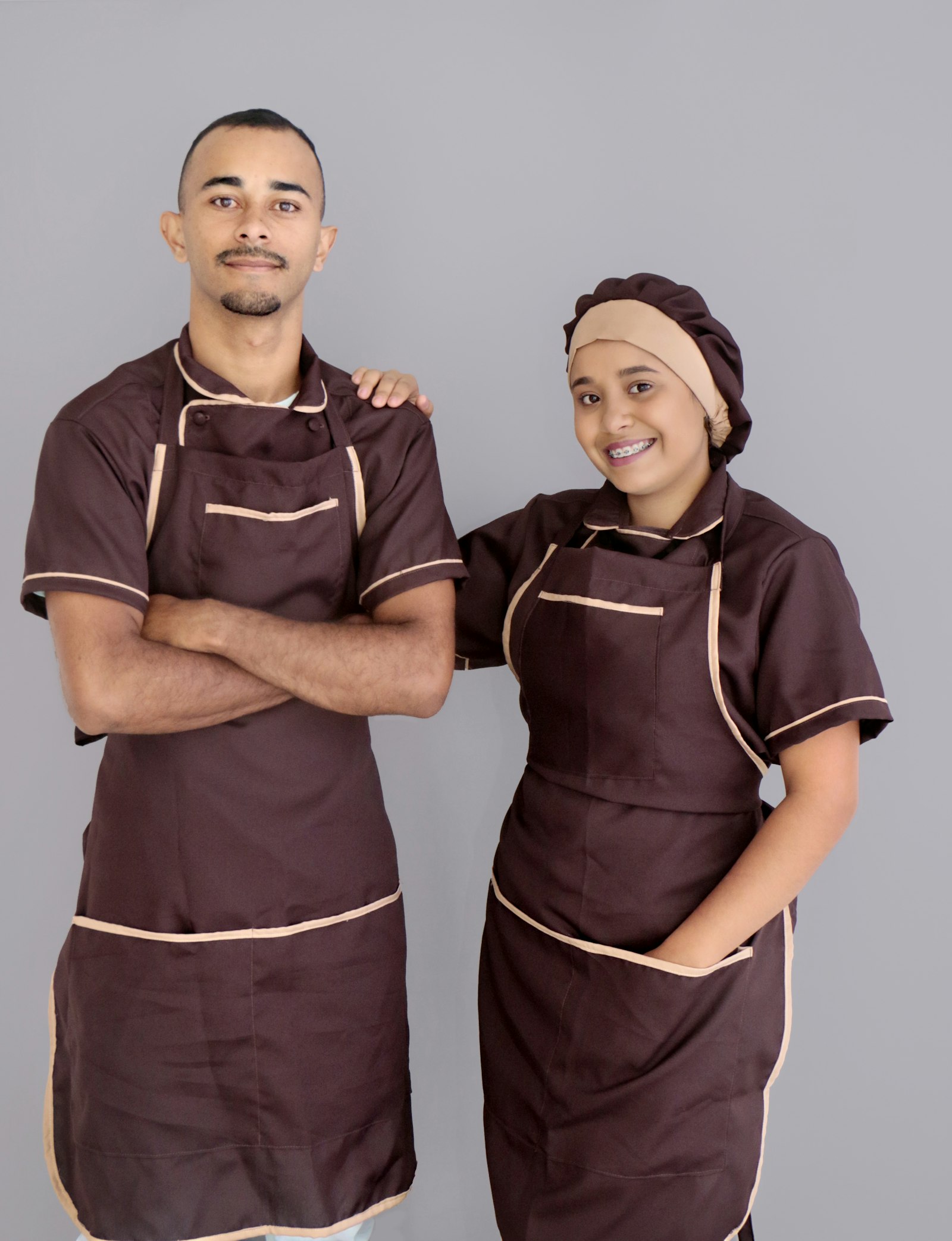
The apron comes in four cuts that matter for us. A bib aproncovers chest to knee and gives you the best logo position on the body, high on the chest where nobody’s arm crosses it. A waist apronis the server’s choice on a fast-casual floor; the logo goes on a pocket or the hip, small. A bistro apron is the long waist apron that reaches the shin, the one you see on Ossington and in the Distillery District, and it takes a logo low on the hip or centred on the front panel. A cross-back apron, with straps that cross behind rather than a neck loop, is what kitchens and coffee bars ask for when staff complain about neck strain over a long shift; the logo still sits on the chest. We go through fabrics and which cut suits which room in custom aprons for restaurants, cafes and salons and on the custom aprons page.
Under the apron, the black tee does the work. It hides everything, it is cheap enough to treat as consumable, and it is the piece you can build yourself in the studio tonight with a small chest logo or a sleeve print. Front of house on a tablecloth floor usually steps up to a polo with an embroidered crest, which is the same logo in a different register. Chef coats and cook shirts we handle too, but they go through the quote form rather than the studio, because the blanks, the placement and the sleeve options are different enough that a person should look at them with you.
Embroidery versus print on hospitality wear
The rule we give restaurants is short. If the piece touches a guest’s eye line all night and goes through a hot wash every day, embroider it. If it is a kitchen layer or a piece of merch with a big colourful graphic, print it. That splits a restaurant cleanly: aprons and front-of-house polos get thread, kitchen tees and bar tees get ink.
Why embroidery wins on aprons specifically: an apron lives a harder life than any other garment in the building. It is wiped, splashed, bleached, dried hot and pulled on and off a dozen times a shift. Machine embroidery is thread locked through the fabric, so there is nothing to crack, peel or fade; a stitched logo on a heavy twill apron generally outlives the apron. It also reads as a uniform rather than a promotion. A guest sees a stitched crest on a bib and files it as “this place has its act together” without consciously noticing. The same logo printed on the same apron reads as a giveaway.
Two honest limits. Embroidery cannot do gradients, photographs or tiny text, so a logo with a hairline script under it will need the script dropped or enlarged before it is digitized. And the first run carries a one-time digitizing step to turn your logo into a stitch file. That file is yours from then on; every reorder skips it. The full comparison on polos is in embroidery versus a printed logo on polos, and custom embroidery in Toronto covers what we can and cannot stitch. If your polos are the question, polo printing in Toronto walks through blanks and placements.
Where print wins is colour and cost at low counts. A kitchen tee with a one-colour logo on the chest does not need thread, and a bar tee with a four-colour illustration cannot be thread. That is the next section.
The bar tee that becomes merch
Walk any strip with a patio in July and you will see it: the bar staff are wearing a black tee with a big, loud, full-colour graphic, and by August three regulars are wearing the same one. That is the cheapest marketing a restaurant in Toronto can buy, and it starts as a uniform order.
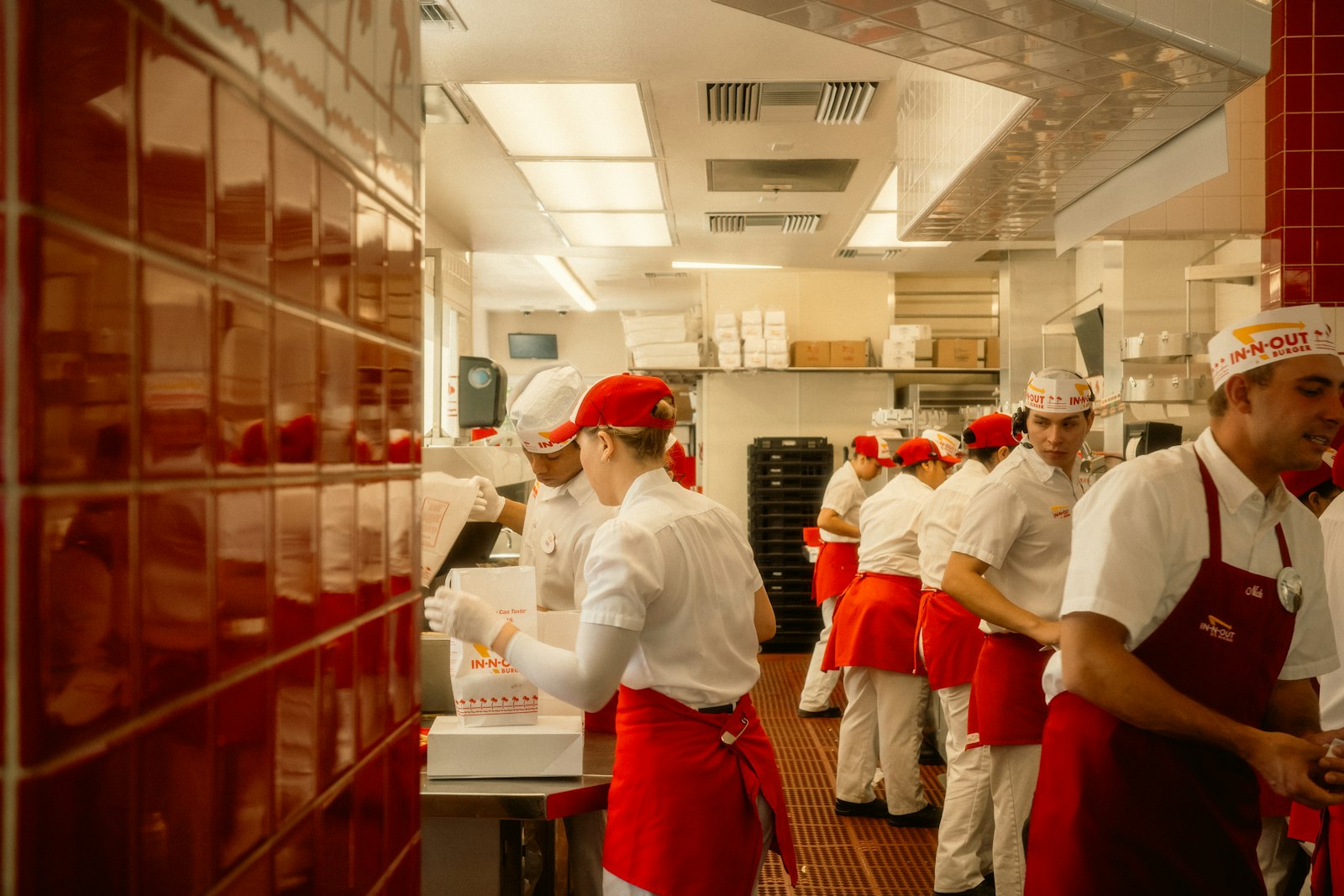
The method is DTF, and it is the right tool for exactly this job. It prints unlimited colour on a black tee with a bright white base under it, so an illustration, a hand-drawn menu item or a gradient sunset over the Yonge and Eglinton skyline all come out the way they look on screen. There is no setup fee and no minimum, so you can run fifteen for staff and see whether anyone asks to buy one before you commit to a hundred. Screen printing takes over once you are confident and the count climbs past 50; our DTF printing page explains where that line sits, and custom t-shirt printing in Toronto covers the wider tee conversation.
One caution we give every restaurant, and most ignore until the first heat wave: a huge print on a black tee gets hot in a kitchen. Any transfer or heavy ink deposit is a layer that does not breathe, and a twelve-inch full-front graphic on someone working a line at thirty-five degrees is a plastic bib. So split the order. The bar and the patio get the big graphic; the kitchen gets the same art shrunk to a left-chest hit, or a sleeve print, or a one-colour version with no white base. Same brand, same tee, two builds. You can lay both out side by side in the studio and order them together.
If you do decide to sell the tee, t-shirt printing is priced by quantity, and a hoodie in the same art is the piece that actually moves once patio season ends and the Leslieville evenings turn cold.
Washability: count the cycles, not the months
A restaurant garment does not age in months. It ages in wash cycles, and a busy room runs more of them than any office ever will. An apron worn daily and washed every night is seven cycles a week, well over three hundred a year. A kitchen tee that gets a second shift after a spill might be nine or ten. A front-of-house polo worn on a rotation of three might be two. The right decoration for each piece follows from that count.
Embroidery on the seven-a-week pieces, without argument. A stitched logo goes through hot washing and commercial dryers indefinitely; the twill around it will wear first. DTF on tees is more durable than people expect, and it is far better than the old vinyl letters that used to peel off restaurant shirts after a summer, but it does have rules: wash cold or warm, inside out, dry on low or hang. Treated that way, a DTF print will outlast the tee. Treated like a bar rag, it will not. We wrote the actual care sheet in how to wash DTF-printed shirts; print it and tape it above the machine.
Two more things the wash decides for you. Choose garment colours that hide the job: black, charcoal, navy and dark brown forgive coffee, sauce and bleach splatter, while a white polo on a floor that serves red wine is a weekly reorder. And put the logo where the apron does not fold over it in the dryer or get scrubbed at the hip; high chest on a bib, pocket on a waist apron. The thread will survive; a badly placed print may not.
Sizing a run when your headcount changes monthly
Corporate orders come with a spreadsheet. Restaurant orders come with a text that says “eight aprons and some mediums.” That is fine, as long as the first order is set up so the second one is trivial. Three decisions do that.
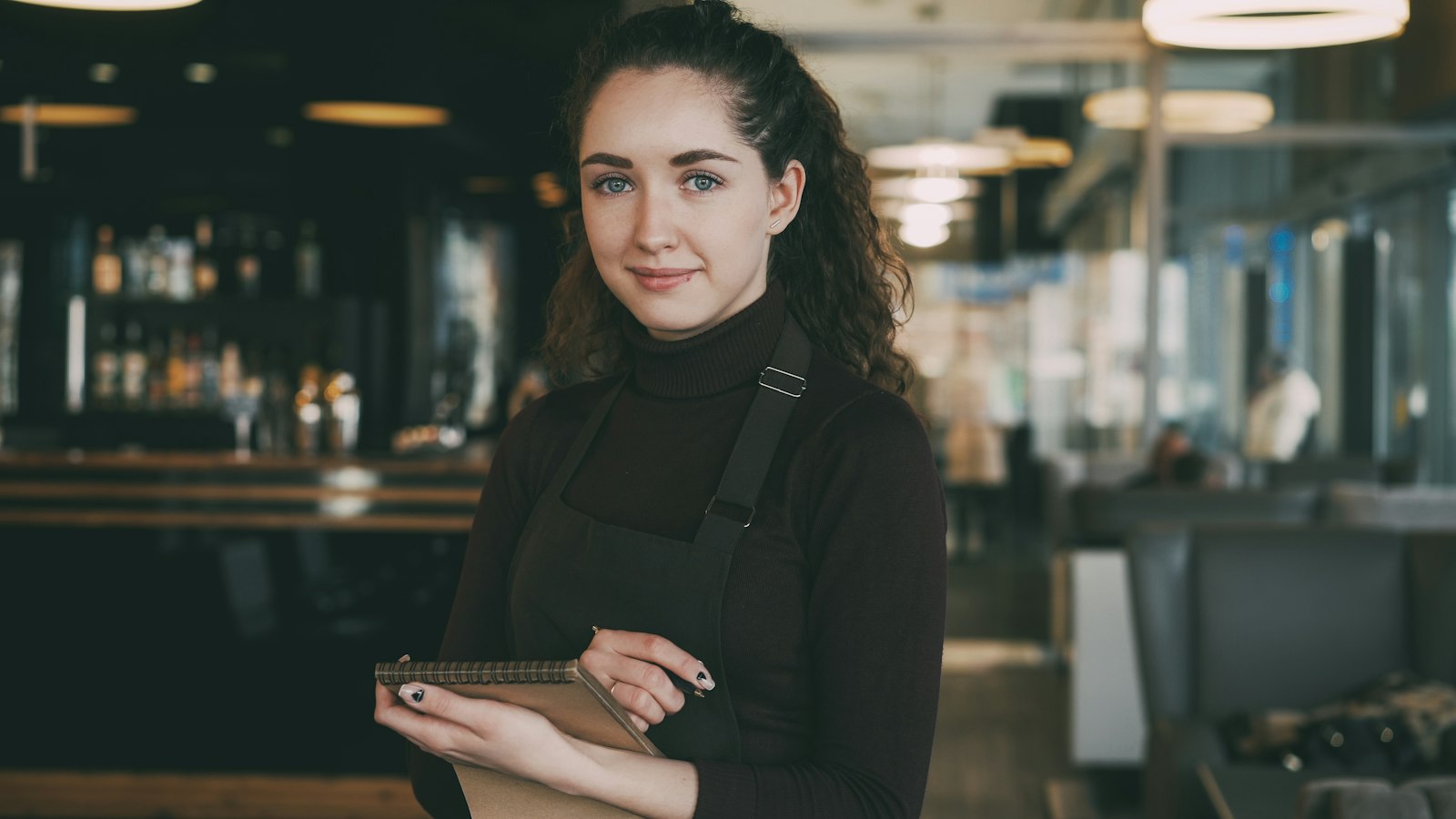
- Pick a mainstream blank. A closeout apron in a lovely rust colour is a trap, because in June it will be gone and your three new hires will not match the room. Choose a style and colour from a stocked line so the reorder is the same garment, not the nearest thing to it.
- Keep the artwork on file, in vector. We store your approved logo, the embroidery stitch file and the exact placement and size. A reorder is then an email with a size and a count. If your logo only exists as a screenshot from Instagram, we redraw it once at the start and it is solved for good.
- Order aprons by headcount plus spares, tees by size. Most aprons are one-size, so a run is simply everyone on the schedule plus two or three for the person who forgot theirs. Tees and polos need real sizes; collect them once at opening and keep the list, so the August top-up does not restart the whole exercise.
- Reorder in small batches on purpose. There is no minimum on embroidery or DTF here, so buying forty aprons at opening to save a dollar each only locks cash in a shelf. Buy what the schedule needs and top up.
The Toronto-specific version of this is the second location. A room in downtown Toronto and a second in Etobicoke or North York should be one order split into two boxes, not two orders. One embroidery run, one thread match, one price break, and the staff who float between rooms are wearing the same apron. The same logic applies if the head office wants polos too; corporate apparel in Toronto covers that layer.
Opening timelines and the print that goes with the uniforms
A restaurant opening in Toronto has a hundred deadlines and the uniforms are the one that gets remembered last, usually the week the health inspection is booked. Work backwards. Production is 2–5 business days once the mockup is approved and paid, then 1–2 days in transit from Ottawa. Add the time it takes you to answer an email. So a comfortable opening order starts two weeks before the soft launch; a tight one starts ten days before, and we will say so honestly if a date is not realistic before you pay rather than after.
The thing that saves time is bundling. The same logo that goes on the apron goes on the menu, the window and the business card, and the same designer who checks the embroidery file can check all of it in one sitting. Menus are the classic mistake: a laminated letter sheet from an office-supply shop lasts a week on a patio. Best menu material for restaurants makes the case for synthetic stock, and menu printing is where those get ordered.
Windows on a strip like Queen West are your largest sign, and the choice between a cut decal and perforated vinyl depends on whether you want the room seen from the street. Window decal versus perforated vinyl explains the trade, and window graphics is the service. For the cards you leave at the host stand, business cards can be built in a browser the same way a tee can. The whole list of what to order and when is in the grand opening print checklist and the restaurant branding checklist; if you are a cafe rather than a full-service room, cafe and coffee shop branding is the shorter version.
What it costs, and the fact that we are an Ottawa shop
Straight answer first: we do not have a Toronto storefront, a GTA pickup counter or a rep who drops by. We print and embroider everything in-house in Ottawa and ship it to you. If your plan depends on someone driving to a counter on a Tuesday afternoon, we are not the right shop, and it is better to know that in the first paragraph than the last.
On price, the honest anchors are these. A one-colour screen-printed tee runs roughly $12–$18 each at 50 pieces and drops under $10 each in the hundreds. Full-colour DTF sits slightly higher per piece with no setup fee, so at the fifteen-tee scale most bars order, it is usually the cheaper total. Aprons and polos are quoted per piece from your logo and headcount, because the blank moves the number more than anything we do to it; a lightweight cotton waist apron and a heavy twill cross-back with leather straps are not the same order. Embroidery carries the one-time digitizing step on the first run and nothing after. Every quote is free and comes with a mockup on the actual garment.
What the transit days buy you is the in-house part. The embroidery machine and the DTF press are down the hall from the person who answers 613-666-9292, so when a file needs fixing or a batch needs to move up the queue, that is one conversation, not a ticket to a fulfilment partner. It is decorated in Ontario, so there is no customs hold and no surprise duty invoice. Transit to Toronto, Scarborough or anywhere else in the GTA is typically 1–2 days once the box leaves the shop; if you are on the east side, custom t-shirt printing in Scarborough and our Scarborough page cover the same ground. For the wider picture of what an independent orders in its first year, small business printing is the hub.
A person checks your file, and how to start
Ordering online is only safe because of what happens after you click. Every order is reviewed by a human designer before it goes to press. A real person opens your logo, checks resolution, colour, sizing and placement, and either fixes it or tells you exactly what is wrong. It is not an automated preflight. For restaurants that matters twice over, because the logo usually arrives as a phone screenshot of the sign, the script under it is too fine to stitch, and the apron colour was picked without looking at what the thread would do against it. We sort all three, show you the result on a free mockup of the actual product before any payment, and nothing runs until you approve it.
Starting is two paths that end in the same place. For tees, polos and hoodies, open the free studio at yayaprints.ca/mockup-creator: upload the logo, drop it on a real black tee or polo in a real colour, size it for the chest or the sleeve, enter sizes and quantities and watch the price move. No account, no deposit. For aprons, chef coats and anything the studio does not build, send the logo, the pieces and a rough headcount through the quote form or to order@yayaprints.ca and we will build the mockup for you; call or WhatsApp 613-666-9292 if it is easier out loud. The embroidery page has the digitizing detail, and restaurant uniforms is the hub for every piece we decorate for hospitality.
Then, in June, when three more servers start, you send one line: “three more of the bib aprons, same as March.” That is the whole reorder. It is the part of the job we built the shop around.
Frequently asked questions
Do you have a shop or pickup in Toronto?
No. We print and embroider in-house in Ottawa, Ontario and ship to Toronto and the rest of the GTA. There is no Toronto storefront, pickup counter or sales rep. Transit is typically 1 to 2 days once the order leaves the shop, and because everything is decorated in Ontario there is no customs hold or surprise duty. If your deadline depends on same-day counter pickup, we are honestly not the right shop.
Should restaurant aprons be embroidered or printed?
Embroidered, almost always. An apron is washed hot nearly every day and wiped, splashed and bleached in between, and a stitched logo has nothing to crack, peel or fade — it generally outlives the apron itself. It also reads as a uniform rather than a giveaway. Print makes sense on the tee under the apron and on bar merch, where a full-colour graphic matters more than a crest. The one limit on embroidery is detail: gradients, photos and very small text need to be simplified before digitizing.
What is the minimum order for custom aprons or staff shirts in Toronto?
There is no minimum on embroidery, DTF or DTG. One apron for a new hire or a single polo for a new manager is a normal order, and the per-piece price does not jump because you only needed one. Screen printing has a practical minimum of about 6 pieces because screens have to be made regardless of the count, and it becomes the best value past roughly 24 to 50 pieces. That is why we suggest restaurants buy what the schedule needs and top up, rather than stocking a shelf.
How much do restaurant uniforms cost?
Tees are the easy anchor: a one-colour screen-printed tee runs roughly $12 to $18 each at 50 pieces and under $10 each in the hundreds, and full-colour DTF sits slightly higher per piece with no setup fee, so small runs usually total less on DTF. Aprons and polos are quoted per piece from your logo and headcount, because the blank drives the price more than the decoration — a light cotton waist apron and a heavy twill cross-back are very different orders. Embroidery adds a one-time digitizing step on the first run only. Every quote is free and includes a mockup on the actual garment.
Can I reorder three aprons in June to match the six from March?
Yes, and that is the point of how we set up the first order. Your approved artwork, the embroidery stitch file, and the exact placement and size stay on file, so a reorder is an email with a count. Pick a mainstream apron style and colour at the start so the same blank is available later, and the June aprons will match the March ones on the floor. There is no re-digitizing and no minimum on the top-up.
Is a big full-colour print on a black tee a problem in a hot kitchen?
It can be. A large transfer or heavy ink deposit is a layer that does not breathe, and a full-front graphic on someone working a hot line in July is uncomfortable. The fix is to split the order: the bar and patio staff get the big graphic, and the kitchen gets the same art as a small left-chest logo, a sleeve print, or a one-colour version. Same tee, same brand, two builds, ordered together.
How long does a uniform order take to reach Toronto?
Production is 2 to 5 business days, counted from the moment you approve the free mockup and pay, then 1 to 2 days in transit from Ottawa to the GTA. A comfortable opening order starts about two weeks before your soft launch. Rush is available on most apparel jobs — tell us the date before you order and we will say honestly whether it is realistic.
Can I design the staff tees myself, and what about the aprons?
Tees, polos and hoodies can be built in the free studio at yayaprints.ca/mockup-creator with no account and no deposit: upload the logo, place it on a real garment in a real colour, pick sizes and quantities, and order online. Aprons, chef coats and cook shirts are not in the studio; send the logo, the pieces and a rough headcount through the quote form or to order@yayaprints.ca and we will build the mockup for you. Both paths end at the same free mockup, and a human designer reviews every file before anything goes to press.
Design it yourself. A human designer still checks every order.
Our free studio gives you the price and the mockup in the browser. What it doesn't do is print your file blindly — every order is reviewed by a real designer before it reaches the press.
- Step 1You design it — free
Upload your logo, drop it on a real garment, set the size and placement, pick colours and quantities. No account, no deposit, no waiting on a reply.
- Step 2A human designer checks it
Before anything prints, one of our designers opens your file and checks resolution, colours, sizing and placement. If it won't print well, we fix it or tell you exactly what's wrong — a person, not an automated preflight.
- Step 3You approve, then we print
You get the corrected mockup back on the actual product. Nothing goes to press until you say yes — and it ships in 2–5 business days.
Outfit the floor, then top up as the schedule changes
Embroidered aprons and polos, printed kitchen and bar tees, one logo on file for every reorder. No minimum on embroidery, DTF or DTG, a free mockup on the actual garment before you pay, a human designer on every file, decorated in-house in Ottawa and shipped to Toronto in 1–2 days once it leaves the shop.
Every order is reviewed by a human designer before it goes to press. A person checks artwork resolution, colour, sizing and placement, and either fixes the file or tells the customer what is wrong — it is not an automated preflight.