
No Trespassing Signs: Ontario Rules and Sizes
No trespassing and private property signs under Ontario's Trespass to Property Act: where to post them, wording, coroplast sizes, and signs for big sites.
- The law
- Ontario's Trespass to Property Act: entry may be prohibited by notice (s. 3(1)), and notice may be given orally or in writing, by signs, or by red and yellow markings (s. 5(1)).
- Where signs go
- Posted so that a sign is clearly visible in daylight under normal conditions from the approach to each ordinary point of access (s. 5(1)(b)): one at every driveway, gate and path people normally use. Substantial compliance is sufficient notice (s. 5(2)).
- Activity signs
- A sign naming or picturing an activity is notice that it is permitted (s. 6(1)); with an oblique line drawn through the name or graphic, it is notice that the activity is prohibited (s. 6(2)).
- Red and yellow markings
- Red markings: entry prohibited. Yellow markings: entry prohibited except for certain activities. Each must contain a circle 10 cm in diameter and be clearly visible from the approach to each ordinary point of access (s. 7).
- Our signs
- 4mm coroplast in 16″ × 24″, 18″ × 24″, 24″ × 36″ or any custom size from 12″ up to one 48″ × 96″ sheet (at most 32 sq ft, short side 48″ or less), single- or double-sided.
- Quantities and turnaround
- 1 to 2,000 signs online at any typed quantity, with the price per sign falling as the quantity rises; bigger runs are quoted. Proof before you pay and a human designer check; 5–7 business days to print, then shipped across Canada or delivered locally across Ottawa–Gatineau.
What does Ontario's Trespass to Property Act say about signs?
It says a sign is one of three ways to give notice, and that a sign must be clearly visible from the approach to each ordinary way in. The law is Ontario’s Trespass to Property Act, and the sections that matter for a sign are short.
- Notice (s. 3(1)). Entry on premises may be prohibited by notice.
- The front door (s. 3(2)). “There is a presumption that access for lawful purposes to the door of a building on premises by a means apparently provided and used for the purpose of access is not prohibited.” A walk that leads to a door reads as an invitation to lawful visitors, and a sign is one way an occupier gives notice otherwise.
- How to give notice (s. 5(1)). Orally or in writing; by the marking system in section 7; or “by means of signs posted so that a sign is clearly visible in daylight under normal conditions from the approach to each ordinary point of access to the premises to which it applies.”
- Substantial compliance (s. 5(2)). Substantial compliance with the sign rule or the marking rule is sufficient notice.
- Activities (s. 6). A sign naming an activity, or showing a graphic of it, is sufficient notice that the activity is permitted (s. 6(1)). The same sign with an oblique line drawn through the name or the graphic is sufficient notice that the activity is prohibited (s. 6(2)).
Read together, that gives every sign three jobs. Be clearly visible from the approach, in daylight. Be at each ordinary point of access, not only the main one. And if you mean one activity rather than all entry, name it or show it with a line drawn through it.
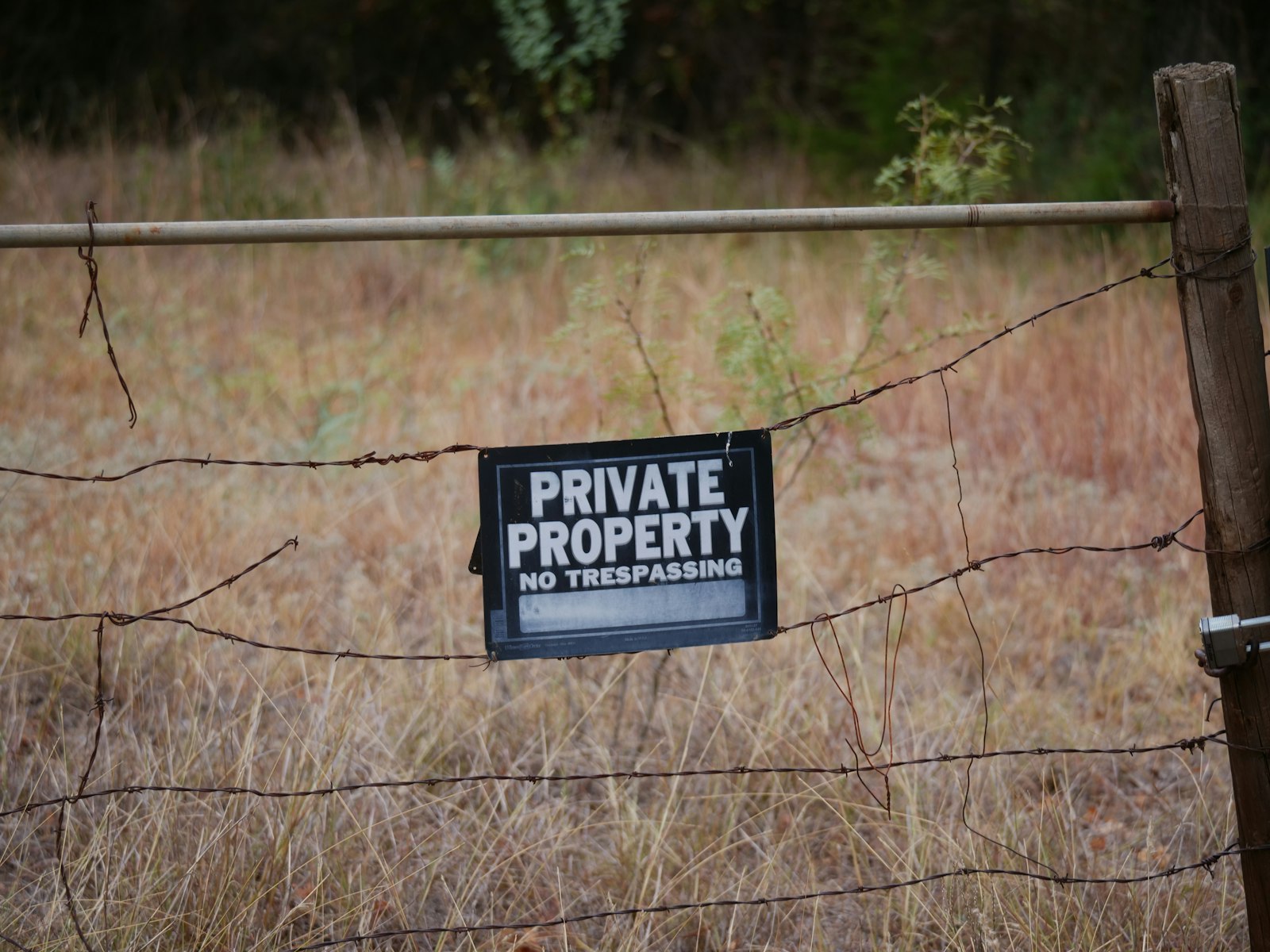
We print signs; we don’t give legal advice. The Act is the authority, and a lawyer can tell you how it applies to your property: what counts as an ordinary point of access on your land, and what to do if someone ignores a sign.
What do red and yellow markings mean in Ontario?
Red markings are notice that entry is prohibited, and yellow markings are notice that entry is prohibited except for certain activities (s. 7(1) and (2)). They are the Act’s alternative to a worded sign.
Each marking must be large enough that a circle ten centimetres in diameter fits wholly within it (s. 7(3)). Ten centimetres is about 4″, so a marking is at least 4″ across in every direction, not a thin stripe or a dot. And like signs, markings must be clearly visible in daylight under normal conditions from the approach to each ordinary point of access (s. 7(4)).
The difference is who understands them. A worded sign says what it means to anyone who reads it; a marking relies on the reader knowing the colour code. Whichever you use, the placement rule is the same, so the count is the same: one in view at each way in.
10 cm
Circle each marking must contain (s. 7(3))
Red
Entry prohibited (s. 7(1))
Yellow
Prohibited except certain activities (s. 7(2))
Each
Ordinary point of access needs one in view (s. 5(1)(b), s. 7(4))
How many no trespassing signs do you need, and where?
One at each ordinary point of access: every driveway, gate and path people normally use to come in, each clearly visible from the approach. The count depends on how many ways in a property has, not on its size alone. Tap a property to jump to its card.
Count one sign for each ordinary point of access: every driveway, gate and path people normally use.
Quick picks: what are you posting?
House or cottage
Plaza, office or apartment lot
Building site
Farm, woodlot or hunting land
18 × 24 in · to scale
A house or cottage: 18″ × 24″ at each way in
18″ × 24″ · 3 sq ft · double-sided at the road, single-sided on a gate or fence
Count the ways in: the driveway, the front walk if it starts at the sidewalk, a side gate, and at a cottage the path up from the water or the back lane. Each gets a sign in plain view from the approach, at about eye level, where someone walking or driving in will see it.
On a long driveway, put the sign at the road end, where someone decides to turn in. The flutes in 4mm coroplast run vertically, so a wire H-stake slides into the bottom edge.
24 × 36 in · to scale
A parking lot: 24″ × 36″ at each driveway
24″ × 36″ · 6 sq ft · double-sided at the curb · one per driveway entrance
Every driveway from the street is a way in, and so is a walkway that cuts in from the sidewalk. A 24″ × 36″ sign at each one carries TRESPASSING in letters about 4½″ tall, read from about 45 feet by the rule of thumb in the size section below.
If the problem is one activity, name it: a sign showing an activity with an oblique line drawn through it is sufficient notice that the activity is prohibited (s. 6(2)), so a crossed-out skateboard says what is not allowed without turning customers away.
36 × 48 in · to scale
A construction site: a sign at every gate in the fence
24″ × 36″, or a custom size up to 48″ × 96″ · single-sided, fixed flat to the fence
On a fenced site, the gates are the ordinary ways in: the vehicle gate, the pedestrian gate and any opening the crew uses. Fix a sign flat to the fence beside each one, where it is not hidden when the gate swings open.
A no trespassing sign is one of several signs on a site. Our guide to construction site signs covers the project board, trade signs and safety signs, and the construction signs page has the details for ordering a site’s signs together.
18 × 24 in · to scale
A farm, woodlot or rural lot: one at every lane, gate and trail
18″ × 24″ or 24″ × 36″ · single-sided on a post or tree, double-sided on its own stake
A rural property has more ways in: the farm lane, each field gate, a trail that meets the road, a track used by ATVs or snowmobiles, a spot where people pull over to walk in. A farm with a lane, six field gates and two trails has nine ways in, so nine signs is where the count starts.
Where land is open, with no fence to steer people to a gate, look at where someone would normally walk in from the road and post so a sign is in view from each of those approaches.
Mount each sign at about eye level, facing the approach, clear of branches and parked cars; a sign at knee height can vanish behind the first snowbank of the winter.
What should a no trespassing sign say?
Say what is prohibited in as few words as possible. PRIVATE PROPERTY – NO TRESPASSING is the standard for keeping people out, and an activity sign names one thing with a line through it.
- PRIVATE PROPERTY – NO TRESPASSING. The standard, covering all entry. PRIVATE PROPERTY on top in the largest letters, NO TRESPASSING below.
- KEEP OUT. The plainest version. PRIVATE – KEEP OUT reads fast on a narrow sign or a gate.
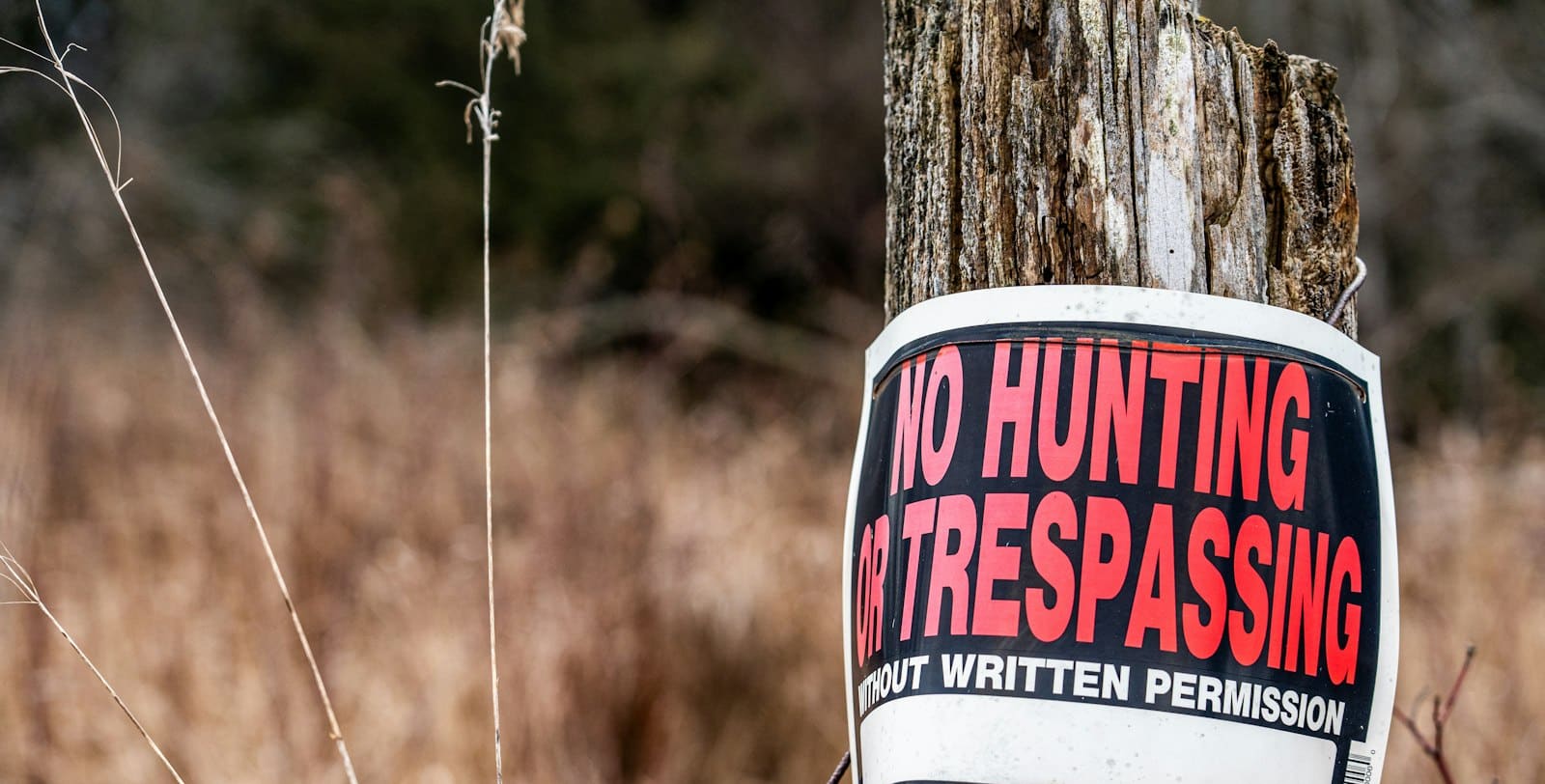
- NO HUNTING, NO ATVs, NO SNOWMOBILES, NO DUMPING. Activity signs, for land where you want to stop one thing rather than all entry. The Act’s form for a prohibited activity is its name or a graphic of it with an oblique line drawn through it (s. 6(2)), so print the crossed-out graphic beside the words.
- Watch the line. Under s. 6(1), a sign that names or shows an activity with no line through it is notice that the activity is permitted. A graphic of a hunter without a line through it says the opposite of a NO HUNTING sign.
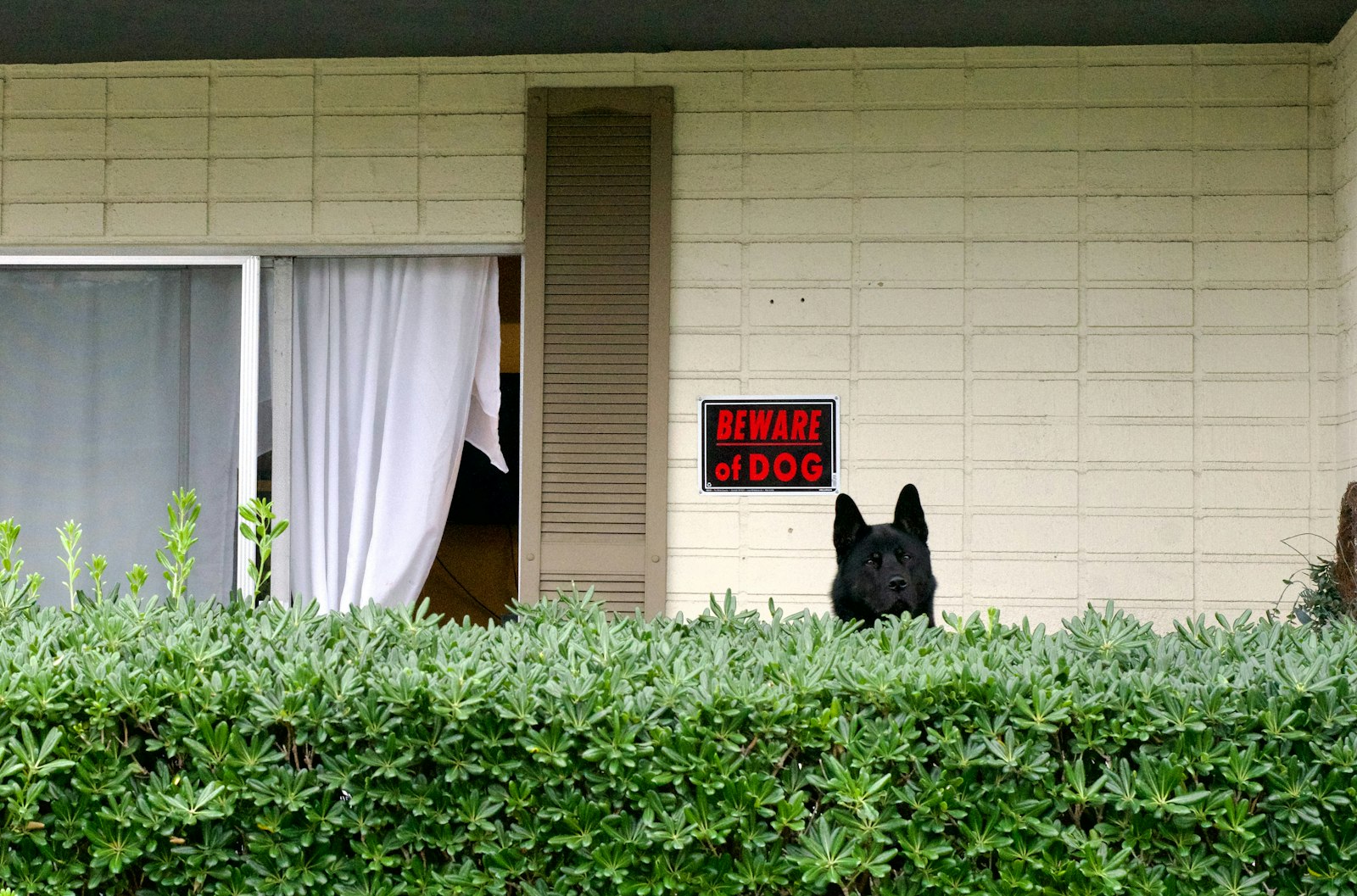
- BEWARE OF DOG. A beware of dog sign is a warning, not a prohibition: on its own it doesn’t say that entry is prohibited. If keeping people out is the goal, post it beside a no trespassing sign, not instead of one.
- Both languages. PRIVATE PROPERTY – NO TRESPASSING / PROPRIÉTÉ PRIVÉE – ENTRÉE INTERDITE on one face speaks to English and French readers. We work in both languages.
Leave off penalty threats and statute numbers copied from US signs: Ontario’s Act asks for a sign that is clearly visible from the approach, not for any particular warning.
What size should a no trespassing sign be?
18″ × 24″ for most driveways, gates and paths; 24″ × 36″ where the sign is read from a car or across a parking lot; and a custom size up to 48″ × 96″ on a long fence or a site entrance. A common sign-making rule of thumb is about 1″ of letter height for every 10 feet of reading distance.
TRESPASSING is eleven letters, so the width of the sign sets how big it can be. The table assumes a bold, condensed typeface with the word on one line; a wider typeface gives smaller letters.
| Size | Area | Where it works | Letters, about | Reads from, about |
|---|---|---|---|---|
| 16″ × 24″ | 2.7 sq ft | A gate, a side path, a back door | 3″ | 30 ft |
| 18″ × 24″ | 3 sq ft | Driveways, gates and paths; room for PRIVATE PROPERTY above | 3″ | 30 ft |
| 24″ × 36″ | 6 sq ft | Parking lot entrances, rural roads, construction gates | 4½″ | 45 ft |
| Custom 24″ × 48″ | 8 sq ft | Long driveways off fast roads, site fences | 6″ | 60 ft |
| Custom 48″ × 96″ | 32 sq ft | Site hoarding, large frontages | 12″ | 120 ft |
Condition matters too, because the Act asks for a sign clearly visible in daylight. Coroplast is made for temporary signs: rain has no effect on it, but sunlight breaks it down over time, so check signs each season and replace any that have faded or fallen. Our guide to coroplast signs covers how the board holds up outdoors, and coroplast vs PVC signs compares it with rigid PVC for a sign meant to stay up for years. For the same sizes across every lawn sign, see the lawn sign size guide.
Should a no trespassing sign be double-sided, and why do rural lots need more?
Double-sided if it stands on its own stake at an angle to the road, so traffic from both directions reads it; single-sided if it is fixed flat to a gate, a fence, a post or a tree.
Printed on one side, a sign on its own stake shows half the road a blank back. Choose one or two sides in the studio, and it shows the price for your choice before you pay.
Rural lots need more signs for a simple reason: more ways in. A house has a driveway and a walk; a farm has a lane, field gates, trails and places where people pull over to walk in, and the Act asks for a sign clearly visible from the approach to each ordinary point of access. Rural signs also stand in full sun, so order a few spares with the first run.
Ordering private property signs in volume
Property managers, farms, developers and construction firms order the same sign by the dozen or the hundred: one design, one or two sizes, and a sign for every way in across every property.
- Property managers. One template across every building and lot; versions per property are quoted.
- Farms and rural landowners. One design for every lane, gate and trail, plus spares for the ones that go missing or fade.
- Developers and builders. A sign at every gate on every site. Developers selling homes from the site order lawn signs the same way; see real estate signs.
- Construction firms. A standard sign that moves from site to site, with the company name small at the bottom.
Big runs are our focus. The lawn sign studio takes 1 to 2,000 signs online at any typed quantity and shows the price for each quantity before you pay. Bigger runs, and versions per property, are quoted through the free quote form, by phone at 613-666-YAYA (613-666-9292) or at order@yayaprints.ca, with the same proof and human designer check. Printing takes 5–7 business days, then the signs ship across Canada, priced for your postal code at checkout, or are delivered locally across Ottawa–Gatineau.
4mm
Coroplast, every size
16″ × 24″ to 48″ × 96″
Stock and custom sizes
1–2,000
Signs online, any quantity
5–7 days
Print turnaround, then shipped
For homes, condos and plazas that want to stop door-to-door selling rather than all entry, see our guide to no soliciting signs.
Frequently asked questions
How do you give notice of no trespassing in Ontario?
Ontario's Trespass to Property Act lets an occupier prohibit entry by notice (s. 3(1)), and notice may be given orally or in writing, by signs posted so one is clearly visible in daylight from the approach to each ordinary point of access, or by red or yellow markings (s. 5(1)). Substantial compliance with the sign or marking rules is sufficient notice (s. 5(2)). We print signs and don't give legal advice; the Act and a lawyer are the authority.
Where should no trespassing signs be posted in Ontario?
So that a sign is clearly visible in daylight under normal conditions from the approach to each ordinary point of access, in the words of s. 5(1)(b) of the Trespass to Property Act. In practice that means one at every driveway, gate and path people normally use to come in, at about eye level and facing the approach. A farm or rural lot needs one at every lane, field gate and trail.
What do red and yellow markings mean on Ontario property?
Red markings are notice that entry is prohibited. Yellow markings are notice that entry is prohibited except for certain activities. Under s. 7 of the Trespass to Property Act, each marking must be large enough to contain a circle 10 cm in diameter and be clearly visible in daylight from the approach to each ordinary point of access.
What should a no trespassing sign say?
PRIVATE PROPERTY – NO TRESPASSING in the largest letters the sign allows, or KEEP OUT. To stop one activity, such as hunting, name it or show it with an oblique line drawn through it, which the Act treats as sufficient notice that the activity is prohibited (s. 6(2)). A BEWARE OF DOG sign is a warning, not a prohibition, so post it beside a no trespassing sign rather than instead of one.
What size should a no trespassing sign be?
18″ × 24″ for most driveways, gates and paths; 24″ × 36″ at parking lot entrances, rural roads and construction gates; and a custom size up to 48″ × 96″ on site hoarding. By the common rule of about 1″ of letter height per 10 feet of reading distance, TRESPASSING across a 24″-wide sign reads from about 30 feet, and across 36″ from about 45 feet.
Can you print private property signs in bulk?
Yes. The lawn sign studio takes 1 to 2,000 coroplast signs online at any typed quantity, with the price per sign falling as the quantity rises. Bigger runs and versions per property are quoted directly through the free quote form, by phone at 613-666-YAYA (613-666-9292) or at order@yayaprints.ca, with the same proof and human designer check. Printing takes 5–7 business days, then the signs ship across Canada.
Set it up yourself. A human designer still checks every order.
Our print studio gives you the price and a proof in the browser. What it doesn't do is print your file blindly — every order is reviewed by a real designer before it reaches the press.
- Step 1You set it up — free
Pick the product, size and quantity in the print studio, then upload your file or start from a ready-made design. The price shows before you pay, with no account and no deposit.
- Step 2A human designer checks it
Before anything prints, one of our designers opens your file and checks resolution, colours, sizing and placement. If it won't print well, we fix it or tell you exactly what's wrong — a person, not an automated preflight.
- Step 3You approve, then we print
You see the proof before you pay. Nothing goes to press until you say yes — then it's printed in 5–7 business days and shipped, with shipping priced for your postal code at checkout.
Design your no trespassing signs and see the proof first
Pick 16″ × 24″, 18″ × 24″, 24″ × 36″ or a custom size, single- or double-sided, see the price for each quantity and approve a proof before you pay. Posting a farm, a portfolio or a site? Send the list for a direct quote.
Every order is reviewed by a human designer before it goes to press. A person checks artwork resolution, colour, sizing and placement, and either fixes the file or tells the customer what is wrong — it is not an automated preflight.