
Custom Running Shirts for Races, Charity Runs and Run Clubs
Custom running shirts for races, charity runs and run clubs: polyester tech tees for runners, cotton for volunteers, dye bleed on polyester, sponsor backs, size charts, and when to order once registration closes.
- Shirt for runners
- The Team 365 TT11, a 3.5 oz/yd² 100% polyester performance tee in 20 colours — the “100% Polyester” option on the t-shirt in our design studio. It wicks sweat and dries fast, which is why runners call it a tech tee.
- Shirt for everyone else
- The Gildan 64000, a 4.5 oz/yd² ring-spun cotton tee (heathers and a few other shades are blends) in more than three times as many colours, with no fabric charge — for finisher, volunteer, fan and family shirts.
- Fit
- The polyester tee has its own size chart. Laid flat it is 2″ wider across the chest than the cotton tee at S and ½″ wider at XL, the same at 2XL, and narrower from 3XL up. Both run XS–5XL in the studio.
- Printing on polyester
- DTF and screen printing both work on polyester; DTG is a cotton method. Dyed polyester can bleed dye into light inks under heat, so we test on the actual shirt colour before the run. No method takes that risk to zero.
- Print sizes (our standard)
- Full front and full back 11″ wide, starting 3″ below the collar, with up to 16″ of height on a tee back for a sponsor grid; left chest 3.5″; sleeve 3″; youth front and back 8″. Files are made at 300 dpi, so an 11″ print is 3,300 px wide.
- Volume pricing
- Large orders get volume pricing. In the online design studio the per-piece price drops at 12, 24, 50 and 100 pieces, and every colour of the same garment in one order counts toward the same price break. Orders in the hundreds are usually screen printed and quoted directly — through the free quote form, by email or by phone — and a large order gets the same free mockup and human designer check as a single shirt.
- Turnaround
- Standard turnaround on clothing is 1–2 weeks. Most apparel orders can rush — 4–5 business days or 1–3 business days, priced at checkout — and every order shows the dates it will be ready before you pay. Plan a race in the hundreds on the standard schedule, counted back from kit pickup.
Polyester or cotton: who should wear which shirt
A race has two kinds of shirt-wearer. The runner wants a shirt that still feels light at kilometre eight; the finisher at brunch, the volunteer who has been at the water table since 6 a.m. and the parent at the finish line want a comfortable tee. Most race-shirt regrets come from buying one shirt for both.
Performance polyester is the runner’s shirt. Polyester barely absorbs water, so sweat spreads through the knit and evaporates instead of soaking in, and a soaked tech tee dries fast and doesn’t hang heavy. Ours is the Team 365 TT11, the “100% Polyester” option on the t-shirt in the studio.
Cotton is everyone else’s shirt. The Gildan 64000 is a ring-spun cotton tee, semi-fitted and true to size. It soaks up sweat and holds it, which is why runners avoid it mid-race and why a volunteer or a finisher won’t mind. It takes every print method we run, DTG included.
| What matters | Team 365 TT11 · polyester | Gildan 64000 · cotton |
|---|---|---|
| Fabric | 100% polyester performance knit, 3.5 oz/yd² | Ring-spun cotton, 4.5 oz/yd²; heathers are blends |
| Who wears it | Runners on race day and at club runs | Finishers, volunteers, fans, family |
| When soaked | Wicks and dries fast | Holds the sweat and hangs heavy |
| Colours | 20 | More than three times as many |
| Studio sizes | XS–5XL, on its own chart | XS–5XL, semi-fitted, true to size |
| Youth sizes | None in polyester | Youth XS–XL (Gildan 64000B) |
| Print methods | DTF or screen printing, tested on the shirt colour | Screen printing, DTF or DTG |
| Price | A flat fabric charge per shirt | No fabric charge |
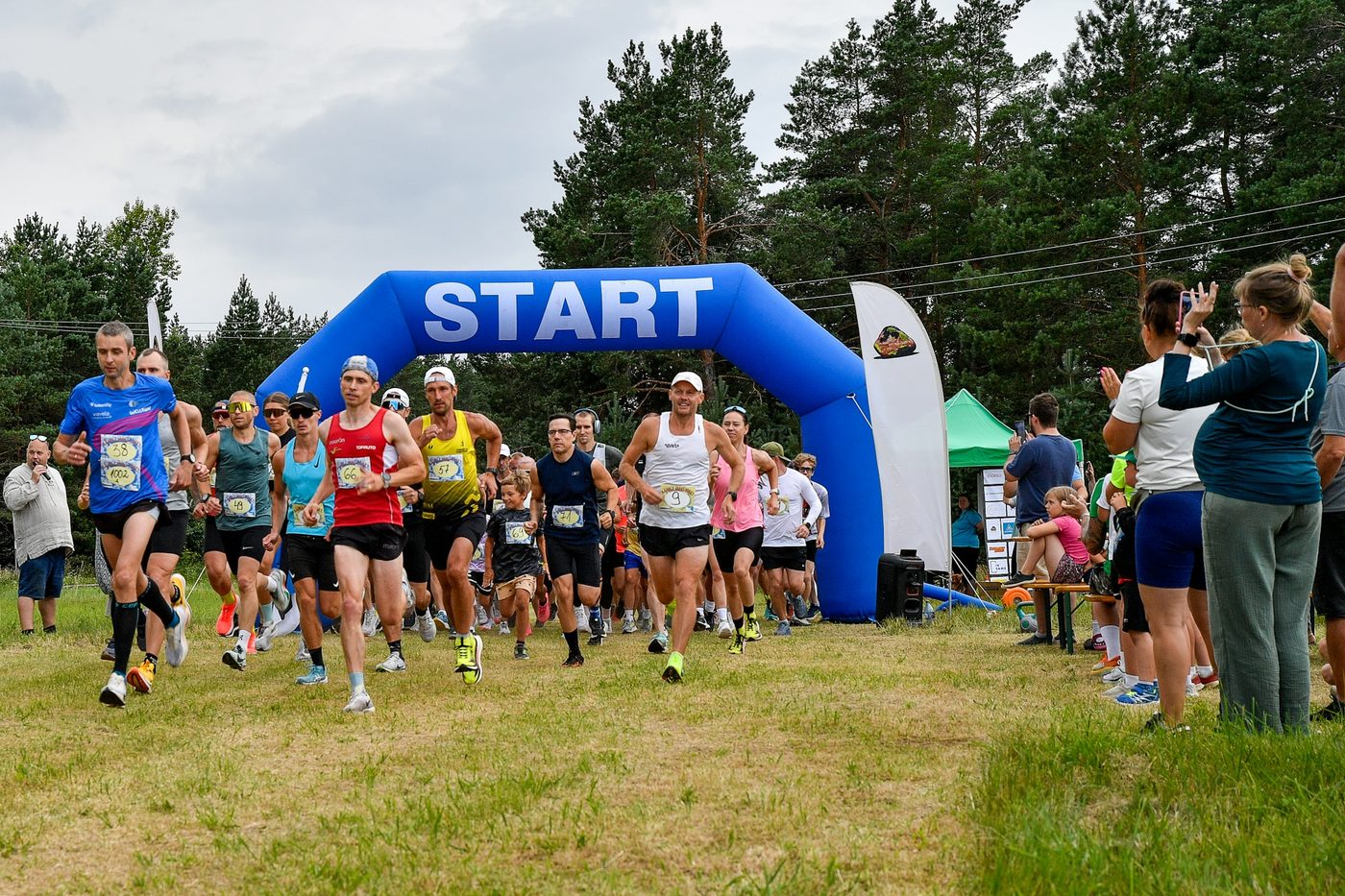
A walk or a family 2K can happily be all cotton. For a timed 10K or a half marathon, a cotton participant shirt becomes a souvenir, because runners who care about their time race in their own kit. Put a tech tee in the race kit and many will wear it on race day, which is when the sponsors on the back get seen.
The polyester tee has its own size chart, and it isn’t the cotton one
The TT11 and the 64000 are different blanks from different makers, so a medium in one is not a medium in the other. These are the published charts the studio shows for each, in inches, laid flat: chest across the front just below the armholes, length from shoulder to hem.
| Size | Cotton 64000 (chest × length) | Polyester TT11 (chest × length) | Difference |
|---|---|---|---|
| S | 18 × 28 | 20 × 28 | Polyester 2″ wider |
| M | 20 × 29 | 21½ × 29 | Polyester 1½″ wider |
| L | 22 × 30 | 23 × 30 | Polyester 1″ wider |
| XL | 24 × 31 | 24½ × 31 | Polyester ½″ wider |
| 2XL | 26 × 32 | 26 × 31½ | Same chest; polyester ½″ shorter |
| 3XL | 28 × 33 | 27½ × 32½ | Polyester ½″ narrower and ½″ shorter |
| 4XL | 30 × 34 | 29 × 33½ | Polyester 1″ narrower, ½″ shorter |
| 5XL | 32 × 35 | 31 × 34 | Polyester 1″ narrower and 1″ shorter |
From S to XL the polyester tee is the roomier shirt, so a runner who likes a close fit can often go one size down from their cotton size: someone who needs about 21 inches across fits a cotton L (22) or a polyester M (21½). At the big end it flips. The polyester 3XL is half an inch narrower and shorter than the cotton 3XL, so someone at the edge of a cotton 3XL may want the polyester 4XL.
So put the right chart on the registration form, not a generic “unisex S–XL” one, and if runners get the tech tee and volunteers get cotton, show both. Both studio tees are unisex cuts, and people who usually wear a fitted women’s tee often find one unisex size down fits. Charts allow an inch or two of tolerance, so anyone between sizes should lay a shirt they like flat and measure it. Our t-shirt size guide walks through it.
Printing on polyester: DTF, screen printing and dye bleed
The two methods most race orders run on both work on polyester. DTF (direct-to-film) printing puts the design on a film, backs it with a powdered adhesive and heat-presses it on, so it holds on polyester as well as cotton, in full colour, with no setup: right for a back of colour sponsor logos or a club order of 20. Screen printing pushes ink through a stencil, one screen per colour, and becomes the best value past roughly 24–50 pieces, so a race in the hundreds is usually screen printed.
Polyester’s one trap comes from its dye. Coloured polyester is dyed with disperse dyes, which can turn to vapour when heated, and the heat that cures a screen print or presses a transfer can release some of that dye into the ink on top. The trade calls it dye migration: a white print turning faintly pink on a red shirt or grey on a royal one, and it doesn’t always show the moment the shirt leaves the press. Most of the cotton tee’s heathers are 65% polyester, so the same caution applies to them.
The defences are well known: inks that cure at lower temperatures, a grey blocking layer under the white on a screen print, a cooler and shorter press for a transfer. They cut the risk without removing it on every colour, so we test on the actual shirt colour before the run. The usual suspects are deep, saturated shades such as reds, maroons, royals and some blacks. Dark ink on a white or light shirt is the low-risk version, because there is little dye to move; white ink on a red tech tee is the combination to test first.
Big prints need a different approach, too. Ink and film don’t breathe, so a solid full-back rectangle becomes a patch that sticks to a wet back; outlines, knockouts or a distressed texture let the shirt show through, and the design wears like part of it. Wash printed tech tees cold and inside out, skip fabric softener (it coats performance fibres and slows the wicking) and hang them to dry.
What goes on a race shirt: the front, the back and the sleeve
Most race shirts share a layout because it works: the event on the front, the sponsors on the back, one more mark on the sleeve. These are our standard print sizes on an adult tee; heights follow the artwork’s proportions, up to the limit shown.
| Placement | Our standard width | Position and height | Race use |
|---|---|---|---|
| Full front | 11″ | Top edge 3″ below the collar seam; up to 13.6″ tall | Event logo, distance and year |
| Left chest | 3.5″ | Over the wearer’s left side; taller than 4.5″, it stops being a chest logo | Small event mark when the back carries the design |
| Full back | 11″ | Top edge 3″ below the collar; up to 16″ tall | Sponsor grid, VOLUNTEER, club name |
| Sleeve | 3″ | Height follows the art | Charity logo or one presenting sponsor |
| Youth front and back | 8″ | Height limits scale down with the width | Kids’ fun-run shirts |
The front is what shows in race photos. An 11-inch event logo with the distance and year is the classic participant shirt; a 3.5-inch mark on the left chest, over the wearer’s left side (the viewer’s right), is the quieter choice when the back carries the design, and it gets the shirt worn again.
The date deserves a decision. “10K · 2027” makes the participant shirt a keepsake, which is the point. Leave the year off volunteer and crew shirts, and the leftovers become next year’s volunteer stock.
The back is where the sponsors go. A grid that works on an 11-inch back: the title sponsor across the top at full width, about 2½ inches tall, then three columns of logos about 3 inches wide with half-inch gaps (3 + ½ + 3 + ½ + 3 is 10 inches). Four rows of 1½-inch cells under the title band come to roughly 11 inches of height, inside the tee back’s 16, so 13 sponsors fit with room to spare. Size logos by how big they look: a square mark 3 inches wide looks far larger than a long wordmark at the same width. Our sponsor shirts page goes further.
Two things decide whether that grid prints cleanly. Files: at 300 dpi a 3-inch logo needs about 900 pixels of width, and the 200-pixel logo from a sponsor’s website footer is under a quarter of that, so ask every sponsor for a vector file (SVG, PDF, EPS or AI) the day they sign. Colours: on a screen print every ink colour is its own screen, so the classic answer is a one-colour sponsor wall, every logo in white on a dark shirt or black on a light one, printed from a single screen. If sponsors need their brand colours, DTF prints the back in full colour with no setup per colour.
Volunteer and crew shirts: the same tee in a different colour
Volunteers have to be found at a glance, by a runner who missed a turn or a parent looking for first aid. Colour does it: runners in one colour, volunteers in a loud contrasting one, with VOLUNTEER or CREW across the back. A word 11 inches wide reads across a finish area; a chest logo doesn’t.
Colour helps the price, too. In the online design studio the per-piece price drops at 12, 24, 50 and 100 pieces, and every colour of the same garment in one order counts toward the same price break: 80 runner tees in navy and 30 volunteer tees in orange are one 110-piece order, and all 110 get the 100-piece price. The studio counts polyester and cotton tees together as well, with the polyester ones carrying their fabric charge. On a screen-printed run, pick a volunteer colour that takes the same ink as the runner shirt; a shirt colour that needs a different ink is a second setup.
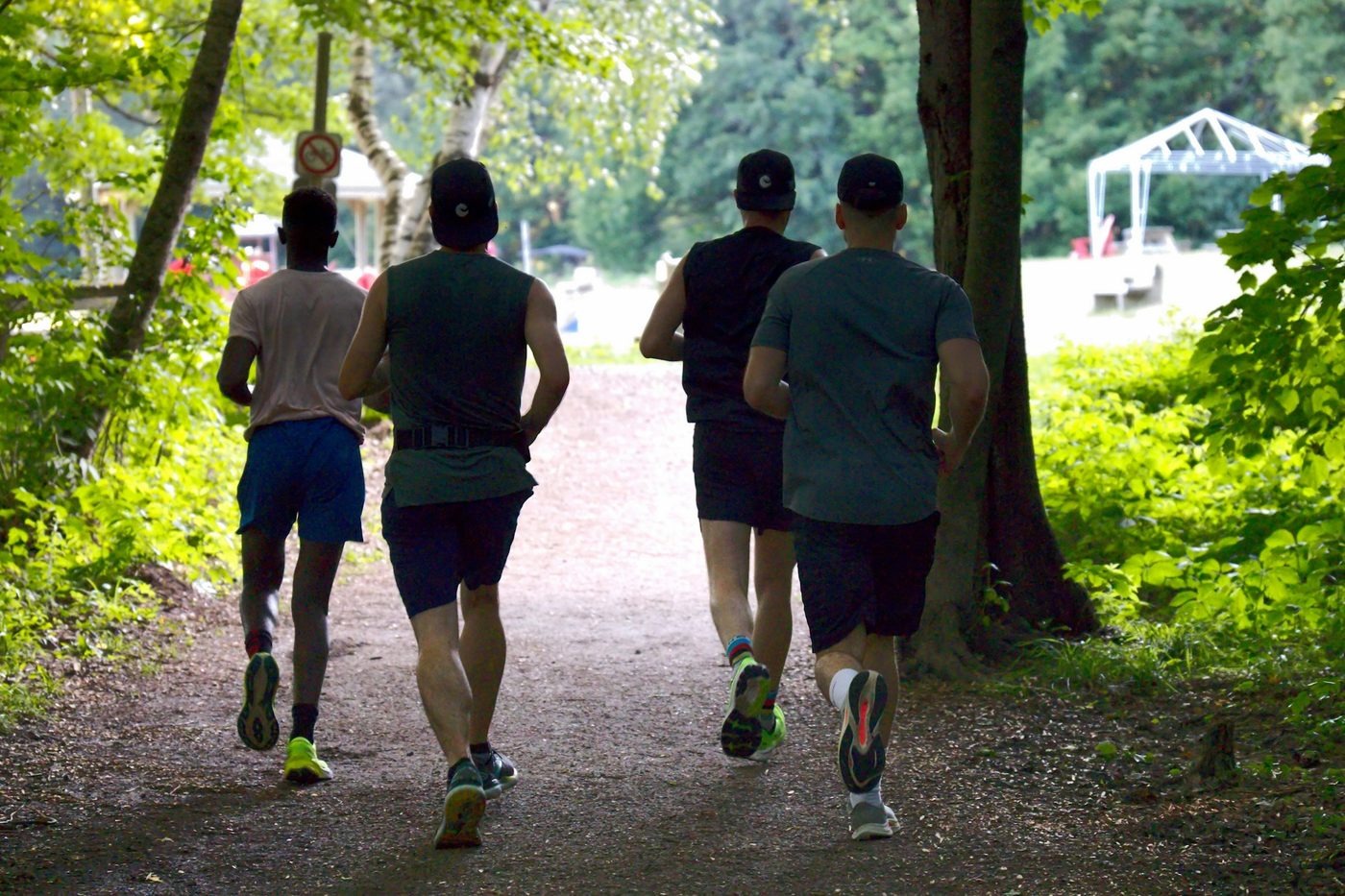
Most volunteers don’t need the tech tee: they pour water, hand out medals and stack barricades, and the cotton 64000 suits that work. Put the people who move, like a marshal jogging between corners, in polyester. For a 6 a.m. start in May or October a long sleeve is kinder; the Gildan 2400 is a 6.0 oz cotton long sleeve in S–3XL, and the long sleeve also comes in 100% polyester. A Safety Yellow tee is a bright colour, not certified hi-vis, so vests that a road-closure plan calls for are a separate garment.
A marathon weekend can need several hundred volunteer shirts on its own. Treat them like a staff shirt order: one colour, the event mark on the chest, the role on the back, no year. For the rest of a charity event, from start banners to sponsor boards, see our nonprofit and fundraising printing page.
Timing and quantities: registration closes, you count, then you order
A race-shirt order has a natural sequence: the shirt-size cut-off passes, you count, then you order. Order before the count and you are guessing with money; count too late and the boxes arrive after kit pickup.
Standard turnaround on clothing is 1–2 weeks. Most apparel orders can rush — 4–5 business days or 1–3 business days, priced at checkout — and every order shows the dates it will be ready before you pay. Rush is the safety net for a late top-up, not the plan: a race in the hundreds is planned, not rushed, and the date to protect is kit-stuffing night, not race day. For a Saturday race with kit pickup on the Thursday and Friday:
| When | What happens | Why |
|---|---|---|
| 4 weeks out | Shirt-size cut-off on registration; count the sizes | Print the cut-off date on the registration page |
| About 3½ weeks out | Order placed, free mockup approved | Nothing prints until you approve it |
| 3½ to 1½ weeks out | Production | Standard turnaround on clothing is 1–2 weeks |
| About 10 days out | Shirts ship from Ottawa | Shipping is quoted for your postal code and shown before you pay |
| The weekend before | Shirts in hand, counted and sorted by size | A week of buffer for a short box or a wrong size |
| Thursday and Friday | Kit pickup | The shirts are already in the bags |
That calendar assumes the full two weeks of production and a few days in transit. It is our planning suggestion, not a rule; a long shipping distance or a design that is still changing adds a week.
Late registrants get “size not guaranteed”, and you order a spread for them on top of the counted sizes, weighted to M, L and XL; our bulk size breakdown has a starting curve with counts at 100, 250, 500 and 1,000. Add a few per cent of spares in those sizes in the same run, because a second run is a second setup. Keep the counts separate by shirt: runner, volunteer and youth tees, each by size.
No minimum on DTF and DTG — we will print a single shirt — so a dozen late shirts is a normal order, though a DTF top-up feels different from a screen print up close. Our event shirts page covers the same planning for festivals and fundraisers.
Run club shirts: names on the back and kit for every season
A run club orders differently: 20, 40 or 60 members, shirts worn every week for years, people joining all season. That is the size of order the studio handles best. Open the t-shirt in the design studio, switch the fabric to 100% polyester, put the club mark on the chest and the name across the back, and type in the sizes. At 24 shirts the per-piece price has already dropped twice.
For names on the back, use the Team names & numbers chart: paste a list, one shirt per line with a name, number and size, and switch numbers off for a names-only shirt. The chart fills in the size boxes and prints the name across the upper back with the number below. Each personalized shirt costs a bit more, and you approve the full chart before paying, so a misspelled surname is caught by you, not by the runner wearing it. Our guide on ordering team names and numbers covers collecting the list.
Ottawa clubs run all year, and the kit follows: the tech tee for summer, a long sleeve for the shoulder months (also in 100% polyester) and a hoodie for the coffee afterwards, in 50/50 fleece or 100% polyester. Singlets are quote-only: size the logo on the tee in the studio, then ask for a quote on the singlet. Keep the blank, colour and file on record so a reorder of three matches the original 40. Our gym and fitness apparel page covers the training-floor side.
Kids’ fun runs: youth sizes on the same order
A family race usually has a kids’ 1K, and the kids want their parents’ shirt. The studio’s youth tee is the Gildan 64000B, the youth cut of the cotton tee, in youth XS–XL: tap “+ Youth sizes” under a colour row. The ages are our estimate, not Gildan’s: XS 4–5, S 6–8, M 9–11, L 12–13 and XL 14–16. Youth tees count with the adult tees toward the price break, so 12 adult and 12 youth tees are priced as 24.
The youth tee is cotton only; there is no polyester youth body in the studio, which is no hardship for a 1K. A teenager running the 5K in the tech tee can try the adult polyester XS: 18½ inches across and 27 long, against the youth XL’s 19 and 25.
Youth shirts print at our youth standard, 8 inches wide instead of 11, so a sponsor grid scaled down for them loses about a quarter of its width. Check that the smallest sponsor still reads, or give the kids the event logo, big and simple. On a screen-printed run the smaller youth print is its own screen. You can open the tee with the youth sizes already showing.
What race shirts cost, and how to order them
A screen-printed t-shirt runs roughly $12–$18 CAD each at 50 pieces and drops under $10 each in the hundreds. Full-colour DTF sits slightly higher per piece with no setup fee. Every quote is free and includes a mockup. Performance polyester costs a little more per shirt than cotton; the studio shows it as a flat fabric charge the moment you switch. Ink colours and print locations on a screen print, sizes from 2XL up and personalized names also move the price.
A club or a small race orders in the studio. Customers can design their own product free at yayaprints.ca/mockup-creator — upload a logo, place it on a real garment, add print-quality text, choose colours and sizes, and order online without emailing or phoning anyone.
A race in the hundreds is quoted. Use the free quote form to send the event logo and sponsor files, the shirt colours, the race and kit-pickup dates, and one table: a row per size, a column per shirt. Or call 613-666-9292; we serve customers in English and French.
Either way, every order gets a free digital mockup on the actual product before any payment, and nothing prints until you approve it. We ship Canada-wide, including the Greater Toronto Area and Greater Montreal; shipping is quoted for your postal code and shown before you pay, and Ottawa organizers can ask us about pickup. Every shirt is printed and decorated in-house in Ottawa and never drop-shipped from overseas, so there are no cross-border customs holds or surprise duties. Our t-shirt printing page compares the three print methods and shows per-shirt pricing.
Frequently asked questions
What is the best material for custom running shirts?
100% polyester performance fabric for anyone running in the shirt: it wicks sweat, dries fast and doesn’t hang heavy when soaked. We use the Team 365 TT11, the “100% Polyester” option on the t-shirt in our design studio. Cotton, such as the Gildan 64000, is the better shirt for finishers, volunteers and fans, who want comfort and colour choice rather than wicking, and it carries no fabric charge.
Can you print on polyester running shirts without the colours bleeding?
DTF and screen printing both work on polyester, but dyed polyester can bleed dye into light inks under heat; a white print turning pink on a red shirt is the classic case. Low-temperature inks, a blocking underbase and a cooler press reduce the risk without removing it on every colour, so we test on the actual shirt colour before the run. Dark ink on a white or light shirt is the low-risk combination.
How far ahead should we order shirts for a 5K or charity run?
Standard turnaround on clothing is 1–2 weeks, and every order shows the dates it will be ready before you pay. Count back from kit pickup rather than race day: for a Saturday race we suggest a shirt-size cut-off about four weeks out, the order placed and the mockup approved that same week, and the shirts in hand the weekend before. A race in the hundreds belongs on the standard schedule; rush is the safety net for a late top-up.
How much do custom race t-shirts cost?
A screen-printed t-shirt runs roughly $12–$18 CAD each at 50 pieces and drops under $10 each in the hundreds. Full-colour DTF sits slightly higher per piece with no setup fee, and performance polyester costs a little more per shirt than cotton. Ink colours, print locations, sizes from 2XL up and personalized names also move the price. Every quote is free and includes a mockup.
Do volunteer shirts in a different colour count toward the bulk price?
Yes. In the online design studio the per-piece price drops at 12, 24, 50 and 100 pieces, and every colour of the same garment in one order counts toward the same price break, so 80 runner tees and 30 volunteer tees in another colour are priced as 110. Youth tees count with the adult tees too. On a screen-printed run, a shirt colour that needs a different ink is its own setup, so pick a volunteer colour that takes the same ink.
Can you print runners’ names on run club shirts?
Yes. In the design studio, the Team names & numbers chart takes a pasted list, one shirt per line with a name, number and size, and you can switch numbers off for names only. The name prints across the upper back with the number below it. Each personalized shirt costs a bit more, and you approve the full chart before paying.
Do you have kids’ sizes for a family fun run?
Yes. The studio’s youth tee is the cotton Gildan 64000B in youth XS–XL, with our estimated ages running from 4–5 (XS) to 14–16 (XL), and youth tees count with the adult tees toward the price break. There is no polyester youth tee, so a teenager who wants the tech tee can try the adult polyester XS, which is 18½ inches across and 27 inches long.
Design it yourself. A human designer still checks every order.
Our free studio gives you the price and the mockup in the browser. What it doesn't do is print your file blindly — every order is reviewed by a real designer before it reaches the press.
- Step 1You design it — free
Upload your logo, drop it on a real garment, set the size and placement, pick colours and quantities. No account, no deposit, no waiting on a reply.
- Step 2A human designer checks it
Before anything prints, one of our designers opens your file and checks resolution, colours, sizing and placement. If it won't print well, we fix it or tell you exactly what's wrong — a person, not an automated preflight.
- Step 3You approve, then we print
You get the corrected mockup back on the actual product. Nothing goes to press until you say yes — then it's ready in 1–2 weeks, or in 1–3 business days with a rush.
Put your race logo on a real tech tee
Open the t-shirt in the studio, switch it to 100% polyester, upload the event logo and the sponsor back, type in your size counts and watch the price update. Races in the hundreds are usually screen printed and quoted directly, so send that count through the free quote form. Every order gets a free digital mockup on the actual product before any payment.
Every order is reviewed by a human designer before it goes to press. A person checks artwork resolution, colour, sizing and placement, and either fixes the file or tells the customer what is wrong — it is not an automated preflight.