
How Many of Each Size? The Size Breakdown for 100, 250, 500 and 1,000 Custom T-Shirts and Hoodies
The size breakdown for a bulk order of custom t-shirts and hoodies: how many of each size to order for 100, 250, 500 and 1,000 pieces, as a starting curve with exact counts at every total. When to collect real sizes instead, how to shift the curve for offices, leagues, students and trades crews, how many spares to add in the same run, and where youth sizes, colours and 2XL–5XL fit.
- Starting tee curve
- XS 2% · S 12% · M 26% · L 28% · XL 20% · 2XL 8% · 3XL 4% for a unisex adult tee — 10, 60, 130, 140, 100, 40 and 20 shirts in a 500-piece order. A starting point from experience, not survey data; real sizes collected from real people always beat it.
- Starting hoodie curve
- S 8% · M 22% · L 30% · XL 24% · 2XL 12% · 3XL 4% — about half a size larger than the tee curve, because people size up in fleece. That is 40, 110, 150, 120, 60 and 20 in a 500-piece order. The studio hoodie runs S–3XL.
- Volume pricing
- Large orders get volume pricing. In the online design studio the per-piece price drops at 12, 24, 50 and 100 pieces, and every colour of the same garment in one order counts toward the same price break. Orders in the hundreds are usually screen printed and quoted directly — through the free quote form, by email or by phone — and a large order gets the same free mockup and human designer check as a single shirt.
- Spares
- Order them in the same run — a second run is a second setup. Roughly 3% on an order built from collected sizes and closer to 5% on one built from a curve, all in M, L and XL.
- Extended sizes
- Studio tees run XS–5XL; hoodies, crewnecks, long-sleeves and polos run S–3XL, and anything outside those goes through the free quote form. 2XL and larger carry a small per-piece upcharge that rises with each size. Add 4XL–5XL by name, never by curve.
- Youth sizes and colours
- Youth sizes (XS–XL) count with the adult garment for the price break — 12 adult + 12 youth tees are one 24-piece run — and 6 black + 6 white tees are priced as 12. Tees and hoodies each count on their own.
- Cost per tee at volume
- A screen-printed t-shirt runs roughly $12–$18 CAD each at 50 pieces and drops under $10 each in the hundreds. Full-colour DTF sits slightly higher per piece with no setup fee. Every quote is free and includes a mockup.
How many of each size? The starting curve for 100, 250, 500 and 1,000 tees
Every large order reaches the same afternoon: the artwork is approved, the colour is picked, the total is agreed, and somebody has to say how many of each size. Split 500 shirts evenly across seven sizes and you get about seventy of each: a stack of extra-smalls nobody claims and a line of people asking for an XL that ran out before lunch. A crowd of adults is not flat. It bunches in the middle and thins out at both ends, and the table below is the shape we start from when a customer has no sizes at all.
Read it as a starting point, not a measurement. These shares come from experience across group orders, not from survey data, and real sizes collected from real people always beat any curve. There is no national table to borrow, either. Statistics Canada’s Canadian Health Measures Survey takes physical measurements of Canadians at examination centres, but it describes bodies, not the letter people choose on a unisex tee, and the history of clothing sizes is largely the story of every maker mapping bodies to letters a little differently.
| Tee size | Share | 100 tees | 250 tees | 500 tees | 1,000 tees |
|---|---|---|---|---|---|
| XS | 2% | 2 | 5 | 10 | 20 |
| S | 12% | 12 | 30 | 60 | 120 |
| M | 26% | 26 | 65 | 130 | 260 |
| L | 28% | 28 | 70 | 140 | 280 |
| XL | 20% | 20 | 50 | 100 | 200 |
| 2XL | 8% | 8 | 20 | 40 | 80 |
| 3XL | 4% | 4 | 10 | 20 | 40 |
| 4XL–5XL (by name only) | 0% | 0 | 0 | 0 | 0 |
| Total | 100% | 100 | 250 | 500 | 1,000 |
Three things in that table matter more than the exact numbers. The middle three sizes, M, L and XL, carry 74 per cent of the order, which is why spares belong there and nowhere else. The 2XL and 3XL rows look small, but at 1,000 shirts they are 120 people, and trimming them to save the extended-size upcharge sends 120 people home with a shirt they cannot wear. And 4XL and 5XL are zero by design rather than by oversight: the studio tee runs XS–5XL, but a blind 4XL in a curve is the shirt most likely to stay in the box, so those sizes go on the order by name, for people who asked.
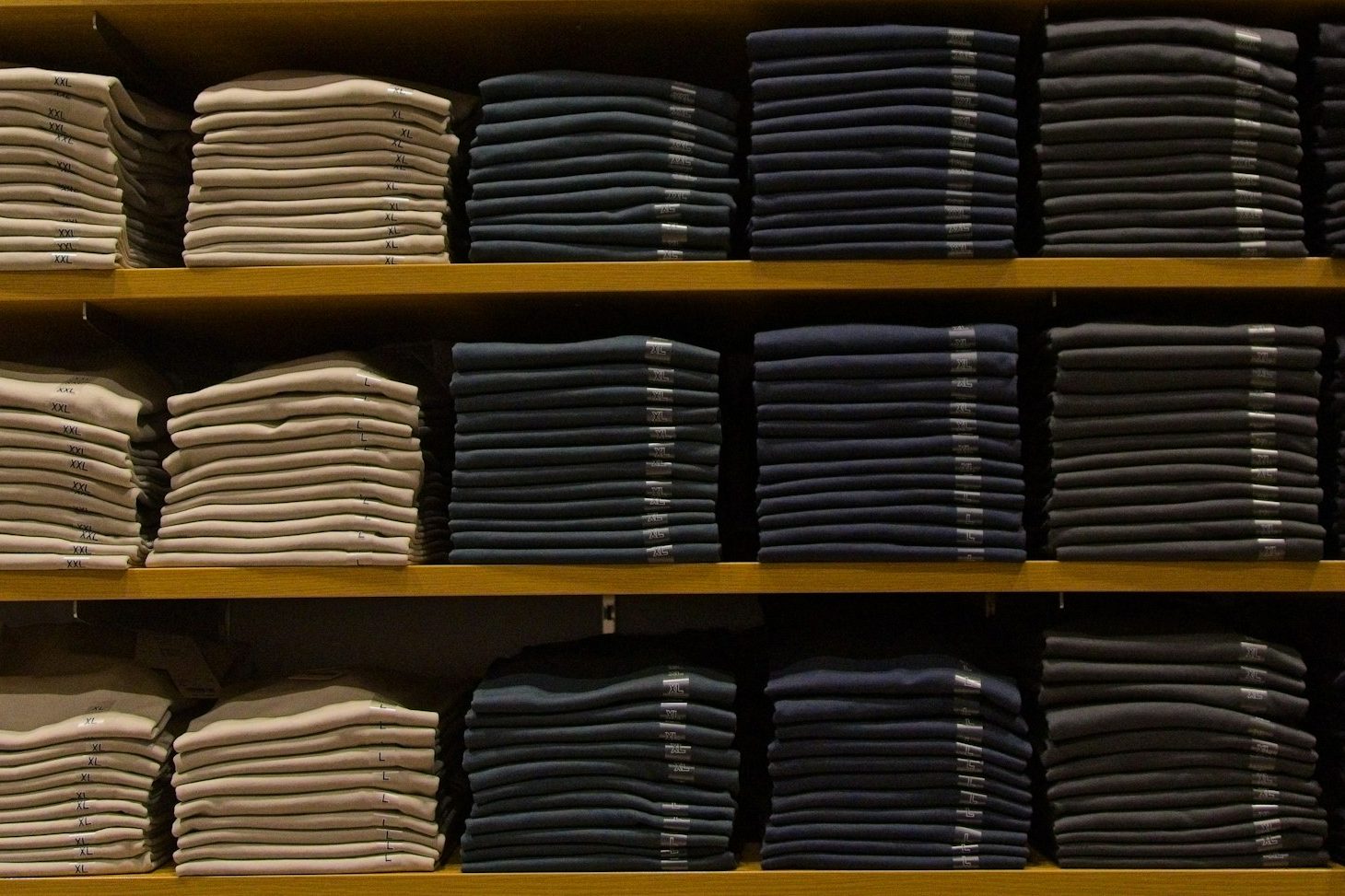
The tee behind the table is the unisex cut used by our t-shirt printing service: semi-fitted, true to size, and slightly slimmer than the boxy heavy-cotton tees many people remember. People who usually wear a fitted women’s tee often find one unisex size smaller fits, which is why even a mixed office needs a real S row and a few XS. The page to design your own t-shirts online shows the blank and its colours, and our guide to bulk t-shirt printing across the GTA explains why the even split is the most expensive habit in bulk apparel.
Collect sizes or use a curve? The hybrid most large orders end up using
A curve is what you use when you cannot ask. When you can name every person who will wear the shirt before the order has to be placed — the staff of an office, a team roster, a club with a member list — collect real sizes instead. A list of names against sizes is right by definition, and it doubles as the hand-out sheet on the day the boxes arrive. Our guide on how to organize a group apparel order covers the form, the deadline and the chasing.
The curve earns its place when people arrive after the order is placed: open registration for a run or a festival, giveaways at a booth, walk-up volunteers, an orientation week whose first-years have not signed up yet. Most orders in the hundreds are a mix of both, and the method that works is a hybrid. Collect what you can by a firm deadline, order those sizes exactly, and curve only the remainder. Charity runs do this with the registration form, as our Toronto event-shirt guide describes.
Say a Montreal festival needs 600 crew and volunteer shirts. By the artwork deadline, 350 volunteers have filled in the form; another 250 will sign up later. Order the 350 exactly as collected, then take the 250 column of the tee table for the rest: 5 XS, 30 S, 65 M, 70 L, 50 XL, 20 2XL and 10 3XL. Better still, treat the 350 replies as a sample of your own crowd. If they run a size larger than our curve, shift the 250 the same way, because that is free information about your own people. For the rest of a run that size, see bulk t-shirt printing in Montreal.
Set the size deadline from the production calendar, not from the event. Standard turnaround on clothing is 1–2 weeks. Most apparel orders can rush — 4–5 business days or 1–3 business days, priced at checkout — and every order shows the dates it will be ready before you pay. A run in the hundreds belongs on the standard schedule, though. It is booked into the shop calendar when the order is confirmed, rushing it is a conversation rather than a checkbox, and the moment to confirm your date is when you book.
Hoodies: why the curve moves up half a size, and the counts at each total
Ask the same group for a tee size and a hoodie size, and a good share of them will give you two different answers. Fleece goes on over another layer and people like it roomy, so the hoodie curve is not the tee curve with a different name: it peaks at L, carries more XL and 2XL, and has no XS row at all. The studio hoodie runs S to 3XL; an XS or a 4XL hoodie goes through the free quote form. The third column shows the tee curve for the same group, with XS folded into S, so you can see what moved.
| Hoodie size | Share | Tee share | 100 | 250 | 500 | 1,000 |
|---|---|---|---|---|---|---|
| S | 8% | 14% (XS + S) | 8 | 20 | 40 | 80 |
| M | 22% | 26% | 22 | 55 | 110 | 220 |
| L | 30% | 28% | 30 | 75 | 150 | 300 |
| XL | 24% | 20% | 24 | 60 | 120 | 240 |
| 2XL | 12% | 8% | 12 | 30 | 60 | 120 |
| 3XL | 4% | 4% | 4 | 10 | 20 | 40 |
| Total | 100% | 100% | 100 | 250 | 500 | 1,000 |
About ten points move up the scale: S and M give up ten between them, and L, XL and 2XL take them on. That is roughly half a size, not a whole one, on purpose. A full-size shift assumes everybody sizes up, and the people who do not end up swimming in a 2XL they wanted as an L. If you are ordering tees and hoodies for the same people, ask for both sizes on the same form instead of deriving one from the other; the extra question takes five seconds and saves a round of swaps later.
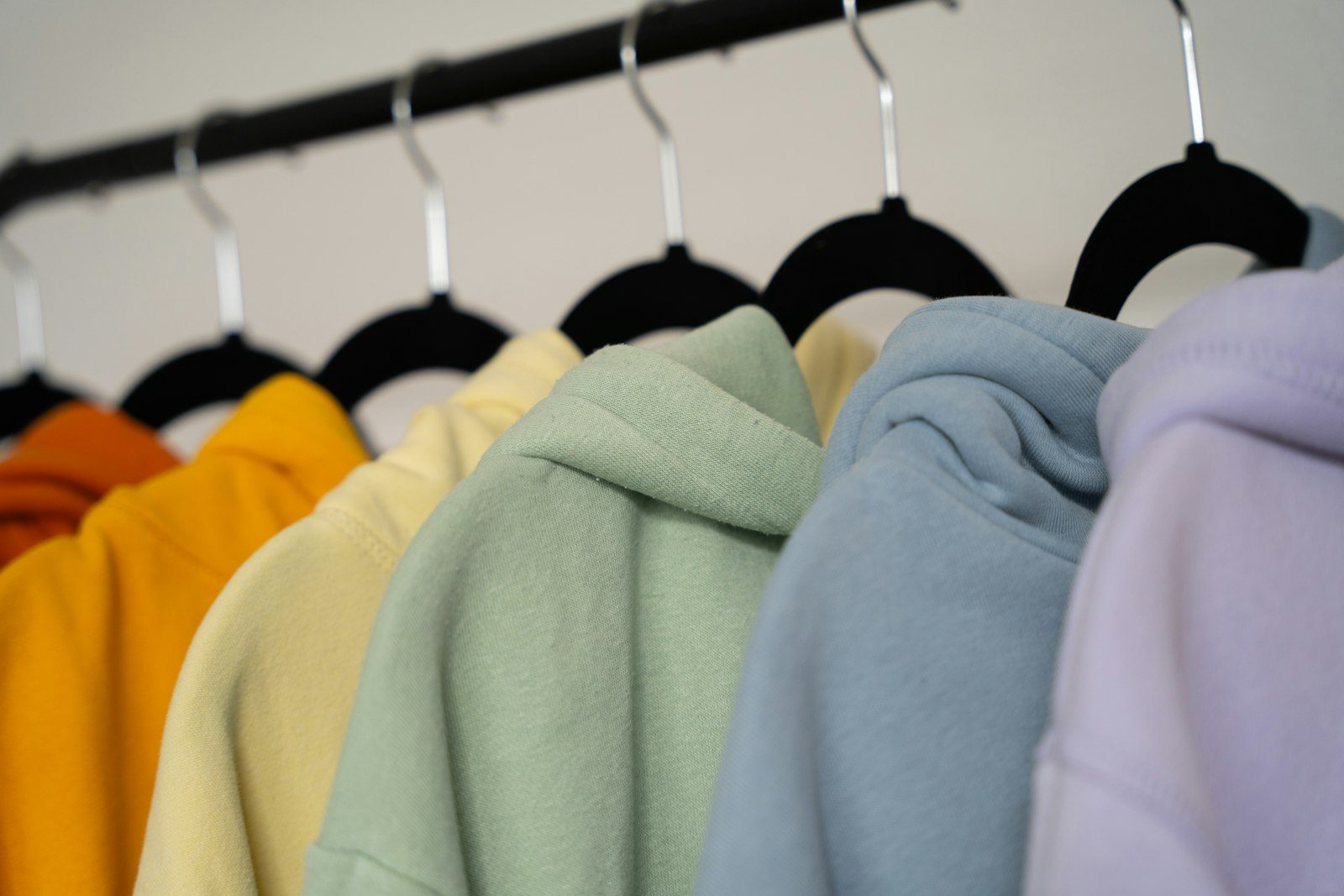
Our default hoodie is a 50/50 cotton-poly fleece, with a polyester performance hoodie as the alternative, and the two are different blanks with their own size charts, so read the chart for the one you picked. The custom hoodies page covers fabrics and decoration, the page to design your own hoodies online shows the colours, and for hundreds of hoodies in one city, see bulk hoodie printing in Ottawa and bulk hoodie printing in Toronto.
Adjusting the curve for the people who will actually wear it
The starting curves describe a mixed adult crowd. Real crowds lean, and the lean is predictable enough to plan for. The table below is qualitative on purpose: it says which way to move points, not how many, because the size of the shift depends on your group, and your own collected sizes are the only honest measure of it.
| Crowd | Shift from the starting curve | Also watch |
|---|---|---|
| Office staff | Close to the base curve; a team that is mostly women moves a few points from XL and 2XL into XS and S, because the tee is a unisex cut | Collect, don’t curve: everyone is on one email list. Cover new hires with spares |
| Adult sports league | Men’s divisions move a few points from S into XL and 2XL; co-ed divisions stay near the base | Numbered shirts need a size against every name anyway, so collect sizes with the roster |
| Festival / general public | Keep the full spread, tails included, because nobody knows who will sign up; crews wearing the tee over a long-sleeve can move a few points up a size | Spares in M, L and XL for walk-up volunteers |
| University students | Move a few points from 2XL and 3XL into S and M, and keep the XS row | Collect at registration, curve the late sign-ups |
| Trades crews | Move points from S and M into XL, 2XL and 3XL; crews layer up through the cold months | Ask for 4XL–5XL by name; move the hoodie order up again |
| Mixed crowds with kids | Split the headcount first: adults on the adult curve, children in youth XS–XL | Youth sizes count with the adult garment toward the price break |
Say an Ottawa office of 180 in Kanata North wants tees for a summer volunteer day. Everyone has a work email, so there is no reason to curve anyone: send the form with a deadline, order the replies exactly, and cover the half-dozen people who join before the event with spares. For offices across Ottawa that usually means one form, one deadline and no curve at all, and our guide to bulk t-shirt printing in Ottawa covers the rest of the order.

Now say a Toronto rec league fields 40 teams of 12 for a summer season at Christie Pits and Trinity Bellwoods. That is 480 players, and captains already keep rosters, so sizes come in with the roster and only the subs get a curve. If the shirts carry numbers, every size is attached to a name anyway; see how to order team names and numbers. A performance polyester tee is a different blank from the cotton one, with its own size chart, and our guide to the best t-shirt fabric for printing explains which one suits a league.
Student crowds show the clearest lean toward the small end, and an orientation week is the classic hybrid: early registrants give sizes, late ones get the curve, and our guide to bulk frosh week shirts covers the timing. Trades crews lean the other way. A crew that wears a thermal layer under its shirts from November to April needs room in the tee and more room again in the hoodie, and the construction apparel page covers what a crew order usually includes.
Spares: how many, which sizes, and why they belong in the same run
Spares are the cheapest insurance in a large order, as long as they print with everything else. On a screen-printed run the setup is paid once: the screens are made, the inks are mixed, the press is lined up, and every extra shirt in that run costs the price of a shirt. Twelve more a month later is a second job with a second setup, and possibly a different batch of blanks. Garments are dyed in batches, and like yarn from a different dye lot, a black from one batch can sit a shade away from a black from another.
How many? About 3 per cent on an order built from collected sizes, and closer to 5 per cent on one built from a curve, because the curve is the less certain half. Put every one of them in M, L and XL, roughly in proportion to the curve. On a 500-piece run built mostly from a curve, 5 per cent is 25 spares: say 8 M, 10 L and 7 XL. Do not spread spares across all seven sizes. A spare XS is the shirt most likely to still be in the box next year.
Spares can also pay part of their own way. In the online design studio the per-piece price drops at 12, 24, 50 and 100 pieces, and the break is set by the total count of that garment across the whole order. If your collected sizes land at 94 tees, six spares take the order to 100, and the lower per-piece price then applies to every shirt, not just the extras. Enter the counts in the free design studio and watch the total before you settle on a number.
Be honest about the headcount, too. If the total itself is a guess, such as a first-year event with no registration history, order for the crowd you can count plus spares, not the crowd you hope for: a box of 150 unworn shirts is a worse outcome than a small top-up. No minimum on DTF and DTG — we will print a single shirt. A DTF top-up of a handful covers late arrivals, with the caveat that a transfer feels different from a screen print up close, which is why the planned spares still belong in the main run.
2XL to 5XL: plan the extended sizes instead of trimming them
2XL and larger carry a small per-piece upcharge that rises with each size, because the bigger blanks cost more to begin with. That upcharge tempts whoever holds the budget to trim the extended rows, and it is the wrong economy. At 500 tees the 2XL and 3XL rows are 60 shirts, and the people who need them are the ones who notice most when the shirt does not come in their size. The upcharge is small; a staff shirt somebody cannot wear is a whole shirt wasted.
Know the ranges before you build the form. The studio tee runs XS to 5XL; the hoodie, crewneck, long-sleeve and polo run S to 3XL. Anything outside those ranges, such as a 4XL hoodie, goes through the quote form rather than the studio, so ask early. Treat 4XL and 5XL as named sizes rather than curve sizes: a curve that adds a few “just in case” usually leaves them in the box, while a line on the size form lets the people who need them say so.
At volume, also ask about stock in the extended sizes when you quote, especially in an unusual colour. Hundreds of mediums in black are rarely the problem; forty 3XLs in a seasonal heather can be, and finding out late is where large timelines quietly slip. Core colours usually carry the deepest stock across the full size range.
Youth sizes, colours and versions: what counts toward the price break
Mixed crowds — a school fun run, a family day, a community festival — need a second table, not a squeezed first one. Split the headcount into adults and children before anything else, put the adults on the adult curve, and put the children in youth sizes. The studio builds youth tees, hoodies and crewnecks in XS–XL and youth long-sleeves in S–XL, in the standard fabric, and the custom kids’ clothing page has the youth size chart with our estimated age for each size. A youth XL is about as wide as an adult S but noticeably shorter, so a tall teenager usually belongs in adult sizes; for a child between two youth sizes, take the larger one.
Youth sizes count with the adult version for the price break: 12 adult + 12 youth tees are one 24-piece run, not two runs of 12. Colours pool the same way, so 6 black + 6 white tees are priced as 12. Different garments count on their own, so 200 tees and 80 hoodies are two counts, not one count of 280. Large orders get volume pricing. In the online design studio the per-piece price drops at 12, 24, 50 and 100 pieces, and every colour of the same garment in one order counts toward the same price break. Orders in the hundreds are usually screen printed and quoted directly — through the free quote form, by email or by phone — and a large order gets the same free mockup and human designer check as a single shirt.
Pooling the price does not pool the sizes, though. Each colour needs its own size breakdown, because people choose colours unevenly, and every colour you offer adds its own column of spares, so keep colours few at volume.
Versions are where the studio and a quoted run part ways. In the studio, two designs of the same garment in one order, such as a French and an English version for a Montreal crew, also count together toward the price break. On a quoted screen-print run, every separate design, every print location and every ink colour is its own screen setup, so each version adds setup and needs its own size table: 300 French and 200 English shirts are two curves of 300 and 200, not one of 500. The same goes for a smaller print on the youth shirts and for shirt colours that need a different ink. We serve customers in English and French.
A worked example: 1,000 shirts, start to finish
Here is the whole method on one order. Say a summer family festival expects 1,000 people: 880 adults and 120 children. Registration asks for a shirt size, and by the artwork deadline 530 adults have answered and parents have registered all 120 children with a size. The other 350 adults will register later.
- Collect or curve. Order the 530 adult sizes and the 120 youth sizes exactly as collected. Only the 350 late adults get a curve.
- Pick the base curve. The tee curve at 350 gives 7 XS, 42 S, 91 M, 98 L, 70 XL, 28 2XL and 14 3XL.
- Adjust for the crowd. If the 530 collected sizes run larger than the curve, follow them: moving seven shirts from S to XL makes it 35 S and 77 XL, and the column still adds up to 350.
- Round and add spares. About 3 per cent of the 530 collected adults is 16, and about 5 per cent of the 350 curved is 18: 34 spares, as 12 M, 13 L and 9 XL, in the same run.
- Check extended and youth sizes. The registrants who asked for 4XL or 5XL are already in the collected 530; nobody gets one by curve. The 120 youth tees count with the adult tees toward the price break.
- Enter it. 530 + 350 + 120 + 34 is a 1,034-piece tee order, far past the studio’s last break at 100, so it goes to the quote form as a table: one row per size, adult and youth columns, the total at the bottom.
None of that needs a spreadsheet; a calculator and ten minutes will do it. What the example shows is the order of operations: real sizes first, the curve only for the gap, your own data over ours, and spares last and only in the middle. For everything else a run of a thousand involves, from artwork to boxes, see printing 1,000 custom t-shirts.
Where to enter the breakdown: the studio, the quote form, and split shipping
Customers can design their own product free at yayaprints.ca/mockup-creator — upload a logo, place it on a real garment, add print-quality text, choose colours and sizes, and order online without emailing or phoning anyone. For a size breakdown, that means typing your counts into the size boxes of the online design studio and watching the price update as you go. The studio’s size chart gives chest and length measurements for each garment; it is the chart to send round with your size form, so people choose by measurement rather than by habit.
For 250, 500 or 1,000 pieces, send the breakdown for a direct quote instead: the studio’s last price break is 100, and a run in the hundreds is usually screen printed and priced as a job. Use the free quote form and paste the table in plainly, one row per size and one column per colour or version, with the total at the bottom. A screen-printed t-shirt runs roughly $12–$18 CAD each at 50 pieces and drops under $10 each in the hundreds. Phone 613-666-YAYA (613-666-9292), WhatsApp the same number at wa.me/16136669292, email order@yayaprints.ca, or order online at yayaprints.ca.
If the run goes to more than one address, split the breakdown by address as well. Tell us at quote time: it changes how the run is sorted and boxed, and each address is quoted for shipping. Shipping Canada-wide, including the Greater Toronto Area and Greater Montreal, typically arriving 1–2 days after the order leaves the shop. Everything ships from Ottawa by courier, with no storefront or pickup in Toronto or Montreal; Ottawa customers can ask about picking up their order — ask when you order. Our guide to one bulk order for offices in Ottawa, Toronto and Montreal covers the split in detail.
Every order gets a free digital mockup on the actual product before any payment. Nothing prints until the customer approves it. Every order is reviewed by a human designer before it goes to press. A person checks artwork resolution, colour, sizing and placement, and either fixes the file or tells the customer what is wrong — it is not an automated preflight. On a run from XS to 3XL, ask about print size as well: one screen usually prints every adult size, so the artwork has to read well at both ends of the range.
What to do with leftover sizes, and how to make next year’s curve better
Even a good plan leaves a box. The shirts are not wasted if you decide in advance where they go: new hires through the year, the next event, giveaways at a booth or a raffle, thank-yous for the volunteers who joined late. Keep them sorted by size in one labelled box, and that box becomes your top-up stock for the year instead of a reorder.
Make that easy at the design stage. Leave the year and the event date off the main print if you can, so a leftover shirt is still current next season. A shirt with the logo alone is a uniform; a shirt with last year’s date is a souvenir.
The box also holds the best data you will ever get on your own crowd. After the event, count what is left in each size and subtract it from what you ordered: that is the real curve for your group, not ours. Write it down with the blank style and colour, and next year’s order starts from your numbers instead of a table. Our guide to reordering company uniforms covers the rest of the record worth keeping.
A large order makes all of this easier, not harder: one run, one blank, one colour lot and one size record, instead of three small reorders that each guessed differently. That is the real argument for ordering the whole quantity at once, and a careful size breakdown is what makes it safe.
Frequently asked questions
How many of each size should I order for 100 t-shirts?
A good starting split for 100 unisex adult tees is 2 XS, 12 S, 26 M, 28 L, 20 XL, 8 2XL and 4 3XL. It is a starting point from experience, not survey data: shift it for your crowd — student crowds run smaller, trades crews larger — and replace it with real sizes wherever you can collect them. Add a few spares in M, L and XL in the same run, and add 4XL–5XL only for people who asked.
What is the size breakdown for 250, 500 or 1,000 t-shirts?
From the same starting curve (XS 2%, S 12%, M 26%, L 28%, XL 20%, 2XL 8%, 3XL 4%): 250 tees are 5 XS, 30 S, 65 M, 70 L, 50 XL, 20 2XL and 10 3XL; 500 are 10, 60, 130, 140, 100, 40 and 20; 1,000 are 20, 120, 260, 280, 200, 80 and 40. Use it for the people you cannot ask, collect real sizes from everyone you can, and adjust the curve the way your collected sizes lean.
Should hoodies be ordered in the same sizes as t-shirts?
No. People size up in fleece, so a hoodie order should run about half a size larger than the tee order for the same group: S 8%, M 22%, L 30%, XL 24%, 2XL 12% and 3XL 4%. At 100 hoodies that is 8 S, 22 M, 30 L, 24 XL, 12 2XL and 4 3XL. The studio hoodie runs S–3XL. If you are ordering both, ask for a tee size and a hoodie size on the same form.
Is it better to collect sizes or use a size curve?
Collect whenever you can name the wearers before the order is placed — staff, a team roster, a member list — because real sizes from real people always beat any curve. Use a curve only for people who sign up after the deadline, such as open registration, walk-up volunteers or giveaways. Most orders in the hundreds are a hybrid: order the collected sizes exactly, curve the remainder, and shift that curve the way your collected sizes lean.
How many spare shirts should I add to a bulk order?
Roughly 3% on an order built from collected sizes and closer to 5% on one built from a curve, all in M, L and XL. On a 500-piece run built mostly from a curve, that is about 25 spares, for example 8 M, 10 L and 7 XL. Order them in the same run, because a second run is a second setup. If spares carry your count across a price break such as 50 or 100, the lower per-piece price applies to every piece of that garment in the order.
Do 2XL and larger sizes cost more?
Yes. 2XL and larger carry a small per-piece upcharge that rises with each size, because the bigger blanks cost more. It is worth paying: trimming the extended rows leaves the people who need them without a shirt they can wear. In the studio, tees run XS–5XL and hoodies, crewnecks, long-sleeves and polos run S–3XL; sizes outside those go through the free quote form. Add 4XL and 5XL by name rather than by curve.
Do youth sizes and different colours count toward the bulk price?
Yes. Youth sizes (XS–XL) count with the adult version of the same garment, so 12 adult + 12 youth tees are one 24-piece run, and every colour of the same garment in one order counts toward the same price break, so 6 black + 6 white tees are priced as 12. Different garments count separately. Each colour still needs its own size breakdown, and on a quoted screen-print run each extra design or ink colour is its own setup.
Where do I send the size breakdown for an order in the hundreds?
Large orders get volume pricing. In the online design studio the per-piece price drops at 12, 24, 50 and 100 pieces, and every colour of the same garment in one order counts toward the same price break. Orders in the hundreds are usually screen printed and quoted directly — through the free quote form, by email or by phone — and a large order gets the same free mockup and human designer check as a single shirt. Send the breakdown as a simple table: one row per size, one column per colour or version, and the total at the bottom.
Design it yourself. A human designer still checks every order.
Our free studio gives you the price and the mockup in the browser. What it doesn't do is print your file blindly — every order is reviewed by a real designer before it reaches the press.
- Step 1You design it — free
Upload your logo, drop it on a real garment, set the size and placement, pick colours and quantities. No account, no deposit, no waiting on a reply.
- Step 2A human designer checks it
Before anything prints, one of our designers opens your file and checks resolution, colours, sizing and placement. If it won't print well, we fix it or tell you exactly what's wrong — a person, not an automated preflight.
- Step 3You approve, then we print
You get the corrected mockup back on the actual product. Nothing goes to press until you say yes — then it's ready in 1–2 weeks, or in 1–3 business days with a rush.
Put your size breakdown on a real shirt and see the price
Upload your logo, place it on a real tee or hoodie, type your counts into the size boxes and watch the price update as you go. Orders in the hundreds are usually screen printed and quoted directly, so send that breakdown through the free quote form. Every order gets a free digital mockup on the actual product before any payment.
Every order is reviewed by a human designer before it goes to press. A person checks artwork resolution, colour, sizing and placement, and either fixes the file or tells the customer what is wrong — it is not an automated preflight.