
Frosh Week and Orientation Shirts in Bulk: How Student Leaders in Ottawa, Toronto and Montreal Plan Hundreds of Matching Tees
Frosh week shirts in bulk: how student leaders in Ottawa, Toronto and Montreal plan hundreds of matching tees — when to order so the boxes land before move-in, what colour-coded teams and leader shirts do to the price, how to size first-years before registration closes, and who signs off on the crest and the slogan. A screen-printed t-shirt runs roughly $12–$18 CAD each at 50 pieces and drops under $10 each in the hundreds.
- Volume pricing
- Large orders get volume pricing. In the online design studio the per-piece price drops at 12, 24, 50 and 100 pieces, and every colour of the same garment in one order counts toward the same price break. Orders in the hundreds are usually screen printed and quoted directly — through the free quote form, by email or by phone — and a large order gets the same free mockup and human designer check as a single shirt.
- Typical cost
- A screen-printed t-shirt runs roughly $12–$18 CAD each at 50 pieces and drops under $10 each in the hundreds. Full-colour DTF sits slightly higher per piece with no setup fee. Every quote is free and includes a mockup.
- When to order
- Theme and budget in spring, artwork and approvals in early summer, sizes from registration, and the order booked by late July for a late-August or early-September move-in. Standard turnaround on clothing is 1–2 weeks. Most apparel orders can rush — 4–5 business days or 1–3 business days, priced at checkout — and every order shows the dates it will be ready before you pay. A run in the hundreds is planned on the standard schedule; rushing it is a conversation, not a checkbox.
- Team colours
- Each shirt colour is its own blank stock and its own size spread to forecast. In screen printing a different ink for each shirt colour can mean separate setups, so fewer team colours — or team colours that all take the same ink — cost less across a run of hundreds.
- Leader shirts
- A different shirt colour from the first-years, the same front design, and LEADER or the role across the back. No minimum on DTF and DTG — we will print a single shirt. Screen printing starts around 6 pieces and becomes the best value past roughly 24–50 pieces.
- University crests
- University names, crests and wordmarks are trademarks the university licenses. Get approval from the university’s brand or licensing office before anything prints. This is general guidance, not legal advice.
- Delivery to campus
- Shipping Canada-wide, including the Greater Toronto Area and Greater Montreal, typically arriving 1–2 days after the order leaves the shop. Ship to a staffed campus office, never a residence mailroom on move-in day; shipping is quoted for your postal code and shown before you pay.
Why frosh shirts are the biggest apparel order a student group places
Orientation week is the one time a student group buys shirts the way a company does: by the hundred, in matching colours, for a date that cannot move. Whatever your campus calls it — frosh, O-Week, orientation, 101 Week at uOttawa, or l’intégration on a French-language campus — the shirt is the uniform of the week, and it is usually the biggest single apparel order the group places all year. It is also placed by volunteers who took the job a few months earlier and will hand it to someone else next year. Student orientation in Canada is run by students’ unions, faculty societies, residence councils and university staff, often several of them on the same campus in the same week.
The pattern repeats in all three cities we ship to. In Ottawa, it is uOttawa in Sandy Hill, Carleton between the Rideau River and the canal, and Algonquin College in Nepean. In Toronto, it is U of T’s three campuses, TMU downtown, York in North York, OCAD U on McCaul Street and Humber in Etobicoke. In Montreal, it is McGill and Concordia downtown, Université de Montréal on the north side of Mount Royal, UQAM in the Quartier latin and Dawson College by Atwater. Big campuses run several orientations at once — a union week, faculty weeks, residence weeks — so one university can send out five separate shirt orders in the same August. The schools are named here as context, not as customers.

That turnover is the reason to think in volume. One run means one blank, one colour lot and one ink, so six hundred shirts match from the front row of the group photo to the back. One order prices every shirt at the full count, instead of splitting a class into small orders that each pay a small-order price. Spares come out of the same run rather than a second setup in September. The school spirit wear page covers campus apparel through the year, and our guide to high-school spirit wear in Toronto handles secondary schools. This one is for the post-secondary committee planning hundreds of tees for next August.
When to order frosh week shirts: the timeline from spring theme to move-in
Work backwards from move-in, which for most universities in Ontario and Quebec lands in late August or around the Labour Day weekend. Check your own academic calendar before you borrow anyone else’s plan: a CEGEP such as Dawson starts its fall classes around the third week of August, so its orientation shirts are needed a couple of weeks before a university’s are. For a late-August or early-September orientation, the year looks like this.
| When | What the committee does | What it means for the shirts |
|---|---|---|
| March–April | Hand-over to the new committee; theme, budget and a first count from last year’s registration | The count picks the method: a few hundred shirts in one design means screen printing |
| May–June | Artwork drafted; sponsor logos collected; sign-off from the union, the faculty and, if university marks appear, the brand or licensing office | Approvals are the slow step; everyone signs off on the same mockup |
| June–July | Registration opens with a size question; leaders are sized at their first training | Real sizes for early registrants, a forecast for the rest |
| By late July | Quote at the real count, mockup approved, order paid, ready date confirmed | Standard turnaround on clothing is 1–2 weeks; a run in the hundreds belongs on it |
| Mid-August | Boxes arrive at a staffed office, are counted against the size list and sorted by team and size | The buffer that absorbs a late approval or a short size |
| Move-in week | Shirts handed out with the kit at check-in | Spares in the middle sizes cover exchanges and late sign-ups |
Production is the short step. Standard turnaround on clothing is 1–2 weeks. Most apparel orders can rush — 4–5 business days or 1–3 business days, priced at checkout — and every order shows the dates it will be ready before you pay. The 1–3 business day tier is limited to smaller runs, though, and an order in the hundreds should be planned on the standard schedule: rushing a large run is a conversation, not a checkbox, so call 613-666-9292 before counting on it. A run of many hundreds is booked into the shop calendar when the order is confirmed, so confirm your date when you book rather than assuming it.
The slow steps are the human ones: an executive that meets every second week, a faculty office that wants to see the design, a sponsor whose logo arrives in July, a size count that keeps moving. Booking by late July leaves a couple of weeks of buffer before a Labour Day move-in, and that buffer is what absorbs a late approval. It also means the boxes land while the people who ordered them still have time to open them. Our guide on how to organize a group apparel order covers the form, the deadline and the money; the rest of this article is what is different about frosh.
Colour-coded frosh teams: what four or eight shirt colours really cost
Splitting first-years into colour teams is an orientation habit for good reason: a team in orange can find itself across a quad. On the order, though, every shirt colour is its own blank stock, its own size spread to forecast and its own pile of spares. The pricing side is kinder than people expect. Large orders get volume pricing. In the online design studio the per-piece price drops at 12, 24, 50 and 100 pieces, and every colour of the same garment in one order counts toward the same price break. Orders in the hundreds are usually screen printed and quoted directly — through the free quote form, by email or by phone — and a large order gets the same free mockup and human designer check as a single shirt.
On a screen-printed run, colour costs money in a different place. Screen printing pushes ink through a stencilled mesh, and every ink colour, every print location and every separate design is its own screen setup. The same screen and the same ink can print on several shirt colours, so four teams in four dark, saturated colours that all take white ink still print from one set of screens. Add a yellow or light-blue team that needs a dark ink to read, and that ink is a second setup.
| Team colours | Blanks and size spreads | Screen setups on a quoted run | Spares | Makes sense when |
|---|---|---|---|---|
| One colour for everyone | One blank colour; one size spread across the whole class | One set of screens per print location and ink colour | One pile in the middle sizes covers every team | The budget is tight, or teams can be told apart another way |
| 4 team colours | Four blank colours; four smaller spreads, each its own forecast | The same screens if one ink reads on all four; a light colour that needs a dark ink adds setups | Spares in every colour; a spare cannot change teams | Teams must be told apart across a field, and the four colours share one ink |
| 8 team colours | Eight blank colours, each needed in stock in every size; eight small spreads | Light colours in the mix usually mean a second ink, and every ink is its own setup | Eight piles of spares and the most leftovers | Each team is big enough to carry its own spread, and the budget allows it |
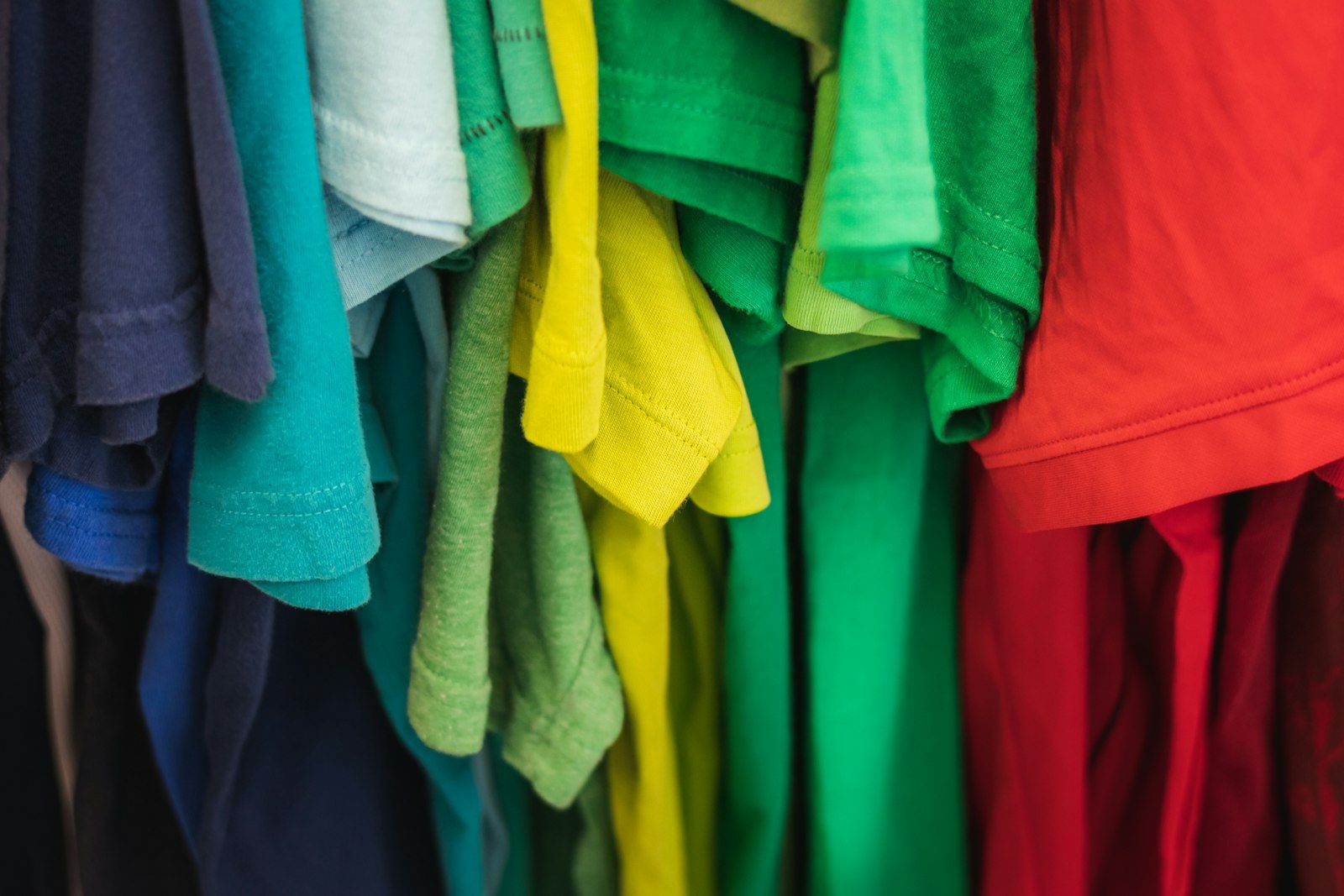
So if the teams must be told apart by colour, choose colours that share an ink, order every colour in the same run so the print matches across them, and keep the number of teams as low as the week allows. Choose from a real swatch of the blank, not from the brand guide: a faculty purple can be matched to a Pantone reference in the ink, but the shirt only comes in the purples the blank is made in. On a tight budget, one shirt colour for everyone with the team name as a small print on the sleeve keeps one blank and one size spread; printed by DTF, eight different team names need no setups, though every shirt then carries a second print. Compare a one-colour and a four-colour version in the free design studio and watch the price change. The same arithmetic sits behind the house-colour advice in our Toronto school spirit wear guide.
Leader shirts and first-year shirts: same design, different job
First-years spend orientation looking for someone who knows where the next event is, so the leader shirt has one job: to be found. Give leaders a different shirt colour from the first-years, keep the front design identical so the week still reads as one event, and print LEADER or the role across the back in the biggest type that fits. Coordinator, safety, first aid, photo: a role on the back does what a lanyard cannot do from across a field. The volunteer section of our Toronto event shirts guide goes deeper on roles and contrast. Frosh adds one twist: a leader often wears that shirt through most of a week-long schedule, so consider two per leader.
Leader shirts are also worth planning on their own clock. Leaders are usually chosen and trained well before first-year registration fills up, so their sizes are known first; collect them at the first training session. A leader run is small, and that suits digital printing. No minimum on DTF and DTG — we will print a single shirt. Screen printing starts around 6 pieces and becomes the best value past roughly 24–50 pieces. A faculty with sixty leaders is a modest screen-printing run; a dozen coordinators with their roles on the back are a DTF order at a normal per-piece price.
Two refinements help. A leader’s first name under LEADER turns “find a leader” into “find Sam”; individual names are added shirt by shirt for a per-shirt surcharge, and our guide to ordering names and numbers covers how to send the list without typos. And put the leader shirts in the same order as the first-year run, even if the two are printed by different methods, so the artwork, the colours and the delivery date all match.
Sizing hundreds of first-years before registration closes
Frosh sizing has a timing problem built in: registration often stays open into August, and the shirt order cannot wait for it. So the order is a forecast in three parts. First, the sizes already collected on the registration form, exported on the day you order. Second, the late registrations you can expect, estimated by comparing where registration stood on the same date last year with where it finished. Third, spares in the middle sizes, from the same run, for exchanges and the students who sign up during the week.
Spread the forecast part over a size curve weighted toward medium and large, with thin tails at the small end and at 2XL and up; our bulk t-shirt size breakdown works the numbers for 100, 250, 500 and 1,000 shirts. The tee in the online studio is a unisex cut that runs XS to 5XL, so ask for its size chart and put it on the registration form instead of letting first-years guess from a favourite brand. Sizes of 2XL and larger carry a small per-piece upcharge that rises with each size, because the blanks themselves cost more, and anything outside that range goes through the quote form.
Then write it down for the people who come after you. The most useful document an orientation chair can leave is one page: the blank’s style and colour, the sizes ordered, the sizes left over, the order and delivery dates, and who signed off. Next year’s committee forecasts from real numbers instead of starting from zero, and the shirts match from one year to the next. For how a four-figure run is organized end to end, what printing 1,000 custom t-shirts involves walks through it, and our t-shirt printing page is the overview of the tees we print.
University crests, slogans and who has to sign off
Two kinds of approval sit between a frosh design and the press, and both take longer than a new committee expects. The first is the university’s. University names, crests, wordmarks and mascots are trademarks the university licenses, so get approval from the university’s brand or licensing office before anything prints. Some schools spell out more: the University of Toronto’s trademark licensing office says only recognized student groups can use U of T names and marks on merchandise, and that U of T–branded merchandise must be produced by an approved, licensed vendor. Rules differ from campus to campus, so ask early whether your design needs approval at all; a theme graphic your committee draws itself is a different conversation from the crest. This is not legal advice, and the licensing office is the authority on its own marks.
The second approval is your own. Orientation committees and student-union policies usually review what goes on the shirt, and for good reason: the shirt is in every move-in photo, in front of parents, staff and sponsors, and it outlives the week by years. Keep it general and sensible. Inside jokes date by October. Anything about drinking is wrong on a shirt for a first-year class that, in Ontario, is mostly under the drinking age of 19. A line that needs explaining will be explained badly in a screenshot. If a phrase makes one person on the committee hesitate, it is the wrong phrase for six hundred shirts.
The tool that makes both approvals easier is the mockup. Every order gets a free digital mockup on the actual product before any payment. Nothing prints until the customer approves it. Send that one image to the union executive, the faculty and the licensing office, so everyone signs off on the same thing. Every order is reviewed by a human designer before it goes to press. A person checks artwork resolution, colour, sizing and placement, and either fixes the file or tells the customer what is wrong — it is not an automated preflight. If last year’s design survives only as a screenshot in a group chat, our vectorization service redraws it as clean vector art once, and next year’s committee inherits a file that prints.
Bilingual frosh shirts for uOttawa and Montreal campuses
Language is a design decision on many of these campuses. The University of Ottawa is a bilingual university, and a shirt meant to welcome its whole first-year class does it in both languages. Montreal campuses work in French and English: McGill, Concordia and Dawson teach in English, Université de Montréal and UQAM in French, and each draws first-years who speak both. In Toronto, York’s Glendon campus is bilingual too.
There are two ways to do it, and the cheaper one is usually the better shirt. One bilingual design, with both languages in one print on the same shirt, is one set of screens and one size spread. Two language versions are two designs. In the online studio, two designs of the same garment in one order still count together toward the price break, but on a quoted screen-printed run each separate design is its own setup, and someone has to forecast how many students want each version, which nobody knows in July. The bilingual shirt has neither problem. Proofread the French as hard as the English and check every accent on the mockup: é, è, ç and the guillemets « » are exactly the characters a decorative font tends to lack.
In Quebec, the Charter of the French Language generally sets French as the language of work, commerce and business, with rules for signs, product labels and commercial documents; the Office québécois de la langue française (OQLF) administers it. Whether any of that touches a student association’s own frosh shirt depends on how the shirt is sold and used; this is not legal advice — check with the OQLF for your case. We serve customers in English and French. For the Montreal side of a big run, bulk t-shirt printing for Montreal is the city guide to ordering tees by the hundred.
The sponsor back and the budget per first-year
Frosh shirts are usually paid for out of the registration or kit fee, often with sponsors covering part of it, so the number that matters is the cost per registered first-year. Start from the anchor. A screen-printed t-shirt runs roughly $12–$18 CAD each at 50 pieces and drops under $10 each in the hundreds. Full-colour DTF sits slightly higher per piece with no setup fee. Every quote is free and includes a mockup. Then build the per-student figure from the whole order — first-year shirts, leader shirts, spares and shipping — divided by the first-years you expect, and get the quote at your real count before the kit fee is set, not after.
Once the count is set, what moves the price is the setups: ink colours, print locations and separate designs. A one-colour front and a one-colour back on one shirt colour is the most economical frosh shirt there is; a four-colour front, a full sponsor back and eight team colours is the most expensive version of the same idea. When the number has to come down, drop an ink colour before you drop to a thinner blank, because a comfortable shirt gets worn long after the week. If the committee is weighing “wholesale” offers, our explainer on wholesale custom t-shirts sets out what the word should mean for a printed order.
The sponsor back is where many frosh budgets balance. Ask every sponsor for a one-colour version of its logo, so the whole back prints as one screen in one ink; a full-colour wall of logos needs digital printing or a stack of extra screens. Set a logo deadline ahead of the artwork deadline, size the logos by sponsorship level, and keep sponsors off the front, which belongs to the theme. Our event shirts guide covers the sponsor wall in more detail, and the event shirts page is the starting point for the other events a student group runs through the year.
Shipping to campus: a staffed office, never a residence mailroom on move-in day
Every frosh order ends as a stack of boxes, so start with where they come from. Printed and decorated in-house in Ottawa, Ontario. Nothing is drop-shipped from overseas, so there are no cross-border customs holds or surprise duties. Ottawa committees can ask about picking up their order; ask when you order. Toronto and Montreal campuses get everything by courier — down the 416 and the 401 to Toronto, along the 417 and Highway 40 to Montreal — because there is no storefront, counter, pickup or delivery van in either city. Shipping Canada-wide, including the Greater Toronto Area and Greater Montreal, typically arriving 1–2 days after the order leaves the shop. Shipping is quoted for your postal code and shown before you pay.
Then choose the address with care. Ship to an office that is staffed in August: the students’ union, the faculty society or the orientation office in the student centre. Check its summer hours before you hand over the address, and name a person who will be there the week the boxes land. Never ship to a residence mailroom on move-in day, when it is buried under every new student’s parcels, and never to a committee member’s summer address in another city. Open every box when it arrives, count against the size list, and sort by team and size while there is still time to fix a shortfall.
If the leader shirts should go to one office and the first-year shirts to another, or a residence council wants its share sent separately, tell us at quote time — it changes how the run is sorted and boxed, and each address is quoted for shipping. On move-in day itself, hand shirts out with the kit at check-in from bins sorted by team and size, and keep the spares on their own table for exchanges. Swap sizes only from the spares, never between two first-years’ kits, and write down what is left at the end of the week for next year’s committee.
After frosh: faculty hoodies and crewnecks for the cold months
The tee is the first order of the year, not the last. By October many faculty societies are selling hoodies and crewnecks for the cold months, and the frosh artwork can carry over: the same mark and colours on a heavier garment. A pullover custom hoodie comes in 50/50 cotton-poly fleece or a polyester performance version, and a crewneck sweatshirt in 50/50 fleece. Both can be printed or embroidered, and embroidery costs more per piece than print. In the studio, hoodies and crewnecks run S to 3XL; zip hoodies and jackets are not in the studio and go through the quote form.
Hoodie runs follow the same volume logic as tees on a heavier blank, so the planning in this article carries straight over. Bulk hoodie printing in Ottawa and bulk hoodie printing in Toronto work through each city, and hoodies for grad classes, teams and clubs covers designs that age well, like names on the back, which is also the shape of a leaders’ thank-you hoodie. To see the frosh mark on fleece tonight, drop it on a hoodie in the hoodie designer and the price updates as you change the count.
To start the frosh order itself, send the count, the team colours, the move-in date and the delivery address through the free quote form, or reach us directly. Phone 613-666-YAYA (613-666-9292), WhatsApp the same number at wa.me/16136669292, email order@yayaprints.ca, or order online at yayaprints.ca. Smaller pieces of the year, like a leader run or a club tee, can be built without talking to anyone. Customers can design their own product free at yayaprints.ca/mockup-creator — upload a logo, place it on a real garment, add print-quality text, choose colours and sizes, and order online without emailing or phoning anyone. Payment is by card or Interac e-Transfer.
Frequently asked questions
When should we order frosh week shirts?
Work backwards from move-in. Set the theme and budget in the spring, finish the artwork and approvals by early summer, collect sizes through registration, and book the order by late July for a late-August or early-September orientation — earlier for a CEGEP, where fall classes start in August. Standard turnaround on clothing is 1–2 weeks. Most apparel orders can rush — 4–5 business days or 1–3 business days, priced at checkout — and every order shows the dates it will be ready before you pay. A run in the hundreds should be planned on the standard schedule; rushing a large run is a conversation, so call 613-666-9292 before counting on it.
How much do bulk frosh shirts cost per student?
A screen-printed t-shirt runs roughly $12–$18 CAD each at 50 pieces and drops under $10 each in the hundreds. Full-colour DTF sits slightly higher per piece with no setup fee. Every quote is free and includes a mockup. For the per-student figure, add the leader shirts, spares and shipping to the first-year shirts and divide by the first-years you expect. Once the count is set, the setups move the price most, so fewer ink colours, print locations, designs and team colours cost less.
Should each frosh team get a different shirt colour?
It works, but each shirt colour is its own blank stock, its own size spread and its own pile of spares, and in screen printing a different ink for each shirt colour can mean separate setups. Four team colours that all take the same ink — white on four dark colours, for example — print from one set of screens; light colours in the mix usually add a second ink. In the online design studio the per-piece price drops at 12, 24, 50 and 100 pieces, and every colour of the same garment in one order counts toward the same price break.
How do we choose sizes before frosh registration closes?
Order on a forecast: the sizes registrants have already given you, plus the late registrations you can expect from last year’s numbers spread over a size curve weighted toward medium and large, plus spares in the middle sizes from the same run. The studio tee is a unisex cut from XS to 5XL, and 2XL and larger carry a small per-piece upcharge that rises with each size. Our bulk t-shirt size breakdown guide works the numbers for 100, 250, 500 and 1,000 shirts.
Can we put the university crest or name on frosh shirts?
Only with the university’s approval. University names, crests, wordmarks and mascots are trademarks the university licenses, so get approval from the university’s brand or licensing office before anything prints. Some schools spell out more — the University of Toronto’s trademark licensing office says U of T–branded merchandise must be produced by an approved, licensed vendor — so ask early, before the design is final. This is not legal advice; the licensing office is the authority on its own marks.
How should leader shirts differ from first-year shirts?
Give leaders a different shirt colour, keep the same front design so the week reads as one event, and print LEADER or the role across the back; a first name can be added on each shirt for a per-shirt surcharge. Leader sizes are known early, so collect them at the first training. No minimum on DTF and DTG — we will print a single shirt. Screen printing starts around 6 pieces and becomes the best value past roughly 24–50 pieces.
Can you print bilingual French and English frosh shirts?
Yes. We serve customers in English and French. One bilingual design, with both languages on the same shirt, is usually the better buy: on a quoted screen-printed run every separate design is its own setup, and two language versions also mean forecasting how many students want each one. In the online studio, two designs of the same garment in one order still count together toward the price break. Check every accent on the mockup before you approve it.
Can we pick up frosh shirts in Toronto or Montreal, and where should they be shipped?
There is no storefront, counter or pickup in Toronto or Montreal; everything is printed in Ottawa and shipped by courier. Shipping Canada-wide, including the Greater Toronto Area and Greater Montreal, typically arriving 1–2 days after the order leaves the shop. Shipping is quoted for your postal code and shown before you pay. Ship to a staffed campus office such as the students’ union or the faculty society, never a residence mailroom on move-in day. Ottawa committees can ask about picking up their order — ask when you order.
Design it yourself. A human designer still checks every order.
Our free studio gives you the price and the mockup in the browser. What it doesn't do is print your file blindly — every order is reviewed by a real designer before it reaches the press.
- Step 1You design it — free
Upload your logo, drop it on a real garment, set the size and placement, pick colours and quantities. No account, no deposit, no waiting on a reply.
- Step 2A human designer checks it
Before anything prints, one of our designers opens your file and checks resolution, colours, sizing and placement. If it won't print well, we fix it or tell you exactly what's wrong — a person, not an automated preflight.
- Step 3You approve, then we print
You get the corrected mockup back on the actual product. Nothing goes to press until you say yes — then it's ready in 1–2 weeks, or in 1–3 business days with a rush.
Plan one run of frosh shirts for the whole first-year class
Send the count, the team colours and your move-in date through the free quote form, or build the design in the studio and watch the per-piece price as the count changes. Every order gets a free digital mockup on the actual product before any payment. A run in the hundreds is planned on the standard schedule and shipped to a staffed office on campus in Ottawa, Toronto or Montreal.
Every order is reviewed by a human designer before it goes to press. A person checks artwork resolution, colour, sizing and placement, and either fixes the file or tells the customer what is wrong — it is not an automated preflight.