
Custom T-Shirt Printing in Hamilton: Workwear for the North End, Club Tees for McMaster and Mohawk, and Merch for James North
Hamilton is its own market, not a GTA suburb, and it orders custom shirts five ways: embroidered workwear and hi-vis for the north-end trades, staff polos for the clinics, club tees for the two campuses, small-run merch for James North, and names and numbers for minor sports from Dundas to Stoney Creek. Real per-shirt pricing, the method that fits each order, the 1–2 week standard turnaround with rush tiers, and 1–2 days in transit from Ottawa once it leaves the shop.
- Minimum order
- None on DTF or DTG — we will print one shirt. Screen printing starts around 6 pieces and becomes the best value past roughly 24–50 pieces.
- Typical cost
- Roughly $12–$18 CAD per screen-printed tee at 50 pieces, dropping under $10 each in the hundreds. Full-colour DTF sits slightly higher per piece with no setup fee. Embroidery is priced by stitch count, not by colour.
- Turnaround to Hamilton
- Standard turnaround on clothing is 1–2 weeks once the free mockup is approved and the order is paid. Most apparel orders can rush — 4–5 business days or 1–3 business days, priced at checkout — and every order shows the dates it will be ready before you pay. Then typically 1–2 days in transit from Ottawa once it leaves the shop.
- Artwork check
- Every order is reviewed by a human designer before it goes to press — resolution, colour, sizing and placement. Not an automated preflight.
- Design it yourself
- Free online studio at yayaprints.ca/mockup-creator. No account, no deposit, real garments and colours, and the price updates as you build it.
- Five Hamilton buyers
- North-end trades (embroidered workwear and hi-vis on certified blanks), clinic staff (polos, not scrubs), campus clubs (a dozen tees with no minimum, or hundreds screen printed), James North merch (cafes, breweries, small brands) and minor sports in Dundas, Ancaster and Stoney Creek (names and numbers).
- Where it is printed
- In-house in Ottawa, Ontario, then shipped to Hamilton. No storefront on James North or anywhere else in the city. Printed in Canada, so no cross-border customs holds or surprise duties.
Hamilton is its own market, and it orders five ways
Hamilton is not a Toronto suburb. It is a city of well over half a million people with its own harbour, its own escarpment, its own university and college and its own way of ordering shirts. Regional planners fold it into the GTHA; nobody on Barton Street thinks of it that way, and neither do we. The requests that reach us from the Hamilton area sort themselves into five piles, and each pile wants a different method.

Workwear comes first: the industrial belt along Burlington Street, the contractors and fabricators that feed it, and the industrial parks off the QEW in Stoney Creek, all ordering embroidered work shirts, caps and hi-vis with durability ahead of everything. Then the clinics and practices around the hospital campuses, buying staff polos rather than scrubs. Then campus, McMaster in Westdale and Mohawk up on the Mountain, where a club of twelve and an orientation run of four hundred are both normal. Then merch for James Street North, Locke Street and Ottawa Street North, where cafes, breweries, galleries and one-person clothing brands want a short run of something they can sell. And then minor sports and community groups in Dundas, Ancaster and Stoney Creek: names and numbers, coach sets, parent hoodies and the fundraiser tee. Each pile gets its own section below, followed by what is the same for everyone: shipping from Ottawa, price, method and the file check.
Embroidered workwear for the north end and polos for the clinics
Steel City is the one nickname Hamilton has earned, and the north-end order still looks like it: a crew of eight to forty, a logo on the left chest of a work shirt, the same logo on a cap, and a hi-vis layer for whoever goes on site. Embroidery is the right tool for nearly all of it. Thread does not crack under a pressure washer or fade in an industrial laundry the way a print will, and a stitched logo on a work shirt still reads as a uniform after two years of Mondays.
Hi-vis needs one thing said plainly. The safety rating on a hi-vis vest or shirt, CSA Z96, belongs to the garment as it was made. We decorate certified blanks; we do not certify anything, and the print or embroidery stays off the reflective tape. The custom hi-vis clothing page shows where a logo can sit, and the hi-vis workwear guide covers classes and colours. Hi-vis, jackets and softshells are quoted by hand through the quote form; size the logo on a tee in the studio if it helps, then order the jackets on a quote.
Order caps with the shirts, because the cap is the piece that stays on in July. Order a size spread and a bin of spares rather than sizes by name, because crews turn over. And keep the style number of the blank so the reorder matches. Custom workwear and hi-vis in Toronto, construction uniforms across Canada and the construction apparel page go deeper, down to the site signs and the truck decals.
The clinic order is the same logic in a quieter fabric. Physiotherapy clinics, dental offices, labs and family practices around the hospital campuses downtown, on the Mountain and out by the university order an embroidered polo for reception and clinical staff, with the clinic name small on the chest. Not scrubs; polos. Keep the logo simple, since thin lines and text under about a quarter inch will not stitch cleanly. Custom embroidery in Toronto explains what embroidery does well and what it refuses to do.
Campus clubs at McMaster and Mohawk: a dozen tees or four hundred
Two campuses, two rhythms. Westdale fills with McMaster students every September, the Mountain does the same for Mohawk, and within a month the club executives, residence councils and intramural captains are all shopping for a shirt. Campus orders come in two sizes with little in between: a dozen for a club, and hundreds for an orientation week, a faculty event or a charity run.
The dozen is a DTF job: no minimum, every shirt can be a different size or even a different design at the same price, and no setup fee. The hundreds are a screen printing job: one or two ink colours on a bright tee, the setup divided across four hundred pieces until it is nothing, and a per-shirt price under ten dollars. Screen printing in Toronto explains why the count moves the price so much. If the shirt is a fundraiser, a tee that costs under $10 in the hundreds sells for two to three times that.
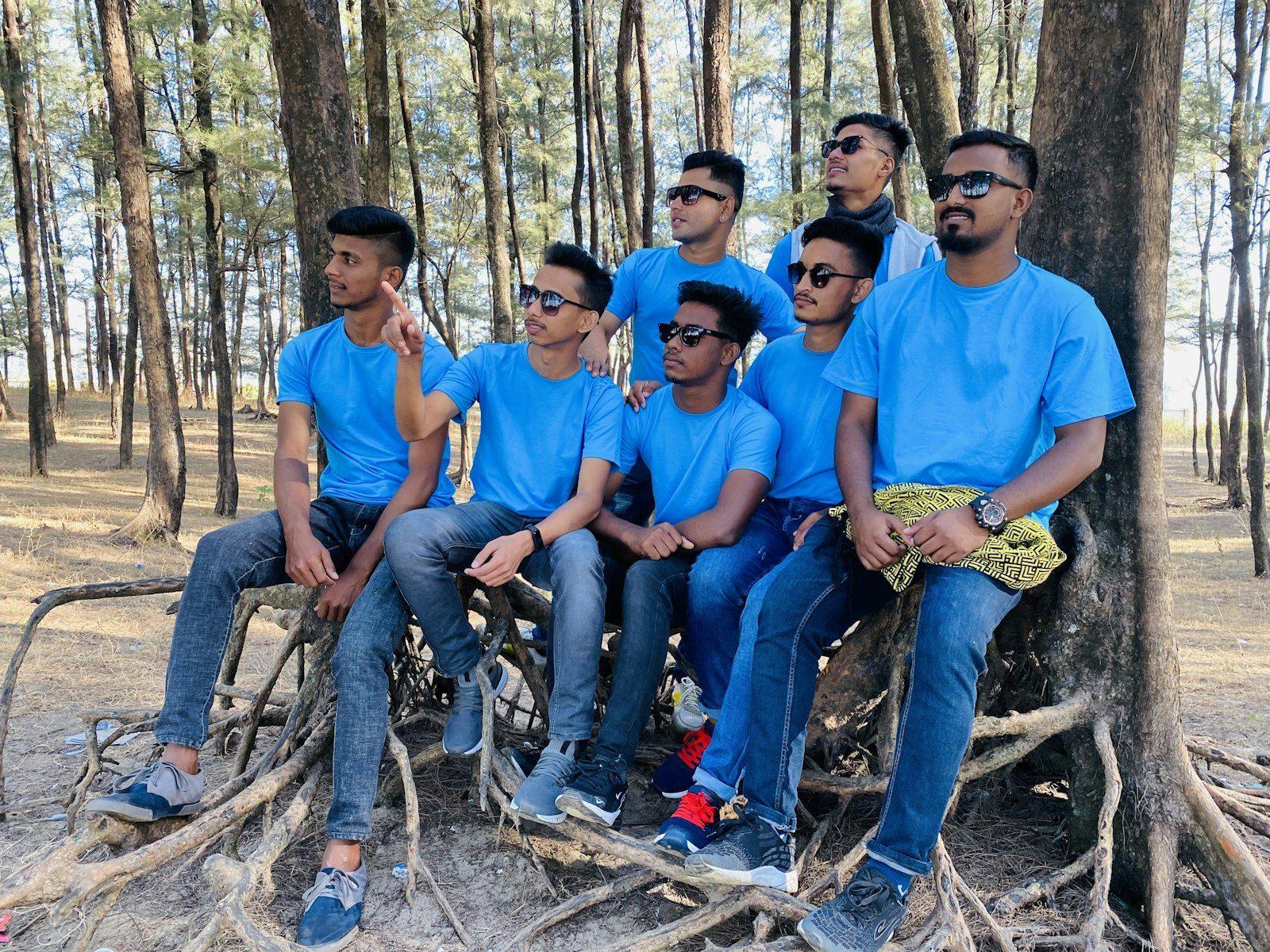
Timing is what campus buyers underestimate. It is late September as this is written, so the orientation runs are done and the next windows are the January term, the spring formals and the year-end tournaments. Send artwork three weeks ahead and the standard 1–2 week turnaround plus 1–2 days in transit covers it; send it the week before and it becomes a rush tier, priced at checkout, and we will say before you pay whether the date is realistic. The free studio builds a tee, long-sleeve, hoodie or cap with the club logo on a real garment and prices it as you go, so the treasurer sees the number before the meeting.
Merch for James North, Locke Street and Ottawa Street North
The most interesting orders in Hamilton come off three streets. James Street North has the galleries and the monthly art crawl, and for one weekend each September it closes for Supercrawl, so every vendor, band and volunteer crew on it wants shirts in August. Locke Street has the cafes and the boutiques. Ottawa Street North is the old textile district, still lined with fabric shops, and we admit to a fondness for a street that shares a name with our city.
What those streets order is a short run of something sellable: a cafe tee in one colour on a heavyweight blank, a brewery hoodie with the tap-room name on the sleeve, the first drop of a one-person label. This is where no minimum matters most. A clothing brand that has not sold a shirt yet should print twelve to twenty-four, not two hundred, and DTF or DTG makes that a normal order. How to start a clothing brand in Toronto covers the first-drop logic from blanks to markets, and it applies on James North exactly as it does on Queen West.
The details that make a run look like a brand are cheap and usually forgotten: a printed neck label instead of the blank’s tag, one blank and one style number so the second drop matches the first, and a sticker or hang tag with the logo. Past roughly fifty pieces of a proven design, screen printing takes over and the per-piece price drops. For the cafe or tap room itself, the cafe and coffee shop branding page covers staff tees, aprons on a quote, and window graphics that ship ready to apply.
Minor sports and community groups in Dundas, Ancaster and Stoney Creek
Dundas, Ancaster and Stoney Creek were towns before they were wards, and they still order like towns, through a volunteer with a spreadsheet. Winter rosters were registered a few weeks ago, so the house-league hockey requests are arriving now, and spring soccer is the next wave. Every one of those orders has the feature no office order has: every shirt is different.
Names and numbers go on by DTF or cut vinyl, because every variation costs the same and there is no screen to set up per player; on a fifteen-player roster the crest goes digital too and the whole order prices flat per shirt. Send one row per player with size, name spelled exactly as it should print, and number, and have a second parent check the spelling. Warm-up tees, long-sleeves, parent hoodies and caps with a name and number can be designed and priced in the browser tonight, with sports-number fonts built in. Sublimated game jerseys are a different product that we quote by hand; run the jersey and the bench tee as one order so the crest matches. For a whole association, custom sports team apparel in Toronto and the sports team apparel page cover multi-team orders and spirit wear.
The community side is the same buyer in a different month: volunteer tees for the August street festival in Dundas, training crews for the spring road race around the bay, a cultural association’s summer picnic by the hundred. Those are screen-printing jobs: one bright shirt colour, the role printed on the back where it reads from behind, and a fixed size spread weighted to medium, large and extra-large rather than sizes collected from a hundred people who have not confirmed they are coming.
Shipping to Hamilton from a shop that is in Ottawa
Straight answer first: we do not have a Hamilton storefront. There is no counter on James North, no pickup in Stoney Creek, no van and no local rep, and the same goes for the rest of the GTA and Waterloo Region. We print everything in-house in Ottawa, about five hundred kilometres up the 401, and ship it to you. If the plan depends on someone collecting a box that afternoon, we are the wrong shop, and it is better to know that now.
What it costs you is the courier leg. Standard turnaround on clothing is 1–2 weeks, and the clock starts when two things have both happened: you have approved the free mockup, and you have paid. Most apparel orders can rush: 4–5 business days or 1–3 business days, priced at checkout, and every order shows the dates it will be ready before you pay. Then it is typically 1–2 days in transit from Ottawa once the order leaves the shop, and shipping is quoted for your postal code and shown before you pay. The same applies to Burlington next door, St. Catharines down the QEW and Brantford out the 403; from where we sit, the west end of the lake is one trip.
What you get back is control, and a border you never cross. The press is down the hall from the person who answers the phone, so a roster change or a bad file is one conversation. It is printed in Ontario, so there is no customs hold and no duty invoice three weeks later, and nothing is drop-shipped from overseas. A company with a crew in Hamilton and an office in Burlington can run one order and split the boxes: one production run, one colour match, one price break. Custom t-shirt printing in Halton Region covers the Oakville-to-Georgetown side of the same trip.
What custom shirts cost in Hamilton, and which method fits
Five inputs move the price of custom shirts in Hamilton: the blank, the method, the number of ink colours, the number of print locations and the quantity. The useful anchor: a screen-printed t-shirt runs roughly $12–$18 CAD each at 50 pieces and drops under $10 each in the hundreds, which is where the orientation and festival runs live. Full-colour DTF sits slightly higher per piece with no setup fee, so a fifteen-player roster or a twelve-shirt club order usually costs less in total that way. Embroidery is priced by stitch count, not by colour, so a small clean left-chest logo is affordable and a large detailed one is not. Every quote is free and includes a mockup.
| Method | Typical Hamilton order | Practical minimum | Colour handling |
|---|---|---|---|
| Screen printing | Orientation weeks, festival volunteers, brewery tees past ~50 pieces | ~6 pieces | Priced per colour; brightest ink on coloured shirts |
| DTF | Campus clubs, rosters with names and numbers, a brand’s first drop | 1 piece | Unlimited colours, every shirt can differ; no setup fee |
| DTG | One-offs and the softest hand on cotton | 1 piece | Unlimited colours; flat per-piece price |
| Embroidery | Work shirts, caps, hi-vis (off the tape), clinic polos | Small runs fine | Thread colours; no gradients or tiny text |
Screen printing pushes ink through a stencilled mesh, one screen per colour, which is why it has a cost floor at small counts and almost none at large ones. DTF prints the design onto a film that is heat-pressed onto the garment, so nothing is set up and every shirt can differ at the same price. Machine embroidery stitches the logo in thread, survives an industrial wash, and is the wrong tool for fine detail, gradients or text under a quarter inch. Between twenty and fifty pieces the artwork breaks the tie: a two-colour crest goes to screen, a photograph or a gradient goes to DTF, and anything where every back differs goes digital. Watch the number move in the studio as you change quantity and colours; the t-shirt printing page lists what we run in-house.
A human designer opens every Hamilton file before it prints
Ordering from a shop five hundred kilometres away is safe because of what happens after you click order, not because of the preview. Every order is reviewed by a human designer before it goes to press. A person checks artwork resolution, colour, sizing and placement, and either fixes the file or tells you what is wrong. It is not an automated preflight.

What arrives from Hamilton is rarely print-ready: a contractor’s logo photographed off the side of a truck, a clinic wordmark 200 pixels wide from a website header, a club crest as a screenshot of a registration page, a brewery label with a gradient that will not stitch. We clean those up or redraw them, and if the logo needs a proper rebuild the vectorization service does it once, permanently. Then you see the result on a free mockup of the actual product before any payment, and nothing prints until you approve it. We will also say no when we have to: a thin-line logo that will not embroider at left-chest size is a conversation before you pay, not a box of forty work shirts you cannot use.
Starting a Hamilton order from the studio or the quote form
Nothing is charged before you have seen what you are buying. For a tee, long-sleeve, hoodie, polo, cap, youth tee or youth hoodie, drop your logo on a real garment at yayaprints.ca/mockup-creator: no account, no deposit, upload a PNG, JPG, SVG or PDF, place it on a real colour, add text in print-quality fonts including sports numbers, enter sizes and quantities, and the price updates as you build. For hi-vis, jackets, jerseys, aprons or anything else the studio does not build, use the free quote form, email order@yayaprints.ca, or call or WhatsApp 613-666-9292, in English or French. Both paths end at the same free mockup and the same designer check, and the production clock starts once the mockup is approved and the order is paid.
Where we land for Hamilton: no minimum on DTF or DTG, screen printing from around six pieces with real volume pricing past 24–50, embroidery and print under one roof, a free mockup before a dollar moves, and 1–2 days in transit from Ottawa once it leaves the shop. If you are comparing shops across the region, where to print custom shirts in the GTA is the fair overview, and custom t-shirt printing in Kitchener–Waterloo covers the other end of the 403.
Frequently asked questions
How much does custom t-shirt printing cost in Hamilton?
It depends on the blank, the method, the ink colours, the print locations and the quantity, so treat any single number with suspicion. As an anchor, a screen-printed t-shirt runs roughly $12–$18 CAD each at 50 pieces and drops under $10 each in the hundreds, where orientation runs and festival crews usually land. Full-colour DTF sits slightly higher per piece with no setup fee, so a twelve-shirt club order usually costs less in total that way. Embroidery is priced by stitch count, not by colour. Every quote is free and includes a mockup.
Do you have a shop in Hamilton?
No. We print in-house in Ottawa, Ontario and ship to Hamilton, Stoney Creek, Dundas and Ancaster by courier. There is no storefront on James North, no counter, no pickup and no local rep anywhere in the city. In exchange you get in-house control: the press is down the hall from the person answering the phone, it is printed in Canada so there are no cross-border customs holds or surprise duties, and transit is typically 1–2 days once the order leaves the shop. Shipping is quoted for your postal code and shown before you pay.
How long does an order take to arrive in Hamilton?
Standard turnaround on clothing is 1–2 weeks, counted from the moment the free mockup is approved and the order is paid, not from the first email. Most apparel orders can rush — 4–5 business days or 1–3 business days, priced at checkout — and every order shows the dates it will be ready before you pay. Add typically 1–2 days in transit from Ottawa once the order leaves the shop. Tell us the date before you order and we will say honestly whether it is realistic.
Can you do embroidered hi-vis and workwear for a crew?
Yes, and it is a large part of what we ship to Hamilton. Embroidery on work shirts, polos, caps and hi-vis survives a work week and an industrial wash far better than a print does. One thing to be clear about: the safety rating on a hi-vis garment, CSA Z96, belongs to the garment as it was made. We decorate certified blanks, we do not certify anything, and the print or embroidery stays off the reflective tape. Hi-vis, jackets and softshells are quoted by hand through the quote form, not the online studio.
Can a small campus club order a dozen shirts without a minimum?
Yes. There is no minimum on DTF or DTG, so a club of twelve in Westdale or on the Mountain orders twelve, every shirt can be a different size, and the per-piece price does not jump because the run is small. Screen printing starts around 6 pieces and becomes the best value past roughly 24–50 pieces, which is where orientation weeks and charity runs belong. The free studio at yayaprints.ca/mockup-creator builds a tee, long-sleeve, hoodie or cap with the club logo and shows the price as you go.
Can you do names and numbers for a minor hockey or soccer team?
Yes. Individual names and numbers are printed digitally, so every shirt can be different at the same flat price with no per-player setup. Send one row per player with size, name spelled exactly as it should print, and number, and have a second parent check the spelling. The online studio has sports-number fonts built in for tees, long-sleeves, hoodies and caps. Sublimated game jerseys are a different product that we quote by hand through the quote form, and running the jersey and the bench tee as one order keeps the crest matching.
Can I design the shirts myself online?
Yes, the whole thing. The free studio at yayaprints.ca/mockup-creator needs no account and no deposit: upload a logo as a PNG, JPG, SVG or PDF, place it on a real t-shirt, long-sleeve, hoodie, polo, cap, youth tee or youth hoodie in a real colour, add text in print-quality fonts including sports numbers, pick sizes and quantities, watch the price update, and order online. The studio does not build hi-vis, jackets, jerseys or aprons; those go through the quote form and we build the mockup for you.
What if our logo is a photo off a truck door or a screenshot?
Send it anyway. Every order is reviewed by a human designer before it goes to press. A person checks artwork resolution, colour, sizing and placement, and either fixes the file or tells you what is wrong; it is not an automated preflight. A phone photo of a truck door, a small website PNG, a scanned letterhead or an AI-generated image all get cleaned up or redrawn as vector artwork, and you see the result on a free mockup of the actual product before any payment. Nothing prints until you approve it.
Design it yourself. A human designer still checks every order.
Our free studio gives you the price and the mockup in the browser. What it doesn't do is print your file blindly — every order is reviewed by a real designer before it reaches the press.
- Step 1You design it — free
Upload your logo, drop it on a real garment, set the size and placement, pick colours and quantities. No account, no deposit, no waiting on a reply.
- Step 2A human designer checks it
Before anything prints, one of our designers opens your file and checks resolution, colours, sizing and placement. If it won't print well, we fix it or tell you exactly what's wrong — a person, not an automated preflight.
- Step 3You approve, then we print
You get the corrected mockup back on the actual product. Nothing goes to press until you say yes — then it's ready in 1–2 weeks, or in 1–3 business days with a rush.
See it on the real garment before a dollar moves
Upload your logo, drop it on a real shirt, hoodie, polo or cap, pick colours, sizes and quantities, and watch the price update as you build. No minimum on DTF or DTG, screen printing from around 6 pieces, printed in-house in Ottawa and typically 1–2 days in transit to Hamilton once it leaves the shop.
Every order is reviewed by a human designer before it goes to press. A person checks artwork resolution, colour, sizing and placement, and either fixes the file or tells the customer what is wrong — it is not an automated preflight.