
Screen Printing in Montreal (Sérigraphie): Bulk Pricing, Ink Colours, Minimums and When It Beats DTF
Screen printing in Montreal (sérigraphie) is the bulk method: one screen per ink colour is set up once, so the per-piece price falls as the run grows. A screen-printed t-shirt runs roughly $12–$18 CAD each at 50 pieces and drops under $10 each in the hundreds. Here is what ink colours, dark shirts and bilingual versions add, where the minimums sit, and when DTF or embroidery wins.
- Minimum order
- No minimum on DTF and DTG — we will print a single shirt. Screen printing starts around 6 pieces and becomes the best value past roughly 24–50 pieces.
- Typical cost
- A screen-printed t-shirt runs roughly $12–$18 CAD each at 50 pieces and drops under $10 each in the hundreds. Full-colour DTF sits slightly higher per piece with no setup fee. Every quote is free and includes a mockup.
- Volume pricing
- Large orders get volume pricing. In the online design studio the per-piece price drops at 12, 24, 50 and 100 pieces, and every colour of the same garment in one order counts toward the same price break. Orders in the hundreds are usually screen printed and quoted directly — through the free quote form, by email or by phone — and a large order gets the same free mockup and human designer check as a single shirt.
- How it is priced
- One screen per ink colour per print location, set up once and spread across the whole run, so the per-piece price falls as the quantity rises. Ink colours, print locations, the shirt colour (dark shirts usually need a white underbase) and the blank move the quote. Spot colours can be matched to Pantone references.
- Bilingual runs
- Each language version is its own set of screens: one bilingual design prints from one set, while separate French and English shirts are two setups. We serve customers in English and French.
- Planning the date
- Standard turnaround on clothing is 1–2 weeks. Most apparel orders can rush — 4–5 business days or 1–3 business days, priced at checkout — and every order shows the dates it will be ready before you pay. Plan a run in the hundreds on the standard schedule and confirm the date when you book.
- Shipping to Montreal
- Printed and decorated in-house in Ottawa, Ontario. Nothing is drop-shipped from overseas, so there are no cross-border customs holds or surprise duties. Shipping Canada-wide, including the Greater Toronto Area and Greater Montreal, typically arriving 1–2 days after the order leaves the shop. No Montreal storefront, counter or pickup — every order ships by courier.
Sérigraphie in one paragraph, and why it is the bulk method
Sérigraphie is the French word for screen printing, built on the Latin for silk, because screens were once made of it. The mesh is polyester now, but the method is the same: a stencil of your artwork is burned into a fine mesh stretched over a frame, so ink passes through only where the design is. A squeegee pulls ink across the screen onto the shirt, and the print is cured with heat so it survives the wash. One screen carries one ink colour in one print location, so a two-colour logo on the front is two screens, and the same logo with a one-colour back is three. Sérigraphie en gros, screen printing in bulk, is what this guide is about.
What makes it the bulk method is where the work sits. Everything that makes a small run expensive happens before the first shirt: the screens are made, the inks are mixed, and the screens are lined up on the press so every colour lands where it should. That work is the same for 50 shirts as for 500. After it, each additional shirt is one more pull of the squeegee and one more pass through the dryer. Digital methods such as DTF have no setup to spread, so most of their price is the same work repeated on every shirt. Screen printing gets cheaper per shirt with every piece you add, which is why it is the volume method in Montreal or anywhere else.
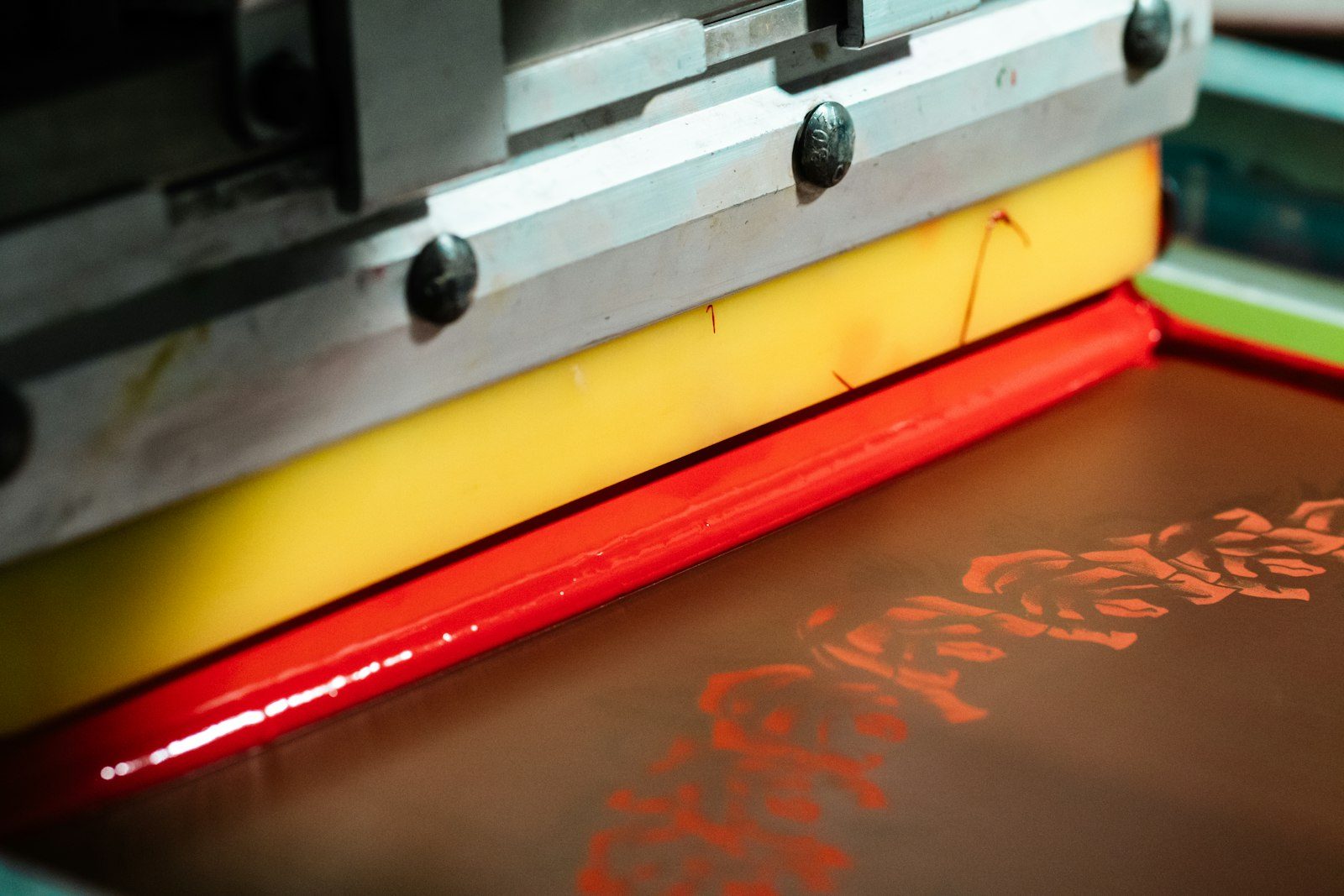
Around Montreal, the orders that end up on screens look alike once the count passes a hundred or so: staff tees for an office tower downtown or a distribution centre off the 40, volunteer shirts for a summer festival in the Quartier des spectacles, orientation shirts for a faculty association in late August, and the first cold-week order of coton ouaté for a whole team. They share one design, a few ink colours and a count that justifies the setup. Our Toronto guide to screen printing walks through the mesh, the stencil and the press in detail. This one is about what they mean for a Montreal buyer designing and ordering several hundred pieces of custom screen printing.
Why 500 shirts cost less each than 50
Take one design, a two-colour logo on the front of a light grey tee, and price it twice: once at 50 shirts and once at 500. The setup is identical both times — two screens, two ink mixes, one session lining them up on the press — because none of it depends on how many shirts follow. At 50 shirts, each shirt carries one-fiftieth of that setup. At 500, each carries one five-hundredth of it, a tenth as much. The blank and the ink on each shirt are the same in both runs, so most of the difference in the per-shirt price is the same setup divided by ten times as many shirts.
That is the whole price curve in one example, and the honest answer to the t-shirt sérigraphie prix question. A screen-printed t-shirt runs roughly $12–$18 CAD each at 50 pieces and drops under $10 each in the hundreds. Full-colour DTF sits slightly higher per piece with no setup fee. Every quote is free and includes a mockup. The curve falls steeply at first and then flattens: going from 50 to 100 pieces halves the setup on each shirt, while going from 500 to 1,000 moves the price far less, because by then the setup is a small share of it and the blank and the print itself make up most of what is left. Our guide to printing 1,000 custom t-shirts covers the far end of that curve.
The same logic shapes how we price large orders. Large orders get volume pricing. In the online design studio the per-piece price drops at 12, 24, 50 and 100 pieces, and every colour of the same garment in one order counts toward the same price break. Orders in the hundreds are usually screen printed and quoted directly — through the free quote form, by email or by phone — and a large order gets the same free mockup and human designer check as a single shirt. In the studio, that means 60 black and 60 heather grey tees in one order are priced as a run of 120, youth sizes count with the adult tee, and tees and hoodies each count on their own.
The other half of the volume case is consistency. One run means one ink mix on one setup, so the four-hundredth shirt matches the first. If a team will need 300 shirts over the year — seasonal hires in May, a second wave in September — one run is usually cheaper than three runs of 100, provided the sizes are predictable and you have room for the boxes. If “wholesale” is the word your purchasing team uses, what wholesale custom t-shirts really means sorts out the vocabulary.
Minimums, honestly: where screen printing starts to win
Our minimums in one line: No minimum on DTF and DTG — we will print a single shirt. Screen printing starts around 6 pieces and becomes the best value past roughly 24–50 pieces. Both halves matter. A screen run of 6 is possible, but its setup is the same setup as a run of 600, divided among six shirts instead of six hundred, so a small order is almost always cheaper with DTF printing, which has no screens at all. The crossover sits between 24 and 50 pieces because that is roughly where a screen-printed shirt, carrying a thin enough slice of setup, starts to undercut a method with none.
Inside that band the artwork and the shirt decide. A one-colour logo on a white or light grey tee crosses over early, near 24 pieces, because it is one screen and needs no underbase. A four-colour design on black crosses late, near 50 or beyond, because it is four screens plus a white layer underneath. Past roughly 100 pieces with one to three solid colours, screen printing is the answer almost every time; the exceptions are photographs, soft gradients and shirts that each need something different, which are covered below. For screen-printed t-shirts in the hundreds, bulk t-shirt printing for Montreal covers the planning side, and our t-shirt printing page lists the garments and methods.
The honest caution runs the other way too: do not order 300 shirts to reach a price break if you need 120. A lower per-piece price on shirts nobody wears is not a saving. The right count is the number of people plus a small spread of spares in the middle sizes, ordered in the same run, because spares printed later are a new setup. And if you are unsure how a design will land with a large group, ask whether a small first batch makes sense before you commit the full run.
What moves a screen-print quote, and how to design for volume
A screen-print quote is built from a handful of levers. Here is how each one moves the number, and how to design around it on a large run.
| Lever | Why it moves the price | Designing for a large run |
|---|---|---|
| Ink colours | Each colour is its own screen and ink mix, set up once | Use as few as the brand allows; an extra colour costs each shirt far less at 500 than at 50 |
| Print locations | Front, back and sleeve are separate screens and separate passes | Add a location only where it earns its place, such as a back print people read from across a room |
| Shirt colour | Dark shirts usually need a white underbase: one more screen, one more pass | A single white print on a dark shirt needs no underbase, because the white is the print |
| The blank | Paid on every piece; 2XL and up carry a small upcharge that rises with each size | At volume an upgrade is paid hundreds of times, so choose the blank before the ink |
| Versions | Each separate design is its own set of screens | Keep versions few; put whatever varies in one small location |
| Quantity | Spreads the setup across more shirts | Count people plus spares and print them in one run |
Notice how the levers swap places as the count grows. On a 50-piece order, cutting an ink colour is the biggest saving on the table, because each screen is spread over only 50 shirts. On a 500-piece order the same colour costs each shirt a tenth as much, and the blank becomes the lever: a better fabric is paid 500 times, a screen once. So for a large run, pick the blank first and design the print for it, not the other way round.
On blanks: tees come in cotton or polyester in a unisex cut, hoodies in a 50/50 cotton-poly fleece or a polyester performance hoodie, and crewneck sweatshirts in 50/50 fleece. In the studio, adult tees run XS–5XL, and hoodies, crewnecks, long-sleeves and polos run S–3XL; sizes outside those ranges go through the quote form. Sizes 2XL and up carry a small per-piece upcharge that rises with each size, because the blanks themselves cost more, so a size curve that leans large is worth planning. The size breakdown for 100 to 1,000 shirts shows how many of each size to order, and for screen printing hoodies before a Montreal winter, bulk hoodie printing in Montreal covers coton ouaté runs on their own terms.
Colour on a screen: spot inks, Pantone references and the white underbase
Screen printing works in spot colours. Each colour in the design is mixed as its own ink and printed flat from its own screen, instead of being built from dots of a few process inks the way a digital printer builds colour. That is why, in screen printing, spot colours can be matched to Pantone references, and why a brand with a defined red or a particular navy tends to end up on screens once the order is large. The Pantone system is a numbered library of colours that designers and printers share, which makes a reference far more useful than “our blue”. Give it at quote time, not after the mockup, so the ink is mixed to it from the start.
Two honest limits. The fabric is part of the colour: the same ink reads a shade differently on white cotton, heather grey and polyester, so judge it on the mockup of the actual shirt, not on a swatch. And photographs and soft gradients are not spot colours. A screen printer can imitate them with halftone dots spread across several screens, a technique called simulated process, but it adds screens and press time, and on most runs it is a job DTF does better.
Dark shirts add a step. Screen ink is slightly translucent, so a red printed straight onto black comes out dull and dark. The fix is a white underbase: a layer of white printed first in the shape of the design and set with a brief flash of heat before the colours go on top. Dark garments usually need one, and it counts as an extra screen and an extra pass. If your colours are black, navy, charcoal or forest green, plan for it, or design a single white print and skip it altogether.
The ink family changes how the print feels. Plastisol sits on top of the fibres, gives bright, opaque colour on dark garments and can be felt under a fingertip. Water-based ink soaks into the cotton for a softer print and suits light shirts. Discharge ink removes the dye from dark cotton in the shape of the design, works only on cotton dyed to accept it, and leaves a shade that depends on the shirt. If hand feel matters, ask which ink a quote assumes. The Toronto screen-printing guide goes deeper on all three.
When DTF beats screen printing, and when embroidery does
Screen printing is the volume method, not the only one, and we run the others too, so there is no reason to steer you to the wrong one. DTF prints the design onto a film that is heat-pressed onto the garment, so there are no screens and every shirt can differ at the same price. Embroidery stitches the logo in thread. Count your pieces, look at your art, and the table usually picks for you.
| Quantity | Logo in 1–3 solid colours | Photo, gradient or full-colour art | A name or version per shirt | Polos, caps, fleece left chest |
|---|---|---|---|---|
| 1–23 | DTF; screen printing starts around 6 pieces, but the setup has few shirts to spread over | DTF | DTF | Embroidery; small runs are normal |
| 24–49 | Close: one colour on a light shirt leans screen, four colours on black lean DTF | DTF | DTF | Embroidery |
| 50–99 | Screen printing | DTF, usually | Screen print the shared design, add the names with DTF | Embroidery |
| 100–499 | Screen printing | Quote both | Screen print the shared design, add the names with DTF | Embroidery; a big back print on a hoodie is screen printed |
| 500+ | Screen printing; the setup is a small share of each shirt | Usually DTF; ask about screen printing if the image can be simplified to a few spot colours | Shared design on screens; keep versions few | Embroidery; a big back print on a hoodie is screen printed |
DTF wins four kinds of order: small runs, where there is no setup to spread; photographs and gradients, which it prints as easily as one colour; many versions, such as a design per department or per sport; and individual names or numbers, which screens cannot vary from shirt to shirt. Full-colour DTF sits slightly higher per piece with no setup fee. A large order often combines the two: the shared design screen printed across all 300 shirts, and the names added with DTF at a per-shirt surcharge. Our DTF vs screen printing comparison puts cost, colour and durability head to head, and the guide to t-shirt printing methods lays out all four methods side by side.
Embroidery belongs where print does not: polos, caps and a left-chest logo on fleece. Hoodies, crewnecks, polos and caps can all be embroidered, and a stitched logo reads as a uniform and does not crack in the wash. It costs more per piece than print, so a 400-person staff order can split three ways: a screen-printed tee for everyone, an embroidered polo for the staff who meet customers, and embroidered caps for the outdoor crews. A big back print on a hoodie is still a screen-printing job. Screen printing vs embroidery compares the cost drivers and where each one wins, and our embroidery service page lists what we stitch.
Bilingual and multi-version runs: each version is its own set of screens
A Montreal order often comes in two languages, and screen printing counts that literally: each language version is its own set of screens. A French shirt and an English shirt are two designs and two setups, each spread over a smaller run. That does not make a bilingual order expensive. It makes the layout a price decision, and there are three ways to make it.
- One bilingual design. French and English in the same print, stacked or side by side. One set of screens, one run and every shirt identical, so the whole count sits on one setup and nobody is handed the wrong language. It is the cheapest layout at volume.
- French on the front, English on the back (or the reverse). Every shirt carries both, which makes it two print locations: two setups, and every shirt printed twice. A good fit when the design is large and each language needs room.
- Separate French and English shirts. Two designs, two sets of screens and two size breakdowns to get right. Worth it when the audiences are genuinely separate, and each version’s count has to carry its own setup. If one version is small — say 30 English shirts against 400 French — print the small one with DTF and accept that the two will feel slightly different to the touch.
One detail trips people up. In the online studio, two designs of the same garment in one order count together toward the price break, so a French and an English version of the same tee are priced on their combined count. A quoted screen-print run works differently: every separate design, every print location and every ink colour is its own screen setup, so each extra version adds setup. That is the honest reason to keep versions few at volume, and it applies beyond language — a version per department, per year or per event date multiplies screens the same way.
On the wording itself, Quebec’s Charter of the French Language makes French the normal language of work and commerce in the province, and it generally requires French on things like commercial signs, product labelling and advertising. Whether it reaches the slogan on a staff or event shirt depends on how the shirt is used, so treat this as general background: this is not legal advice — check with the OQLF for your case.
French lines usually run longer than their English twins, and accents have their own pitfalls in fonts and files. Our custom t-shirt printing guide for Montreal covers accents, fonts and copy, and our French-language guide to custom t-shirts in Quebec covers the same ground in French.
Ordering screen printing from Montreal, Laval or the South Shore
We do not have a shop in Montreal. There is no storefront, counter, pickup point, showroom or delivery van on the island or off it. Every order is printed and decorated in-house in Ottawa, Ontario, and travels by courier along the 417 and the 40. Nothing is drop-shipped from overseas, so there are no cross-border customs holds or surprise duties. We ship across Montreal and its suburbs, from the industrial parks of Saint-Laurent to distribution centres in Laval and offices across the Jacques Cartier Bridge in Longueuil.
The rest is courier time: shipping Canada-wide, including the Greater Toronto Area and Greater Montreal, typically arriving 1–2 days after the order leaves the shop. Shipping is quoted for your postal code and shown before you pay. Before the order leaves, the run has to be printed. Standard turnaround on clothing is 1–2 weeks. Most apparel orders can rush — 4–5 business days or 1–3 business days, priced at checkout — and every order shows the dates it will be ready before you pay. For a run in the hundreds, plan on the standard schedule: the shortest rush tier is limited to smaller runs, and rushing a large run is a conversation, not a checkbox, so call 613-666-9292 before counting on it.
A run of many hundreds is booked into the shop calendar when the order is confirmed, so confirm your date when you book rather than assuming it. Then work backwards from the day the shirts are needed: transit, production, the mockup approval and payment that start the clock, and before all of it the slow part, collecting sizes from several hundred people. The city’s calendar is predictable — festival season, the July 1 moving-day scramble, late-August orientation, the first cold week of autumn — so start before those dates crowd in. Orientation committees will find the planning in frosh week shirts in bulk.
A large run often has more than one destination: a head office downtown and a distribution centre in Laval, or staff split between the island and the South Shore. Tell us at quote time — it changes how the run is sorted and boxed, and each address is quoted for shipping. Ordering for offices in Ottawa, Toronto and Montreal at once? One apparel order for three cities walks through it.
How to start a screen-print order from Montreal
There are two ways in, and both end with a person checking the file. The first is the free online design studio. Customers can design their own product free at yayaprints.ca/mockup-creator — upload a logo, place it on a real garment, add print-quality text, choose colours and sizes, and order online without emailing or phoning anyone. It is the simplest way to see a design on the shirt colour you are considering, and to see what the price breaks do to your count before anyone writes a quote.
The second, for a run in the hundreds, is a direct quote through the free quote request form, by email or by phone. Send what decides the price: the garment and shirt colour, the count per colour with a size breakdown, the number of ink colours and any Pantone references, the print locations, the number of versions, the date you need the shirts and every delivery address. Zip hoodies, jackets, toques, tote bags, aprons and jerseys are not in the studio, so those go through the form too. Phone 613-666-YAYA (613-666-9292), WhatsApp the same number at wa.me/16136669292, email order@yayaprints.ca, or order online at yayaprints.ca. We serve customers in English and French.
Every order is reviewed by a human designer before it goes to press. A person checks artwork resolution, colour, sizing and placement, and either fixes the file or tells the customer what is wrong — it is not an automated preflight. On a screen-print run that check matters more than usual, because a hairline that would close up in the mesh, or a drop shadow that quietly adds a screen, would repeat on every shirt in the run. If all you have is a logo saved from a website, the designer fixes or redraws it, and our vectorization service redraws a logo as clean vector art.
Every order gets a free digital mockup on the actual product before any payment. Nothing prints until the customer approves it. Payment is by card or Interac e-Transfer, and a large order gets the same free mockup and human designer check as a single shirt — the only difference is that the setup is spread across a few hundred more pieces.
Frequently asked questions
How much does screen printing cost in Montreal?
A screen-printed t-shirt runs roughly $12–$18 CAD each at 50 pieces and drops under $10 each in the hundreds. Full-colour DTF sits slightly higher per piece with no setup fee. Every quote is free and includes a mockup. Within that range, the number of ink colours, the print locations, a dark shirt that needs a white underbase and the blank itself move the price, because each colour and location is its own screen setup spread across the run. Shipping is quoted for your postal code and shown before you pay.
What is the minimum order for sérigraphie (screen printing)?
No minimum on DTF and DTG — we will print a single shirt. Screen printing starts around 6 pieces and becomes the best value past roughly 24–50 pieces. A small screen run is possible, but its setup is the same as a large run’s and is divided among far fewer shirts, so under about 24 pieces a digital method usually costs less. Inside the 24–50 band, a one-colour print on a light shirt tips toward screens sooner than a multicolour print on black.
Why does a larger order cost less per shirt?
Because the setup is done once. Screen printing needs one screen per ink colour per print location, made, inked and lined up on the press before the first shirt, and that work is the same for 50 shirts as for 500. Spread across 500, each shirt carries a tenth of the setup it would carry at 50. Large orders get volume pricing. In the online design studio the per-piece price drops at 12, 24, 50 and 100 pieces, and every colour of the same garment in one order counts toward the same price break.
Do French and English versions cost more to screen print?
Each language version is its own set of screens, so on a quoted screen-print run a separate French shirt and English shirt are two setups, each spread across a smaller count. One bilingual design with both languages in the same print uses one set of screens for the whole run, while French on the front and English on the back is two print locations on every shirt. In the online studio, two designs of the same garment in one order still count together toward the price break. We serve customers in English and French.
Can you match our brand’s Pantone colour?
Yes. In screen printing, spot colours can be matched to Pantone references, because each colour is mixed as its own ink. Give the reference when you ask for the quote so the ink is mixed to it from the start. The fabric affects how a colour reads — the same ink looks slightly different on white cotton, heather grey and polyester — and dark shirts usually need a white underbase to keep colours bright. You judge the result on a free mockup of the actual shirt before paying.
When is DTF or embroidery a better choice than screen printing?
DTF wins small runs, photographs and gradients, many versions of a design, and individual names or numbers, because it has no screens and every shirt can differ. Embroidery belongs on polos, caps and a left-chest logo on fleece; it costs more per piece than print but reads as a uniform. For a design in one to three solid colours, screen printing starts around 6 pieces and becomes the best value past roughly 24–50 pieces, and a large order often combines the methods: the shared design screen printed, the names added with DTF.
Do you have a shop in Montreal where we can pick up the order?
No. There is no storefront, counter, pickup point, showroom or delivery van in Montreal, Laval or on the South Shore. Every order is printed and decorated in-house in Ottawa, Ontario, and shipped by courier, typically arriving 1–2 days after the order leaves the shop. Shipping is quoted for your postal code and shown before you pay. Nothing is drop-shipped from overseas, so there are no cross-border customs holds or surprise duties.
How far ahead should we order a run of several hundred shirts?
Standard turnaround on clothing is 1–2 weeks. Most apparel orders can rush — 4–5 business days or 1–3 business days, priced at checkout — and every order shows the dates it will be ready before you pay. Plan a run in the hundreds on the standard schedule: the shortest rush tier is limited to smaller runs, and rushing a large run is a conversation, not a checkbox, so call 613-666-9292 before counting on it. A run of many hundreds is booked into the shop calendar when the order is confirmed, so confirm your date when you book.
Design it yourself. A human designer still checks every order.
Our free studio gives you the price and the mockup in the browser. What it doesn't do is print your file blindly — every order is reviewed by a real designer before it reaches the press.
- Step 1You design it — free
Upload your logo, drop it on a real garment, set the size and placement, pick colours and quantities. No account, no deposit, no waiting on a reply.
- Step 2A human designer checks it
Before anything prints, one of our designers opens your file and checks resolution, colours, sizing and placement. If it won't print well, we fix it or tell you exactly what's wrong — a person, not an automated preflight.
- Step 3You approve, then we print
You get the corrected mockup back on the actual product. Nothing goes to press until you say yes — then it's ready in 1–2 weeks, or in 1–3 business days with a rush.
See the run on a real shirt before any screens are made
Try the design in the free studio, or send a run in the hundreds through the free quote form with your counts, ink colours and Pantone references. Every order gets a free digital mockup on the actual product before any payment. Printed and decorated in-house in Ottawa, Ontario, and shipped to Greater Montreal, Laval and the South Shore.
Every order is reviewed by a human designer before it goes to press. A person checks artwork resolution, colour, sizing and placement, and either fixes the file or tells the customer what is wrong — it is not an automated preflight.