
Made in Canada Custom Apparel: Why Where It's Printed Matters
Printed in Canada, decorated in Canada, or just shipped from a Canadian address? The three very different claims behind “Canadian” apparel, what each means for duty, turnaround and recourse, and how to verify it.
Made in Canada, Product of Canada and printed in Canada are three different claims
"Canadian" is doing a lot of work in apparel marketing right now, and almost none of it is precise. Three separate claims get blurred into one, and only two of them are regulated the way most buyers assume.
"Product of Canada"is the strictest. The Competition Bureau's guidance says it will not challenge that claim when the last substantial transformation of the good occurred in Canada and at least 98% of the total direct costs of producing or manufacturing it were incurred here. For a t-shirt that would mean the fibre, the knitting, the dyeing, the cutting and the sewing were all Canadian.
"Made in Canada"is the middle claim. Same requirement for the last substantial transformation, but the cost threshold drops to at least 51% — and the claim is meant to carry a qualifying statement telling you there is imported content in there, along the lines of "Made in Canada with imported parts." You can read the thresholds yourself in the Bureau's "Product of Canada" and "Made in Canada" claims guidelines.
"Printed in Canada" — or decorated, or finished in Canada — is the third claim, and it is not a country-of-origin claim at all. It describes one step in the process: where the ink met the garment. No percentage is attached to it, because it is not making a statement about where the garment came from in the first place.
Here is the part the industry rarely says out loud: almost all made in Canada custom apparel is that third row. The blank was very likely knit and sewn offshore, from cotton grown somewhere considerably warmer than Ontario, and then decorated here. Printing a logo on a finished shirt is not the kind of substantial transformation that changes where a garment comes from, and the cost of decorating it does not come close to half of what the garment cost to produce.
| Claim | What it actually requires | Typical custom apparel order |
|---|---|---|
| Product of Canada | Last substantial transformation here, plus at least 98% of total direct costs incurred in Canada | Essentially never |
| Made in Canada | Last substantial transformation here, at least 51% of direct costs, plus a qualifying statement about imported content | Rare — genuine domestic cut-and-sew only |
| Printed / decorated in Canada | No content threshold. Describes where the decoration happened, not the garment's origin | Almost every order — including ours |
None of this makes a Canadian shop dishonest. It makes the wording matter. If a supplier waves a flag at you and never separates those three rows, assume they live in the bottom one and are letting you hear the top one.
What a Canadian apparel printing shop can honestly claim
So here is our version, stated plainly. We do not weave cloth. Nobody in this building has ever spun yarn or cut a pattern. We buy blank garments from the same global supply chain every decorator in North America buys from, and we are not going to pretend otherwise to win a search result.
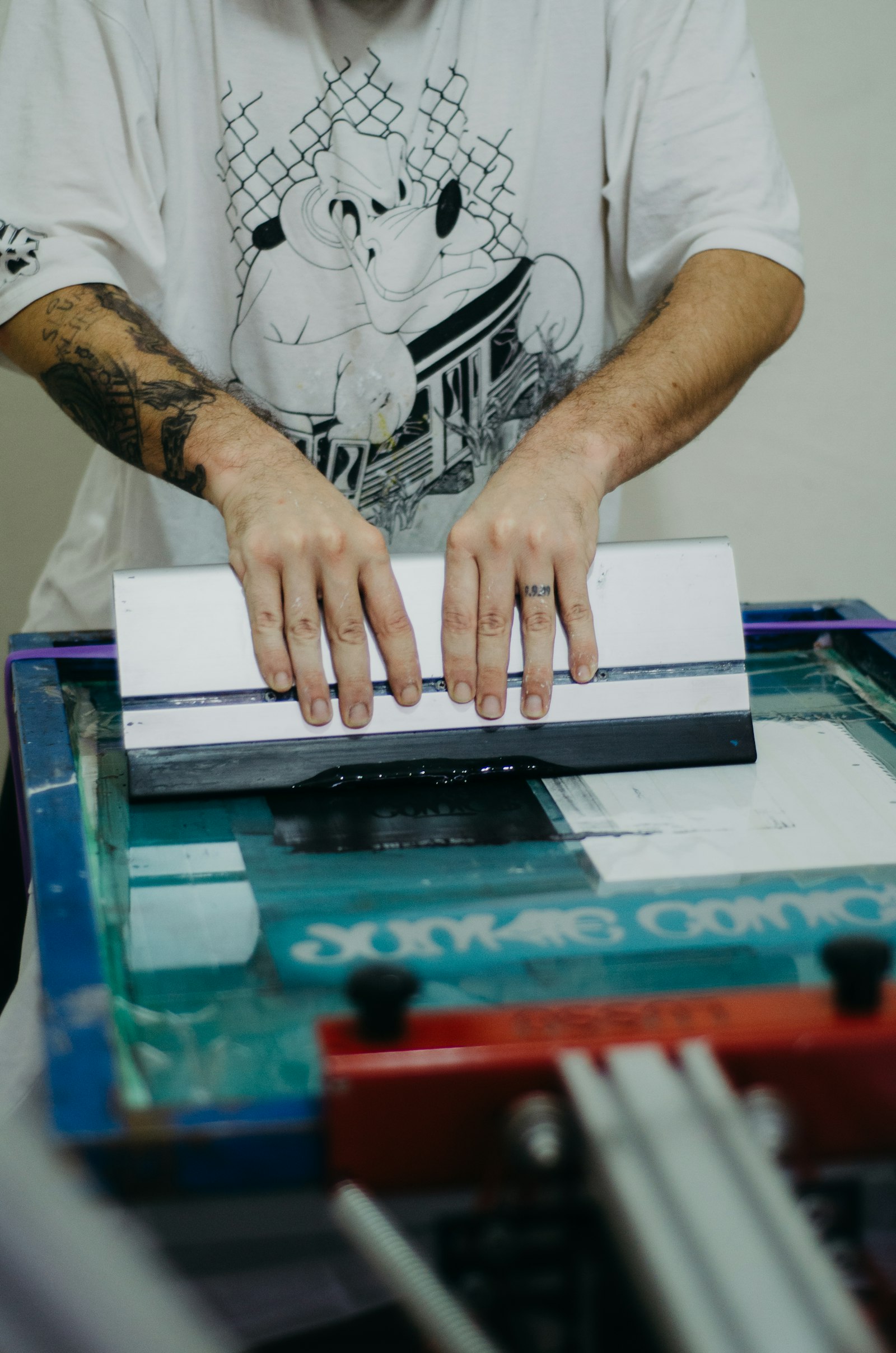
What does happen in Ottawa is everything after the blank arrives. Artwork gets cleaned up and colour-matched. Screens get burned and registered for screen printing, or film gets printed and powdered for DTF. Somebody stands at the press. Somebody pulls the shirt off the platen, checks the registration against the last one, and either boxes it or throws it in the reject pile. Then it gets folded, counted, bagged and either handed across a counter or put on a truck. All of it here.
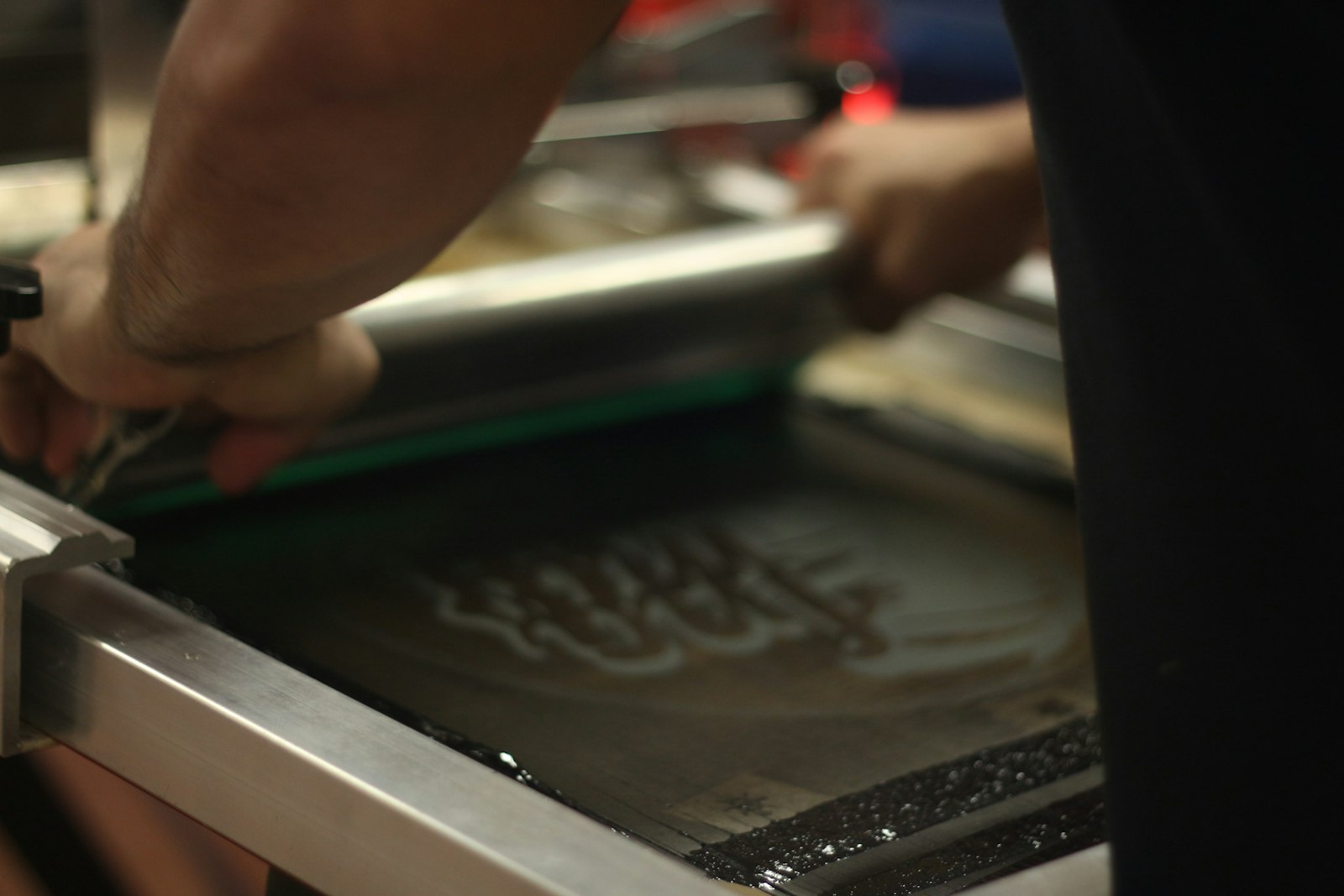
That decoration step is real manufacturing, not a rounding error. Ink chemistry, cure temperature, mesh count and press pressure are the difference between a print that survives forty washes and one that cracks by the spring. It is just not the step that determines a garment's country of origin, which is why we say printed in Canada and stop there rather than stretching for a phrase we have not earned.
The second thing that genuinely happens here is quality control. Every piece in your order passes through somebody's hands in this shop before it ships. When a shirt in the middle of a run comes out with a hairline registration shift, we catch it, because the person who printed it is the person who will hear about it. If you want to know what to look for yourself, we wrote a whole piece on how to tell good shirt printing from bad. And the same logic applies to embroidery, where a badly digitized file will pucker a polo no matter which country stitched it.
Why decorating in Canada actually changes what you get
If the blank came from overseas either way, does the decorating location matter? For a custom order — as opposed to buying a finished product off a shelf — it matters more than almost anything else about the supplier. Here is the honest list:
- Turnaround measured in days, not weeks. No ocean freight, no consolidation window, no clearance.
- No customs, duty or brokerage surprise on a parcel that never crosses a border.
- Prices quoted and charged in Canadian dollars, so an exchange-rate move between quote and invoice is not your problem.
- A reachable human in your own time zone — approvals happen inside one working day instead of bouncing overnight.
- Real recourse. If a box arrives wrong, the reprint conversation starts the same morning.
- A physical address you can visit, and the ability to hold a sample before you commit to a big run.
Those last three are the ones people underrate until the day they need them. The first three are the ones that show up on the invoice and the calendar. The next few sections take the three biggest ones apart, because "we're local, so we're better" is an assertion, and assertions are worth nothing without the mechanism underneath.
Turnaround: days instead of weeks, because the press is down the hall
Our standard turnaround is 2–5 business days after you approve the free mockup and pay. Rush work often lands in 1–2 business days. Small digital runs can occasionally go same day if you reach us early with clean art — but we will not promise that sight unseen, and you should be suspicious of anyone who does.
The reason those numbers are possible has nothing to do with working harder. It is that the press is down the hall, not down the highway. When an overseas quote says three to four weeks, printing is a small slice of it. The rest is a production queue you are sharing, a container waiting to fill, transit, customs clearance and a final domestic leg. Every one of those is a place your deadline can quietly die, and none of them are things your supplier controls once the box leaves.
Approvals are the other quiet advantage. A mockup that goes out at 9am here gets a decision before lunch, and a change request gets actioned the same afternoon. When your decorator is eleven or twelve hours offset, every round trip on artwork costs a full day even when everyone is being responsive. Two rounds of revisions is a week gone before anything is printed. We break down where the days actually go in how long custom apparel really takes.
The practical version: if your event is in nine days, custom t-shirts printed in Ottawa are a routine order. The same job placed offshore is a gamble on a shipping schedule. And if you are ordering from outside the National Capital Region, the transit is still domestic — see ordering custom apparel from anywhere in Canada for realistic province-by-province timing.
Duty, exchange rates and the price you actually pay
A domestic parcel does not clear customs. There is no duty line, no brokerage fee, no phone call from a carrier asking for a commercial invoice before they will release your shirts. Anything we ship moves through the regular Canada Post and courier network like any other domestic package. That alone removes the single most common way an imported apparel order blows its budget and its date at the same time.
Pricing is quoted in Canadian dollars and charged in Canadian dollars, with Ontario HST at 13% on top. Nothing between the quote and the invoice moves because a currency did. To put real numbers on it: a basic one-colour screen print on a standard cotton tee runs roughly $12–$18 each at 50 pieces and can drop under $10 each in the hundreds, depending on the garment, the ink and the placement. Small full-colour DTF runs sit a bit higher per piece but carry no setup cost at all. A back print adds about $7 per piece; embroidery adds about $10 per piece. Which method makes sense at which quantity is worked through in choosing a printing method for small orders.
Shipping Canada-wide is quoted on your order before you pay, and pickup and delivery are free across the National Capital Region — Ottawa, Kanata, Barrhaven, Nepean, Orléans, Stittsville and Gatineau. There are no setup fees on DTF, and no minimum on DTF or DTG, which means we will genuinely print one shirt. Screen printing has a practical floor of about six pieces because somebody has to burn a screen either way, and bulk discounts start around 50.
Now the honest part. On a 2,000-piece run of a simple design, an overseas factory will beat our per-unit price and it will not be close. We are not going to argue with arithmetic. What we will say is that most buyers comparing quotes are not ordering 2,000 pieces — they are ordering 25 for a team, and at that size the offshore unit price advantage is swallowed whole by freight, minimums and the cost of being wrong.
A named human, a phone number, and an address you can drive to
Call 613-666-9292 during business hours and a person picks up. Not a menu tree, not a chatbot that collects your email so somebody can reply tomorrow. Email order@yayaprints.ca and the reply comes from a specific person who has your file open, and that same person stays on your order from mockup to pickup. It is a small thing right up until the moment something goes sideways, and then it is the whole thing.
Because here is what recourse looks like at distance: you open a ticket, you attach photos, you wait for a time zone to wake up, and you negotiate with somebody who has never seen the garment and cannot see the press. Here it looks like a phone call, a reprint that goes on the schedule that afternoon, and — if you are in the region — you picking the corrected box up yourself. Nobody enjoys either version. One of them costs you a day and the other can cost you the event.
The other underrated thing about a physical shop is the sample. Before a large uniform order, you can hold one finished piece: feel the weight of the blank, check the print against the light, wash it once and see what happens. That is the single best money you can spend on a uniform program or a workwear rollout, and it is the thing that is functionally impossible to do properly when your decorator is on another continent. Reorders are easier too, since we keep artwork, blank details and placement measurements on file — the mechanics of that are in reordering company uniforms.
What overseas production is genuinely better at
An article like this turns into propaganda the second it pretends there is no reason anyone ever prints offshore. There are several, and they are good ones.
Very large runs at very low unit cost. Once you are into the thousands of identical pieces, scale wins. A factory built to run one design all week will always beat a shop that runs forty different jobs. If unit price is genuinely your only constraint and your timeline is measured in months, that is what offshore production is for.
Cut-and-sew from scratch. This is the big one, and it is the thing we simply do not do. Custom patterns, a fit you designed, your own fabric, your own trims, a garment that does not exist as a blank anywhere — that requires a factory with a pattern room and a sewing floor. Any decorator who tells you they can do that in a week is selling you something. Expect a sampling round, expect to pay for it, and expect the whole process to take a season rather than a fortnight. If that is where your brand is heading, our guide on starting a clothing brand in Canada covers when to make that jump.
Unusual garments. Some blanks are not stocked in North America at all, and if your product depends on one, geography decides for you.
Plenty of Canadian brands run both models at once and are completely upfront about it: garments cut and sewn overseas, decorated and quality-controlled here. That is a legitimate structure. It is also, precisely, why the labelling language matters — a brand doing exactly that can say "printed in Canada" with a clear conscience and cannot say "Product of Canada" at all.
How to verify a Canadian custom clothing company's claims
Plenty of "Canadian" apparel sites are storefronts that forward your order to a fulfiller in another country and never touch the goods. That is not automatically a scam — brokering is a real business — but you should know when you are paying one, because it changes your turnaround and your recourse. Four questions sort it out in about five minutes:
- "Where is the press?" Ask what equipment they own and where it physically sits. A shop that prints answers instantly and usually with more detail than you wanted. A broker gets vague fast.
- "What is your street address, and can I pick up?" A real production address is not a secret. If the only address is a PO box or a suite number that turns out to be a mail service, you have your answer.
- "Who actually decorates it?" Ask directly whether the job is printed in-house or sent out. Ask what happens if a piece is misprinted midway through the run — the answer tells you whether they are standing next to the press.
- "Can I get a sample first?" The single most revealing question. A local shop can put a printed sample in your hand in days. A drop-shipper cannot, and will steer you away from asking.
- "Do you mean made in Canada, or printed in Canada?" Ask it plainly. A shop that answers precisely is a shop that will be precise about your deadline too.
One more thing worth knowing if you are building your own label: apparel sold in Canada carries genuine textile labelling requirements covering fibre content and dealer identification. If you are replacing the manufacturer's neck tag with your own, that information becomes your responsibility — a detail a lot of new brands discover late.
Supporting Canadian custom apparel, without the flag-waving
We are not going to lecture you about buying local. You have a budget and a date, and those are legitimate reasons to choose anything. But it is worth naming what the money does, because it is not sentimental — it is structural.
The reason you can order twelve shirts at all is that a shop near you carries the equipment, the ink inventory and the staff to make twelve shirts economic. That capacity exists because bigger orders pay for it. Every 200-piece uniform run that stays in the country is what keeps the door open for the person who walks in on a Thursday needing eight hoodies for Saturday. Offshore production cannot serve that customer at any price, and it never will.
It also means the same shop that prints your first small batch can print your fiftieth. You are not switching suppliers when you grow — you move from DTF to screen printing inside the same building, with the same artwork files and the same person answering the phone. We have been doing this since 2015, and most of the orders that matter to us started as somebody ordering one shirt to see if we were any good.
If you want to see the thing before you commit, build it yourself in the free online design studio. Upload your art, knock the background out in a click, set the placement, try it on a few garment colours, and get a live price. Or send us the details through the quote form and a person will come back with a free mockup before you pay anything. Either way, the file lands on a machine about four kilometres from Parliament Hill.
Frequently asked questions
Is custom apparel actually made in Canada?
Usually not in the strict sense. The blank t-shirt or hoodie is almost always knit and sewn overseas, then decorated in Canada. That is why honest shops say 'printed in Canada' rather than 'Made in Canada' - printing a design on a finished garment is not the kind of substantial transformation that changes a product's country of origin. Genuine Canadian cut-and-sew exists, but it is a different, slower and more expensive business than custom decoration, and very few custom apparel orders involve it.
What is the difference between Made in Canada and Product of Canada?
They are two regulated claims with different thresholds. The Competition Bureau will not challenge 'Product of Canada' when the last substantial transformation happened here and at least 98% of total direct production costs were incurred in Canada. 'Made in Canada' needs the same substantial transformation but only 51% of direct costs, and it is supposed to carry a qualifying statement noting imported content. 'Printed in Canada' is neither of those - it simply describes where the decorating happened.
Are your t-shirts printed in Canada?
Yes. Every order is printed, embroidered, checked and packed in our own shop in Ottawa, Ontario. Nothing is drop-shipped from overseas and nothing is sent to a third-party decorator in another province. We buy blank garments from the usual global supply chain like every decorator does, so we describe our shirts as printed in Canada rather than made in Canada - that distinction is deliberate, and it is the accurate one.
Do I pay duty or customs on custom shirts ordered in Canada?
No. A parcel that ships from Ottawa to an address in Canada never crosses a border, so there is no duty, no customs clearance and no brokerage fee. You pay the quoted price plus applicable tax - 13% HST in Ontario. That is one of the most concrete advantages of ordering domestically: importing apparel yourself can add duty, brokerage and clearance delays that are difficult to predict before the shipment is already in transit.
How can I tell if a custom clothing company is really Canadian?
Ask four questions. Where is the press physically located? What is the street address, and can I pick up in person? Who actually decorates the garments - you, or a third party? Can I get a printed sample before the full run? A shop that prints in-house answers all four instantly. A storefront that forwards your order overseas gets vague, offers no pickup, and steers you away from sampling.
Is it more expensive to get custom apparel printed in Canada?
Per unit, on very large runs, yes - an overseas factory running thousands of identical pieces will beat a domestic shop and it will not be close. At the sizes most people actually order, no. A one-colour screen print on a cotton tee runs roughly $12 to $18 each at 50 pieces and under $10 in the hundreds, with no duty, no exchange-rate drift, and domestic freight quoted up front.
Design it yourself. A human designer still checks every order.
Our free studio gives you the price and the mockup in the browser. What it doesn't do is print your file blindly — every order is reviewed by a real designer before it reaches the press.
- Step 1You design it — free
Upload your logo, drop it on a real garment, set the size and placement, pick colours and quantities. No account, no deposit, no waiting on a reply.
- Step 2A human designer checks it
Before anything prints, one of our designers opens your file and checks resolution, colours, sizing and placement. If it won't print well, we fix it or tell you exactly what's wrong — a person, not an automated preflight.
- Step 3You approve, then we print
You get the corrected mockup back on the actual product. Nothing goes to press until you say yes — then it's ready in 1–2 weeks, or in 1–3 business days with a rush.
Printed in Ottawa, shipped across Canada
Send your artwork and quantity and you'll get a free digital mockup before you pay anything - quoted in Canadian dollars, printed in our own shop, with a real person's name on the file and a phone number that a human answers.
Every order is reviewed by a human designer before it goes to press. A person checks artwork resolution, colour, sizing and placement, and either fixes the file or tells the customer what is wrong — it is not an automated preflight.