
Custom Vehicle Magnets: When They Beat Decals, and Why They Fall Off
Magnets are right when the branding has to come off — leased trucks, a personal car used part-time for work, a vehicle that's branded some days and plain on others. They need a flat steel panel, so aluminum and plastic doors are out, and nearly every complaint traces back to the same two habits. Here's how they compare to decals, and how to stop one marking your paint.
- Best for
- Leased vehicles you can't mark permanently, a personal car used part-time for work, and fleets that need branding some days and a plain vehicle on others.
- Surface required
- A flat steel panel. Aluminum, fibreglass, composite and plastic doors hold nothing at all — test the exact panel with a fridge magnet before you order.
- Paint safety
- Magnets don't damage paint; what gets trapped under them does. Take them off at least weekly, wash and dry both the panel and the back of the magnet, and never reapply over ice or grit.
- Sizes & stock
- 6″ × 12″ up to 18″ × 24″ on 25-mil magnetic vinyl, or 30-mil for large sizes and highway driving. Corners are cut rounded as standard.
- Indicative price
- Roughly $25 for a single 12″ × 18″ magnet, dropping per unit in matched pairs and fleet sets. Live pricing is shown in the studio; quotes are free.
- Design & ordering
- Design and order car magnets online at yayaprints.ca/print-products/car-magnets — pick the size, upload your logo, watch the price update, order without an account.
- Human designer check
- Every order is reviewed by a real designer before press — a person checks resolution, colour, sizing and placement, and either fixes the file or tells you exactly what's wrong.
Four situations where a magnet is genuinely the best buy
Vehicle magnets get treated as the cheap thing people settle for, which is unfair. There are four situations where a magnet is not a compromise at all — it is the correct answer, and a wrap would be the mistake.

1. The vehicle is leased. Lease agreements care a great deal about what you do to the paint, and adhesive graphics are a return-condition argument waiting to happen. A magnet touches nothing. At the end of the term the doors go back exactly as they came, and the magnets move to the next truck.
2. It is your own car and you do not want it branded all the time. Realtors, mobile groomers, tutors, cleaners, weekend caterers, part-time trades — a lot of small businesses run out of the car that also does the school run. Magnets let you be a business at 10 a.m. and anonymous at 4 p.m., which also matters if you would rather not advertise what is in the trunk overnight in a residential driveway.
3. The same vehicle is branded some days and not others.This is the underrated one. A truck shared between two divisions. A subcontractor who runs under the general contractor's name on one site and their own on the next. A seasonal business where the branding is only true for four months. You cannot un-print a decal, but you can lift a magnet in ten seconds.
4. It is the cheapest real entry to vehicle branding. A pair of door magnets is a fraction of any printed decal package and a rounding error against a full vehicle wrap. If you want to find out whether vehicle branding actually generates calls before you spend on one, magnets are the honest pilot: put a dedicated phone number on them for a season and count what comes in.
They also buy you speed. A magnet is a printed rectangle, not an install appointment. Nobody has to book your vehicle in for a day. For a one- or two-truck trade the cheapest complete branded look is a pair of door magnets plus a run of logo shirts, and you can lay both out in an afternoon — the shirts in our free design studio, the magnets in the print studio.
And four where they are the wrong call
Permanence.A removable object can be removed by someone who is not you. Magnets get stolen out of parking lots, left on a tailgate and driven off, or taken off for a car wash and never put back — so now you have a vehicle branded on one side. If the branding has to be there without anyone maintaining it, you want printed decals or cut vinyl lettering instead.
Sustained highway speed. A correctly sized magnet on a clean flat panel holds fine at road speed. The problem is that the failure is not gradual. A lifting decal peels slowly and you notice; a magnet with one corner proud catches air and at 110 km/h it is gone in under a second. If the vehicle does long highway runs daily, the discipline required goes up sharply, and plenty of operators simply take them off for the drive.
Curved, ribbed or heavily creased panels.Magnetic vinyl only pulls where it actually touches steel. Cargo vans with ribbed sides, doors with a strong body crease through the middle, rounded car doors that fall away at the edges — on all of those a large magnet grips across part of its own area while the rest acts as a sail. Vinyl conforms to those shapes. A magnet does not.
Looking good three years from now. Magnets are a consumable. The edges go first, then the corners take a curl, then the face dulls from sun and road grit. There is an aesthetic point too: a magnet reads as a magnet, a rectangle with a visible edge sitting on the paint, and from three metres away everyone can tell. For most trades that is completely fine. For a business selling a premium service, cut lettering that looks painted onto the door reads differently. Our work van branding comparison walks those tiers with real budget ranges.
Check the panel first: the fridge-magnet test
This is the most common wasted order in the category and it takes thirty seconds to avoid. Magnets need ferrous steel. A large and growing share of vehicles use aluminum or composite for exactly the panels you want to brand — doors, hoods, tailgates — because those materials save weight. There is nothing magnetic there, and no thickness of magnet changes that.
So before you spend anything, take a fridge magnet out to the vehicle and touch it to the exact spot the graphic will sit. Not near it, on it. Test every panel you intend to use and test the whole footprint, because the flat middle of a door can be steel while the pressed edge is not.
- Glass and plastic never work— windows, bumpers and the plastic cladding on many SUVs and pickups. For a window you want a decal.
- Fibreglass and composite bodies never work— a lot of box bodies, service bodies and food trailers.
- Damaged or fresh paint is a hard no. Never put a magnet over a chip, a scratch through to primer, a bubbling rust spot or a recent respray. A magnet flexes with the vehicle and every one of those becomes a place for an edge to lift the finish. If the panel was repainted, ask the shop that sprayed it when their finish is cured.
If the test fails you have lost nothing. Tell us the make, model and which panels failed and we will quote printed decals cut to the same layout. Same artwork, different material.
Why magnets fall off, and how to keep yours on
The hold comes from contact area. That is the whole physics of it. A magnet lying flat across its entire footprint is very hard to move at speed. A magnet with one corner a millimetre proud is a wing. Everything below is a way of losing contact.
The magnet is bigger than the flat area. The leading cause, and it comes from ordering a standard size instead of measuring. If an edge overhangs a body crease, a handle recess or a trim strip, that edge is not touching steel, and air gets under it.
Something is acting as a spacer. Road film, wax, polish, salt crust, ice, or grit off a gravel driveway. Wax is worth calling out on its own: a freshly waxed door is slippery, and the magnet creeps down the panel instead of gripping.
Cold. Magnetic vinyl stiffens as the temperature drops, which is a real issue in an Ottawa January. A stiff sheet bridges over small imperfections instead of settling into them, so effective contact falls right when road spray and ice are at their worst. Warm the magnet indoors before applying it in deep cold, make sure the panel is genuinely dry, and check the edges before you drive.
Washing, and thin stock on a big panel.Automatic brushes grab an edge and a pressure wand gets under a seam, so magnets come off before every wash. And a small magnet on 25-mil stock is fine while a large one has far more area catching air relative to its stiffness — for 18″ × 24″ panels, or any vehicle doing daily highway kilometres, use the 30-mil heavy stock.
The routine that prevents nearly all of it:
- Size the magnet to the flat area, with margin inside the body lines.
- Wash and dry both the panel and the back of the magnet before applying.
- Apply from the centre outward, then run a thumb around the whole perimeter.
- Check all four corners before a highway trip.
- Take them off before a car wash, before long high-speed drives in freezing weather, and any time ice is building along an edge.
- Store them flat and face-up — not rolled, not folded, not stacked.
Do car magnets damage paint? Sometimes, and here is the mechanism
The magnet itself does not attack paint. There is no adhesive and no solvent. What causes damage is what gets trapped between the magnet and the door and then left there for months. Three mechanisms, and knowing them tells you exactly what the routine is for.
Grit under vibration. A moving vehicle shakes constantly. Sand, salt and road dust caught underneath get worked back and forth against the clear coat thousands of times a day. That is the fine scratching people find when they finally lift a magnet that has been on since spring.
Trapped moisture. Water wicks under an edge and then has nowhere to go. The panel never dries and never sees air. On healthy paint that is survivable for a while; over an existing chip it is how rust starts.
Differential weathering — the ghost rectangle. This is the one that surprises people, because it is not damage in the scratch sense. The paint around the magnet gets a full season of sun and oxidises normally. The paint under it does not. Lift the magnet a year later and there is a rectangle slightly different in colour and gloss from everything around it. On older single-stage paint the outline can be obvious, and washing will not bring it back.
The routine, stated plainly:
- Take the magnets off at least weekly, and more often in winter when the roads are salted.
- Wash and dry both surfaces— the door and the back of the magnet. The back is the half everyone forgets, and it is the half carrying the grit.
- Let both dry fully before reapplying, and reapply a couple of centimetres off from where it sat so the ghosting line never sharpens.
- Take them off entirely if the vehicle will sit for weeks. A parked, unmoved magnet through a summer is the classic ghosting case.
Adhesive graphics raise the same question from the other direction, and the answer is different in an interesting way — our piece on whether vehicle wraps damage paint covers what happens to factory finish under vinyl, and why the risk sits with the removal rather than the film.
Sizing, thickness and why the corners are rounded
Measure the flat area, not the door. Take a tape to the usable unbroken region inside the body lines, clear of the handle and any trim, and take a straight-on photo of the panel. Those two things are all we need. A magnet with a couple of centimetres of margin on every side is doing everything right; one that fills the door edge to edge is asking to lift.
Standard sizes run 6″ × 12″ for car doors, 12″ × 18″ as the common work-vehicle size, and 12″ × 24″ or 18″ × 24″ for van and truck doors with real room on them. If none of those fit your panel, we cut to your measurement.
Design for the distance, not for your screen.The signage rule of thumb is roughly one inch of letter height for every ten feet of reading distance, so a two-inch phone number reads at about twenty feet — a car length or two in traffic. That maths is brutal on a 12″ × 18″ panel, and it is why crowded door magnets fail. In the two seconds of attention you get, a driver absorbs about three things: the name, one line saying what you do, and the phone number. Cut the address, the social handles and usually the website.
Thickness and corners.25-mil magnetic vinyl is the standard and the right choice for most door magnets; 30-mil is worth the upgrade for large panels, daily highway kilometres, and anyone who knows they will be less than religious about the maintenance. Corners we cut rounded as standard on every magnet — square corners are the first thing to lift, the first thing a sleeve catches, and the first thing to crease in storage, so it is not a decision you have to make or pay for.
Artwork.Vector art or a genuinely high-resolution file scales to a door panel cleanly; a logo pulled off a website at 400 pixels wide does not. If you are not sure what you have, send it anyway — our guide to preparing logo files explains what print-ready looks like, and the PNG-versus-vector explainer covers why a transparent background is not the same thing as a scalable file.
Magnets vs decals vs lettering vs a wrap
These four are not competing for the same job. They sit on a ladder of permanence and cost, and the honest way to choose is to answer one question first: does the branding need to come off?
| Option | Comes off | Works on curves | Best for | Cost tier |
|---|---|---|---|---|
| Door magnets | In seconds, by anyone | No — flat steel only | Leased, personal and part-time-branded vehicles | Lowest |
| Cut vinyl lettering | With heat and time | Yes, within reason | Name-and-number branding that looks painted on | Low |
| Printed decals | With heat and time | Yes, including glass | Full-colour logos, photos, window graphics | Medium |
| Partial or full wrap | Professional removal | Yes, over the whole body | Owned vehicles you want seen across a parking lot | Highest |
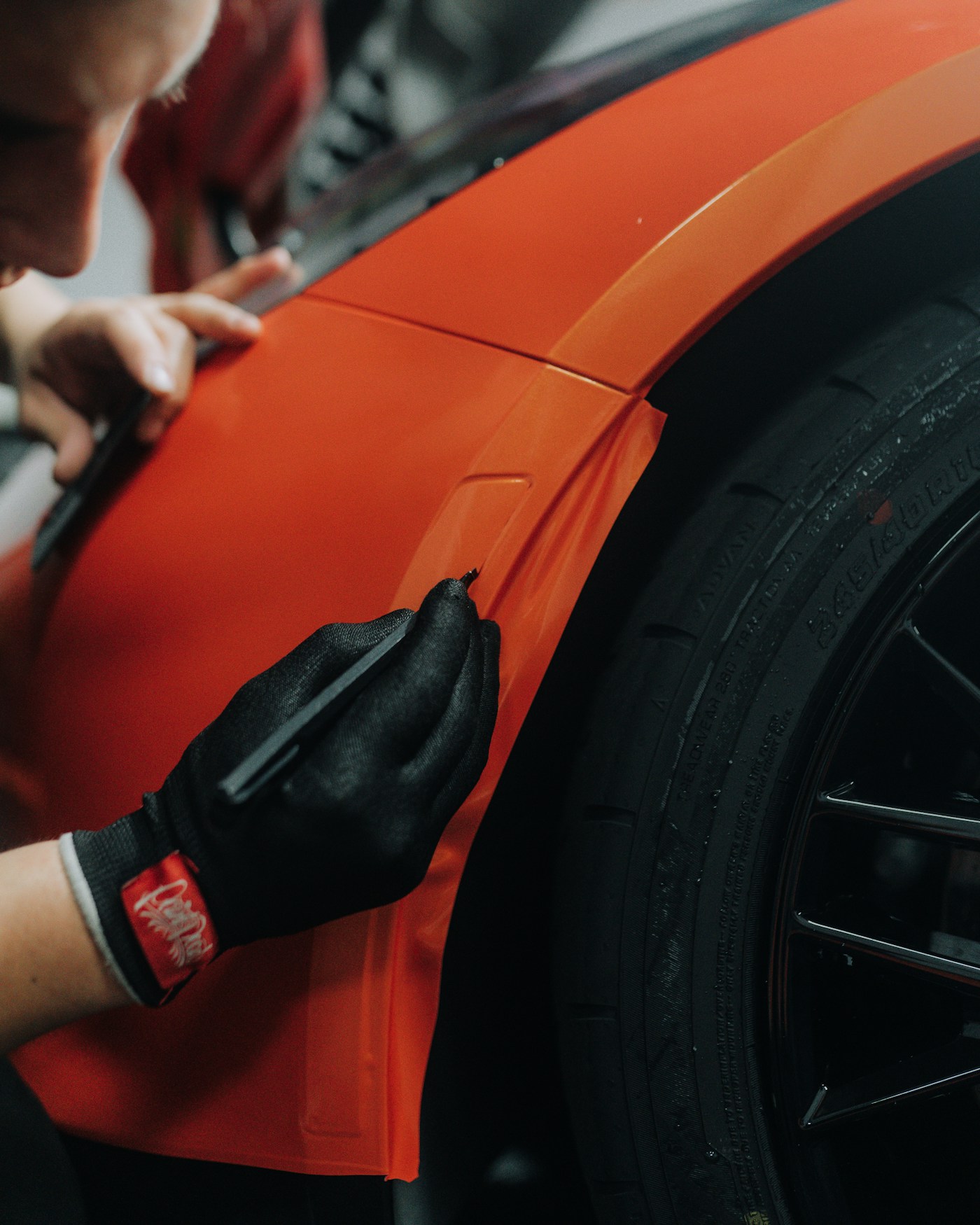
The useful metric is cost per branded year. Magnets are cheap to buy, get replaced every couple of seasons and need weekly maintenance. Lettering and decals cost more up front and then run unattended for years. Over a five-year vehicle the gap narrows far more than the sticker price suggests. Our vehicle wrap cost guide for Ottawa covers the full-coverage end, and the prep guide covers what has to happen to a vehicle before any adhesive graphic goes on. A pattern that works: magnets in year one while you find out whether vehicle branding pays, then move the winning layout onto a wrap once you know it does. The artwork carries straight over.
What they cost, and how long they last
A single 12″ × 18″ magnet starts around $25, and the per-unit price falls as the count rises — a matched pair for both front doors is the usual order, and a set for a fleet of ten costs noticeably less each than a one-off. Larger sizes and the 30-mil stock add to that. Treat those numbers as indicative rather than a rate card: live pricing updates in the studio as you change size, stock and quantity, and a written quote is free and comes with a mockup.
Lifespan is about care more than stock. Magnets that come off weekly, get washed on both sides and are stored flat stay presentable for a couple of seasons. Magnets left on all year through salt and sun look tired well before that. Worth putting that against the other branding you buy: a screen-printed crew tee runs roughly $12–$18 each at 50 pieces and lasts years of wear, so a magnet is not automatically the cheapest impression available. You can price a shirt run yourself in the online shirt designer and compare before deciding where the next few hundred dollars goes.
Two buying notes. Order a spare— the most common failure here is not wear, it is a magnet on the shoulder of a highway, and a single replacement costs more per unit than adding one to the original run. And order in pairs even if you think you need one, because a vehicle branded on one side reads as a mistake rather than a business.
Designing and ordering yours
Car magnets are one of the products you can build yourself online instead of emailing back and forth. Open the car magnet studio, pick your size, choose 25-mil or the 30-mil heavy stock, upload your logo, and the price updates as you go — no account and no deposit to reach a number. The studio shows the production window for your exact configuration before you pay. As a rule work leaves here within a few business days of you approving the mockup and paying, and outside the Ottawa–Gatineau area you should allow a day or two of transit on top. We do not promise a specific delivery date.
If your panel needs a size that is not on the list, or you want a contour cut to the shape of your logo, or you are doing a fleet set with different sizes per vehicle, that is a quote instead. Send your measurements and a photo of the door through the quote form, or read the vehicle magnets service page for what we can and cannot cut.
Either route, a human designer reviews the file before it prints. A real person checks resolution, colour, sizing and placement on the panel, then either fixes the file or tells you exactly what is wrong with it. That is not an automated preflight warning. Phone screenshots, a PNG off your website, a PDF from whoever made your business cards, even an AI-generated logo — send what you have and we clean it up or redraw it as vector.
One last thought on the wider kit. A magnet only works while the vehicle is moving or parked in sight. If the truck sits at a job all day, a jobsite sign or an A-frame on the sidewalk earns more per dollar than the door panel does, and the signs and banners hub covers the rest of that kit.
Frequently asked questions
Do car magnets damage paint?
Not on their own — the magnet has no adhesive. Damage comes from grit and moisture trapped underneath. Road sand worked back and forth by vibration causes fine scratching, trapped water can start rust over an existing chip, and a magnet left in one place for months leaves a ghost outline because the paint around it weathers while the paint beneath it doesn't. Take them off at least weekly, wash and dry both the panel and the back of the magnet, and never put one over a chip, a scratch or a fresh respray.
Will a vehicle magnet stay on at highway speed?
Yes, if it is sized to sit entirely on the flat part of the panel, applied to a clean dry surface, and has no lifted edge. It fails when a corner overhangs a body crease or a door handle recess and catches air, and that failure is instant rather than gradual. Walk around the vehicle and press the perimeter before a highway trip, use the 30-mil heavy stock on large magnets, and take them off for long high-speed drives in freezing weather.
How do I know if my vehicle's doors are magnetic?
Hold a fridge magnet against the exact spot where the graphic will go. Many modern vehicles use aluminum or composite doors, hoods and tailgates, and nothing magnetic will stick to those. Test every panel you plan to use and test the full footprint, because a door can be steel in the middle and something else at the pressed edge. If it fails, printed decals do the same job on the same panel.
How often should I take the magnets off?
At least once a week in normal conditions, and more often in an Ottawa winter when the roads are salted. Wash and dry both the door and the back of the magnet, let both dry fully, and reapply slightly off from where it sat before. Take them off entirely if the vehicle is going to sit unused for weeks.
Can I leave magnets on through a car wash?
No. Automatic brushes grab the edges and a pressure wand will get under a seam. Take them off before every wash — it doubles as the cleaning stop that protects the paint underneath. Store them flat and face-up rather than rolled or folded, because a crease in magnetic vinyl never fully flattens out again.
What size should a door magnet be?
Measure the flat, unbroken area of the panel inside the body lines and leave a couple of centimetres of margin on every side. 12″ × 18″ suits most work vehicles, 6″ × 12″ suits a car door, and 12″ × 24″ or 18″ × 24″ suits larger van and truck doors. For legibility, allow roughly one inch of letter height per ten feet of reading distance, and keep the layout to three things: the name, what you do, and the phone number.
Magnets or decals — which costs less over three years?
Magnets cost far less up front and more over time, because they are a consumable that gets replaced every couple of seasons and needs weekly maintenance. Decals and cut lettering cost more up front and then run unattended for years. Choose magnets when the branding genuinely has to come off — a lease, a personal car, a shared vehicle — and choose decals when it doesn't.
Does a person check my artwork before it prints?
Yes. Every order is reviewed by a human designer before it goes to press. A real person checks resolution, colour, sizing and placement on the panel, then either fixes the file or tells you exactly what is wrong with it. Send a phone screenshot, a website PNG, a PDF or an AI-generated image — we clean it up or redraw it as vector, and you approve a free mockup before anything prints.
Design it yourself. A human designer still checks every order.
Our free studio gives you the price and the mockup in the browser. What it doesn't do is print your file blindly — every order is reviewed by a real designer before it reaches the press.
- Step 1You design it — free
Upload your logo, drop it on a real garment, set the size and placement, pick colours and quantities. No account, no deposit, no waiting on a reply.
- Step 2A human designer checks it
Before anything prints, one of our designers opens your file and checks resolution, colours, sizing and placement. If it won't print well, we fix it or tell you exactly what's wrong — a person, not an automated preflight.
- Step 3You approve, then we print
You get the corrected mockup back on the actual product. Nothing goes to press until you say yes — then it's ready in 1–2 weeks, or in 1–3 business days with a rush.
Brand the truck today, take it off tomorrow
Build your car magnets online — pick the size, upload your logo, and watch the price update — or send us your door measurements and a photo and we'll lay it out for you. Free mockup before anything prints, and a real designer checks the file either way.
Every order is reviewed by a human designer before it goes to press. A person checks artwork resolution, colour, sizing and placement, and either fixes the file or tells the customer what is wrong — it is not an automated preflight.