
How to Choose the Best Custom Clothing Printing Company in Canada
“Best” is not a trophy, it is a checklist. The eleven things that actually separate a great Canadian custom apparel printer from a cheap one — and how to test each of them before you spend a dollar.
What 'best custom clothing printing in Canada' actually means
Every shop in the country says it's the best. The word is free, so it carries no information. What actually matters is whether a shop's setup matches the job you're bringing them — because a printer who is genuinely excellent at 2,000-piece screen runs can be completely wrong for your eight shirts due Thursday, and the friendly little studio that nails your eight shirts may be the wrong call for a 600-piece uniform rollout.
So the useful question isn't "who is the best custom apparel company in Canada." It's "which shop can I test in ten minutes and trust with this specific order." We print custom clothing in Ottawa and ship it across the country, so we obviously have a stake in your answer. That's exactly why this is written as a test you can run on any shop, including us. Every question below has a checkable answer. A shop that gets cagey about one of them has told you something useful.
Here is the whole checklist in one place. The rest of the article explains what each answer really means and what a bad one is hiding.
| Ask them this | Good answer sounds like | Warning sign |
|---|---|---|
| Do you print this in your own building? | Yes — here's the equipment we run | "We use production partners" |
| Can I see a mockup before I pay? | Free, usually the same day | Only after a deposit |
| What date will these be ready? | A date, tied to approval and payment | "A couple of weeks, usually" |
| What's your minimum order? | None on digital; a handful on screen | A big minimum on every method |
| My logo is a small JPEG — now what? | Opens it, tells you honestly, quotes the fix | "It'll be fine" (unopened) |
| Is this blank right for the job? | Suggests something better, explains why | Sells whatever is on the shelf |
| Who is handling my order? | A person's name and a reply time | A ticket number and silence |
| What's the all-in price? | Itemized, with tax and shipping shown | A per-shirt number and "plus fees" |
| Will a reorder next year match? | Art, blank and placement kept on file | "Just send the file again" |
| What if something arrives wrong? | A stated reprint policy and a window | No policy, or "all sales final" |
| Where are you, and how does it ship? | A real address and clear shipping terms | No address anywhere on the site |
You don't need all eleven for every order. For a dozen tees for a stag weekend, questions one through four and seven are the whole game. For a staff uniform program you'll be re-ordering for years, questions nine and ten quietly matter more than the per-piece price ever will.
1. Do they actually print it, or broker it out?
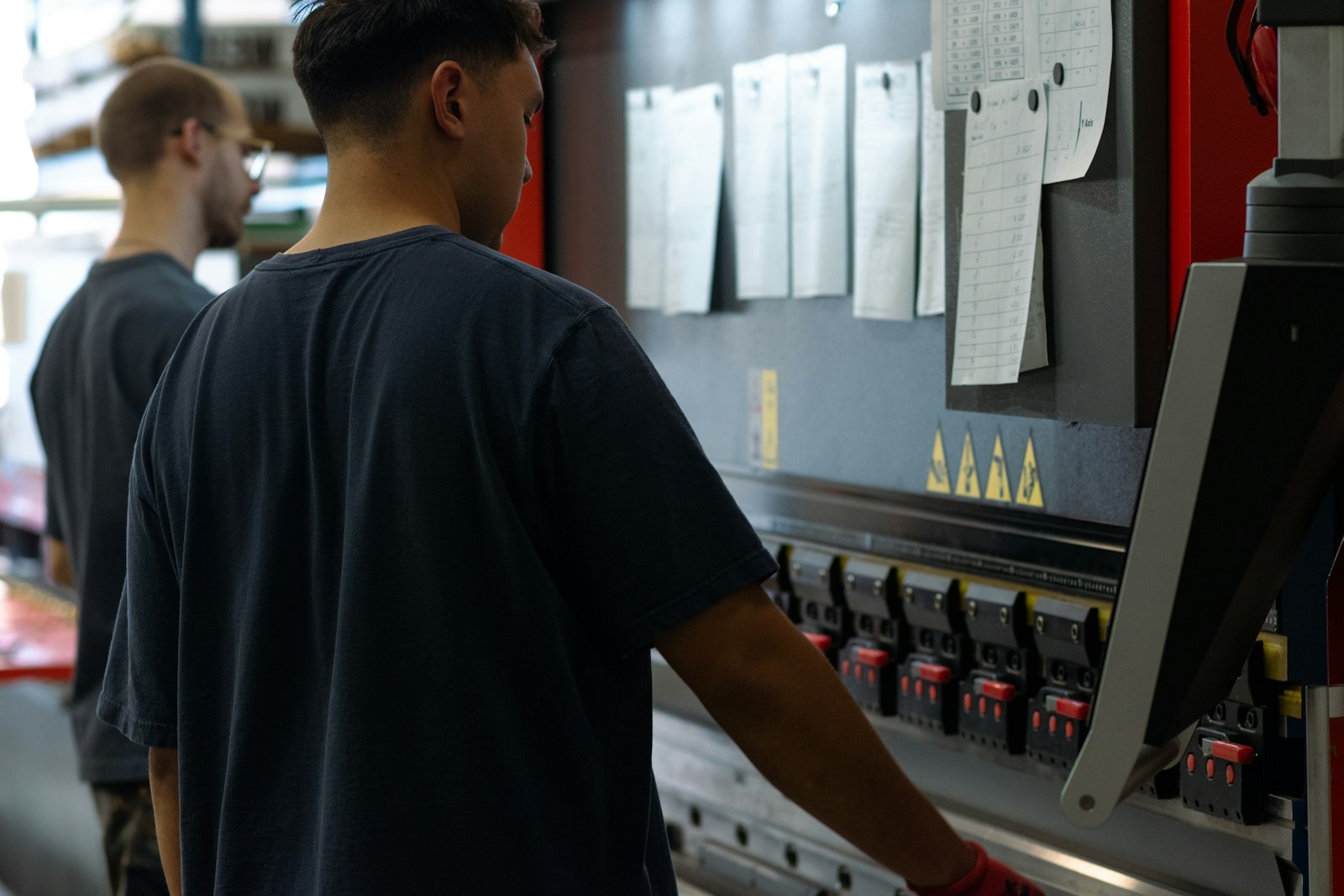
This is the first question because it silently determines the answer to half the others. A meaningful number of "printers" in Canada own no printing equipment at all. They take your order, mark it up, and send it to a contract shop in another province — or to an overseas supplier — and then relay messages back to you. Sometimes that works fine. But you are now two phone calls away from the person holding your shirts, and nobody in that chain can walk over to the press and look.
Ask it directly: "Is my order printed on your own equipment, in your own building? What machines do you run?"A shop that prints will answer casually and in detail, because it's just their Tuesday — they'll name the press, tell you which method they'd use for your art, maybe mention what's already on the schedule that week. A broker gets abstract fast: "our production network," "our partner facilities," "we handle all of that for you." That's not a lie, but it's an answer to a different question.
Why it matters in practice: rush jobs, changes mid-run, a colour that needs eyeballing against a garment, a customer who calls at 4pm to swap two mediums for two larges. All of those are trivial when the press is down the hall and nearly impossible when it's down the highway. Turnaround promises from a broker are really someone else's turnaround promises with a courier leg stapled on.
Our answer, for the record: everything is printed and stitched here in Ottawa, on our own gear, and has been since 2015. Nothing gets drop-shipped from overseas with our name on the packing slip. If you care about Canadian production specifically, be aware that "Made in Canada" claims are regulated and mean something specific about where a product was manufactured — a shirt printed here on an imported blank is a decorated import, and an honest shop will say so rather than blur the line. We go into that distinction properly in our guide to Canadian-made custom apparel.
2 and 3. A free mockup before payment, and a real date
You should see your design on the actual garment, in the actual placement, before any money changes hands.Not a description. Not "left chest, 3.5 inches." A picture. Roughly a third of the corrections we make happen at this stage, and they're almost always things nobody could have caught in words — a logo that reads fine on screen but disappears on a navy shirt, a print sized for an XL that swallows a youth small, a tagline that turns out to be one word longer than the design can carry.
A shop that charges you to see a placement mockup is charging you to find out what you're buying. (Charging to redrawa broken logo is a different and perfectly legitimate thing — that's real work, and it should be quoted up front.) If you'd rather not wait for anyone, you can build the mockup yourself in our free online design studio: upload a PNG, JPG, SVG or PDF, knock the background out in one click, drag, resize, rotate and centre it, add text in real print fonts, switch the garment colour, flip between front, back, left-chest and full-front placements, and check out straight from the screen. It runs on t-shirts, long sleeves, hoodies, polos, caps and onesies.
Then pin them down on time. Ask for a date, not an adjective. "Fast" and "a couple of weeks" are not schedules. Our standard turnaround is 2–5 business days after you approve the mockup and pay— both, not either. Rush work often lands in 1–2 business days. Same-day is genuinely possible for a small DTF or DTG run if you catch us early with clean art, but we will never guarantee it sight unseen, and neither should anyone else. A shop that promises same-day to a stranger on the phone is promising that nothing will go wrong today.
The other half of that honesty is on you: the clock starts at approval, not at enquiry. The single most common reason a two-day job becomes a five-day job is a committee sitting on the mockup. If your deadline is real, decide fast and pay fast — that's the part you control. Our full breakdown of where the days actually go is in how long custom apparel takes.
4 and 8. Minimums, and whether the quoted price is the price you pay
A shop's minimum order tells you what equipment it owns. If every method carries a 24- or 48-piece minimum, that shop is built around screen printing, where a screen has to be burned and registered for every colour in your design before the first shirt runs. That setup is real work, and spreading it over six shirts makes no sense for anyone — which is why our own screen printing has a practical floor around six pieces.
Digital printing has no such floor. There is no minimum on DTF or DTG — we will print one shirt, and there are no setup fees on DTF. So the honest test isn't "do they have a minimum" but "do they penalise a small order that doesn't need to be big." If a shop pushes you to 50 pieces for a design that a digital press would handle in an afternoon, they're solving their problem, not yours. Bulk pricing should be a reward for volume, not a toll gate. Ours starts kicking in around 50+ pieces. If you're genuinely torn between methods, read the best printing method for small orders or DTF vs screen printing.
Then there's the quote itself. The most common bad experience in this industry isn't a bad print — it's a number that grows between the estimate and the invoice. Ask for the line items, and check them against this:
| Line item | What it should look like |
|---|---|
| Digital mockup | Free, and sent before you pay anything |
| Screen setup | Charged per colour, per design — and zero on DTF |
| Artwork redraw | Only when your file can't be used, quoted first |
| Rush | Named up front, not discovered on the invoice |
| Second print location (back) | Roughly +$7 per piece |
| Embroidery instead of print | Roughly +$10 per piece |
| Shipping | Canada-wide, quoted for your postal code |
| Tax | Ontario HST at 13%, shown separately |
For scale: a basic one-colour screen print on a standard cotton tee runs roughly $12–$18 each at 50 pieces and can drop under $10 each in the hundreds. Small full-colour DTF runs sit a bit higher per piece but carry no setup cost at all, which is why they win on tiny orders. Every one of those numbers moves with the garment, the ink coverage and the number of placements, so treat them as a sanity check rather than a price list — the full picture is in our Canadian t-shirt printing cost breakdown.
5 and 6. What they do with your messy logo, and whether they'll talk you out of a blank
Almost nobody sends print-ready artwork. Most files arrive as a logo dragged off a website, a screenshot of a logo, or a PNG from a designer who left the company in 2019. That's normal. What separates shops is when they tell you.
Ask: "Open my file and tell me whether it will hold up at 11 inches wide."A good answer describes your actual file — its size, whether the edges are clean, whether the background is truly transparent, whether that thin script will survive a heat press. A bad answer is "yeah, that'll be fine" from someone who hasn't opened it, followed three days later by a box of shirts with a fuzzy logo on them. If a file genuinely can't be saved, a clean vector redraw is the fix, and it should be quoted before anything prints — that's what our vectorization service is for. If you want to arrive with a clean file in the first place, follow how to prepare logo files for printing.
The garment side of this is the same test in a different costume. A shop with a huge catalogue isn't automatically better; a shop that will tell you no is. There are combinations that genuinely fight each other: heavy plastisol on a thin performance poly can suffer dye migration, dense full-front prints stiffen a lightweight tee, fine embroidery on a loose knit needs the right backing or it puckers, and a gradient-heavy logo is happier on a printed tee than stitched into embroidery.
So ask what they'd change about your order. If the answer is "nothing, sounds great," either your order is genuinely straightforward or nobody looked. We would rather spend five minutes on the phone steering you off a blank that will disappoint you — a high-visibility spec that needs certified fabric, a workwear garment that has to survive industrial laundry, a cap whose crown is too soft for the logo you want on it — than take the order and hear about it later. Fabric choice drives more of the final result than most people expect; our fabric guide covers the trade-offs.
7. The best custom t-shirt printing company in Canada answers the phone
Run this test on every shop on your list: send the same question by email at nine in the morning and see who replies before lunch. Pre-sale response time is the most reliable predictor of what support looks like after you've paid, because a shop is never faster at anything than it is when it's trying to win you.
Call, too. Not for the answer — for the texture. Does a person pick up? Do they know what DTF is without transferring you? Can they tell you, roughly, what's on the press this week? Our number is 613-666-9292 and a human answers it. Quotes generally go back the same business day, and once your job is live it belongs to one named person here, so you never have to re-explain your order to whoever picks up next.
The thing worth paying for, though, isn't politeness. It's a shop that will tell you when you're about to make a mistake. Real examples from ordinary weeks: someone ordering 40 shirts who'd have paid less at 55 because of where the volume break sits. A three-colour design that loses nothing at two colours and gets meaningfully cheaper on screen. A team ordering slim-cut blanks with a size run that goes to 3XL, where the fit will land badly on half the group. A back print that nobody will see because the group is sitting down all day.
None of that comes out of a checkout page. It comes out of someone reading the order and caring about the outcome, and it is the single biggest practical difference between a quote from a person and an automated one. If you're organising for a group, our group order guide covers the coordination side that trips up most first-timers.
9 and 10. Reordering a year later, and what happens when something goes wrong
This is the criterion nobody thinks about until it bites. You order 60 staff polos in March. In February the following year you hire six people and need six more that look identical. If the shop kept nothing, you're rebuilding the job from memory — and "navy" is not a colour, it's a category. The new six arrive slightly different and now everybody can see who started last year.
Ask: "If I call you in fourteen months, what will you have on file?" The answer you want is specific: the artwork, the exact blank style number and colour code, the print or stitch placement measured from the collar, the ink or thread colours, and the size breakdown you ordered last time. We keep all of that, which is why a reorder is usually a two-line email rather than a whole conversation. The practical routine is in how to reorder company uniforms.
The related question is what happens on a bad day, because occasionally there is one. A press misfires, a size gets miscounted into a box, a courier loses a week. What separates shops is not whether that ever happens — it's whether they told you the policy before you paid. Ask outright: "If a piece comes out wrong, what do you do, and how long do I have to tell you?"A shop that answers plainly has thought about it. A shop that goes quiet, or points at "all sales final" on custom goods without qualification, has told you how the bad day will go.
Our version: tell us, send a photo, and we sort it — reprint or refund on anything we got wrong. The honest flip side is that an approved mockup is a shared decision. If a typo went out in the design and both of us signed off on it, that's a reprint we'll help you with, not a defect. Which is a good reason to read your mockup once more before you hit approve, ideally out loud.
11. 'Custom clothing printing near me' in a country this size
People search for a printer "near me" and then apply the wrong logic to the results. Proximity matters far less than you'd think for the printing itself — the press doesn't care where you live — and far more than you'd think for the timeline, because every kilometre between the shop and your door is a day of transit risk sitting on top of the production time.
Ask for a physical address.Not a service-area map, not a list of cities — a street address where the equipment lives. It is a remarkably effective filter. Shops that print have addresses; storefronts that resell often don't. Ours is in Ottawa, and if you're in the National Capital Region you can skip couriers entirely: free local pickup and delivery across Ottawa, Kanata, Barrhaven, Nepean, Orléans, Stittsville and Gatineau. For everyone else we ship Canada-wide, with the freight shown on your quote before you pay.
Build the transit leg into your deadline rather than discovering it. Production and shipping are two separate clocks: a job that leaves the shop on Tuesday still has to cross the country, and published transit times stretch as the distance grows. Ottawa to Toronto is not Ottawa to Whitehorse. When somebody asks us for a hard event date, we quote the ready date and the ship window together, because quoting only the first one is how people end up with shirts arriving the Monday after the tournament. More on that in shipping custom apparel across Canada.
One last practical note: if your order is big, awkward or split across multiple sites — several branches, several teams, a conference and a head office — ask how they handle split shipments before you order, not after. A shop that does it routinely will have an opinion. A shop that doesn't will improvise with your deadline.
When a print-on-demand marketplace is genuinely the better choice
An article like this is supposed to end by saying you should always use a real shop. You shouldn't. There are cases where a big print-on-demand marketplace is the right answer and we'll say so on the phone rather than take an order we're wrong for.
- One novelty item for yourself.A single mug-joke shirt for your brother's birthday doesn't need a mockup call, a fabric conversation or a reorder record.
- You're dropshipping a storefront. If you want 40 designs listed across a dozen colourways with zero inventory and automatic fulfilment when someone buys, that is exactly what those platforms are built for. Most of them print direct-to-garment, one piece at a time, on demand.
- You're purely testing designs. No stock risk while you find out which idea people actually click on.
What you trade away is worth knowing before you choose. Per-piece cost is higher at any real quantity. You take whatever blank the platform stocks. Colour consistency between batches is nobody's promise. There is no one to call when the shipment is late, and there is no institutional memory of your order — a reprint in a year is a fresh roll of the dice. For a novelty tee, none of that matters. For anything a group wears together, all of it does.
The line is roughly this: a marketplace is right when the shirt is the whole product; a print shop is right when the shirt represents something — a company, a team, a brand, a wedding party, a fundraiser. The moment the pieces need to match each other, match last year, arrive by a specific date, or survive a work week, you want an actual production shop with a name on your job. That's also when the gap between a good and a bad print quality decision starts showing up in the wash.
Run the eleven questions. Whoever answers all of them plainly, without hedging, is the best custom clothing printing company in Canada for your order— and that's the only version of "best" that spends. If you'd like to run them on us, the phone is 613-666-9292 and the email is order@yayaprints.ca.
Frequently asked questions
How do I choose the best custom t-shirt printing company in Canada?
Test three things before you pay. First, ask whether they print on their own equipment in their own building, or broker it out to someone else. Second, insist on a free mockup showing your design on the actual garment before any money moves. Third, ask for a specific ready date rather than 'a couple of weeks'. A shop that answers all three plainly will almost always be straight with you about price, minimums and problems too.
What questions should I ask a custom apparel printer before ordering?
The high-value ones are: do you print in-house? Is the mockup free and before payment? What exact date will this be ready? What is your minimum? Will you open my logo file and tell me if it will print well? Who specifically handles my order? What is the all-in price including tax and shipping? Will a reorder next year match? And what happens if a piece arrives wrong? Vague answers to those questions are the answer.
Is it better to use a local print shop or an online print-on-demand site?
It depends on what the shirt is for. Print-on-demand wins for a single novelty item or for dropshipping a store with no inventory. A real print shop wins whenever the pieces have to match each other, match a reorder next year, arrive by a hard deadline, or hold up to real wear. As a rule of thumb: a marketplace is right when the shirt is the product, and a shop is right when the shirt represents a group.
How much should custom t-shirt printing cost in Canada?
As a sanity check, a basic one-colour screen print on a standard cotton tee runs roughly $12 to $18 each at 50 pieces and can drop under $10 each in the hundreds. Small full-colour digital runs sit a little higher per piece but carry no setup cost. Adding a back print is about $7 more per piece and embroidery about $10 more. Ontario HST is 13%. Garment choice, ink coverage and placements move all of it.
Do custom clothing printers have a minimum order?
It depends entirely on the method, which is why the answer varies so much between shops. Digital methods like DTF and DTG have no minimum at all - we will print a single shirt with no setup fee. Screen printing has a practical floor around six pieces because a screen has to be made for every colour before the first shirt runs. Bulk discounts typically start around 50 pieces. A shop with a large minimum on every method simply owns one kind of equipment.
How long does custom apparel take to get printed and shipped in Canada?
Our standard turnaround is 2 to 5 business days after you approve the mockup and pay, and rush work often lands in 1 to 2 business days. Same-day is possible for small digital runs with clean artwork but is never guaranteed. Then add shipping time on top: production and transit are two separate clocks, and distance across Canada matters. Always ask a shop for the ready date and the ship window together, not just the first one.
Design it yourself. A human designer still checks every order.
Our free studio gives you the price and the mockup in the browser. What it doesn't do is print your file blindly — every order is reviewed by a real designer before it reaches the press.
- Step 1You design it — free
Upload your logo, drop it on a real garment, set the size and placement, pick colours and quantities. No account, no deposit, no waiting on a reply.
- Step 2A human designer checks it
Before anything prints, one of our designers opens your file and checks resolution, colours, sizing and placement. If it won't print well, we fix it or tell you exactly what's wrong — a person, not an automated preflight.
- Step 3You approve, then we print
You get the corrected mockup back on the actual product. Nothing goes to press until you say yes — then it's ready in 1–2 weeks, or in 1–3 business days with a rush.
Run the checklist on us
Send your artwork, sizes and deadline and you will get a free mockup, an itemized price with tax and shipping shown, and a real ready date - usually the same business day. Printed in Ottawa, shipped Canada-wide, with the freight shown up front.
Every order is reviewed by a human designer before it goes to press. A person checks artwork resolution, colour, sizing and placement, and either fixes the file or tells the customer what is wrong — it is not an automated preflight.