
Custom Long-Sleeve Shirts: When They Beat a Tee, and How to Print the Sleeves
A long sleeve is the right buy at 5 to 15 degrees, when arms need covering on a job site, or when the sleeve print is the design. Expect a few dollars more than the same artwork on a tee — it carries about 30% more fabric — and remember a sleeve is a separate print location with its own screen and its own pass on the press.
- Design it yourself
- The long-sleeve tee is one of the garments you can build free at yayaprints.ca/mockup-creator — pick a colour, drop artwork on the front, the back or either sleeve, set your size run and order online. No account, no deposit.
- Human designer check
- Every order is reviewed by a real designer before press. A person checks resolution, colour, sizing and placement, and either fixes the file or tells you exactly what is wrong. It is not an automated preflight.
- Sleeve print size
- Sleeve artwork is sized to a box roughly 3.5 inches wide, starting about 1 inch below the shoulder seam. Both sleeves can carry different designs.
- Minimums
- None on DTF or DTG — one long sleeve is fine. Screen printing starts around 6 pieces and gets good past 24 to 50.
- Indicative pricing
- A printed long-sleeve tee usually lands a few dollars a piece above the same design on a short-sleeve tee, with volume breaks at 12, 24, 50 and 100 pieces. Live prices show in the studio and quotes are free.
- Colours and fabric
- More than two dozen stock colours including Safety Green and Safety Orange, in cotton, a 50/50 blend or polyester — the blend and polyester carry a small per-piece upcharge.
- Turnaround
- 2 to 5 business days after mockup approval and payment, plus 1 to 2 days transit outside the Ottawa-Gatineau area. Printed in-house in Ottawa and shipped Canada-wide.
Three different reasons to buy one, three different shirts
Nobody buys a long sleeve the way they buy a tee. A tee is a default. A long sleeve is bought for a reason, and there are really only three of them — warmth, coverage, or the look. The mistake that costs people money is picking one garment for all three.
Warmth, as a light layer.This is the shoulder-season shirt: the thing somebody grabs at 9 °C in October instead of a hoodie, and the thing they wear under the hoodie in January. If that is the job, you want a mid-weight cotton or a blend and a cut with a bit of room in the body, because it will spend half its life with something over top. It is not a thermal and it should not pretend to be one. If real warmth is what you actually need, you are shopping for a crewneck sweatshirt or a hoodie, not a long-sleeve tee.
Coverage, for outdoor work.Landscapers, roofers, trades crews, camp staff and anybody working a summer shift outdoors wear long sleeves in July on purpose — sun, scratches, bugs and hot surfaces are all worse on a bare forearm than a covered one. Here the fabric matters more than the fit: a polyester or blend sheds sweat instead of holding it, and high-visibility colours are the point rather than a style choice. Safety Green and Safety Orange are both stock colours, and if the job needs certified striping rather than a bright shirt, that is a different garment — see hi-vis workwear.
The look, for merch and retail. The third buyer does not care about temperature at all. A long sleeve gives you two extra printable surfaces that a tee does not have, and for streetwear, bands, cafes and school merch the sleeve hit is frequently the whole design. That is a genuinely different product from the two above, and it is worth spending more on the blank, because this shirt is being sold rather than handed out. Everything we make in this category lives on the custom long-sleeve shirts page.
Why the same cotton feels heavier in a long sleeve
Blank tees are described in ounces per square yard — 4.3 oz for a light fashion tee, 5.3 to 6 oz for a standard one. People assume that number tells them how warm the shirt will be. It does not, because it is a measure of the fabric, not of the garment.
A long-sleeve tee in exactly the same 5.3 oz jersey as your short-sleeve tee uses somewhere around 30 to 40% more of it, most of that wrapped around the part of the body that loses heat fastest. That is why a long sleeve ordered on the strength of "same fabric as the tees we liked" almost always arrives feeling heavier and warmer than people expected. It is also, incidentally, most of the reason it costs more: you are paying for fabric by area, and there is more area.
So pick weight against the job, not against the tee you already own. If the shirt is going under something, go lighter than your instinct — a heavy long sleeve under a hoodie is a sauna, and it will not get worn twice. If it is the outer layer at an October market or a spring tournament, mid-weight cotton is the sweet spot. If it is a work shirt for hot days, polyester or a 50/50 blend beats cotton outright, because wet cotton stays wet.
You choose that fabric per garment in our free design studio — cotton is the baseline, and the blend and polyester carry a small flat upcharge per piece. One caution on polyester: some poly dyes migrate under press heat and can tint a light print pink or grey days after it ships. That is managed with the right ink and cure temperature, and it is a good reason to say "this is polyester" when you order rather than letting us find out. There is more on blanks in our guide to choosing t-shirt fabric for printing.
Cuffs, hems, and the parts nobody looks at until they fail
The single biggest quality difference between two long sleeves that look identical in a photo is the cuff, and it is the part almost no buyer asks about.
A ribbed cuffis knit separately in a 1x1 rib — usually with a little spandex — and sewn on. Rib has recovery: it stretches over a hand and pulls back. That is what keeps the sleeve from creeping up a forearm all day, and it is what makes a shirt still look like a shirt after forty washes. A plain hemmed cuff, where the sleeve is simply turned under and stitched, is cheaper, reads more relaxed and modern, and has no recovery at all. Push those sleeves up once and they stay pushed up; after a season they gape.
Neither is wrong. A rib cuff is the right call for work shirts, kids, anything worn under a jacket, and anything you want to survive being pushed up and pulled down twenty times a shift. A hemmed cuff suits retail and merch, where the drape matters more than the recovery. Fleece garments like a crewneck sweatshirt almost always use rib at the cuff and waist for the same reason.
Two more construction details are worth knowing. Side-seamed shirts have a seam running down each side and hold a shape close to the body; tubular shirts are knit as a cylinder, cost less, and can twist slightly after a few washes. And set-in sleeves— the seam sitting at the edge of the shoulder — give you a clean flat panel to print on, where a raglan seam runs diagonally through the area a chest logo wants to sit. If your design is going near the shoulder, set-in is the easier garment.
Whatever the cuff, keep the print off it. Ribbing is under constant tension and any printed film sitting on it will crack along the ribs long before the same print on the body would — which is also why how you wash a printed shirt matters more on a long sleeve than on a tee.
Fit: the shoulder seam and the sleeve-length problem
A long sleeve is the one garment where the wrong size is visible from across a room. On a tee, a size out is a bit baggy. On a long sleeve, the cuff sits over somebody's knuckles or halfway up their forearm, and everybody can see it.
The reason is that a size run does not scale evenly. Going up a size adds a couple of inches of chest but only about half an inch to three-quarters of an inch of sleeve, so arm length changes far more slowly than body width. A tall, slim wearer who normally takes a medium tee will often want a large in a long sleeve purely for reach — and then swim in the body. There is no fix for that in a unisex blank; there is only knowing it before you order forty of them.
Two practical rules. First, the shoulder seam belongs at the edge of the shoulder, where the arm starts. If it has slid down the bicep, the shirt is too big, and every print on it is now sitting in the wrong place too. Second, cotton shrinks in length more than in width, so a shirt that fits at the cuff on day one is shorter in the arm after a hot wash. Long-sleeve runs come in S through 3XL in our studio, with a small upcharge on 2XL and up, which is standard across the trade because the blanks genuinely cost more.
For a group order, the fastest way to get sizes right is to stop guessing: have people measure a long sleeve they already own and wear, rather than naming a letter. Our guide to organising a group apparel order has a collection process that works, and you can enter the whole size run in the studio size grid and see the total update before you commit to anything.
Sleeve printing: why it is a separate location, and why it costs
Here is the thing that surprises most first-time buyers. Adding a small logo to a sleeve is not a minor tweak to the front print. It is a second print location, and print shops price by location for a very physical reason.
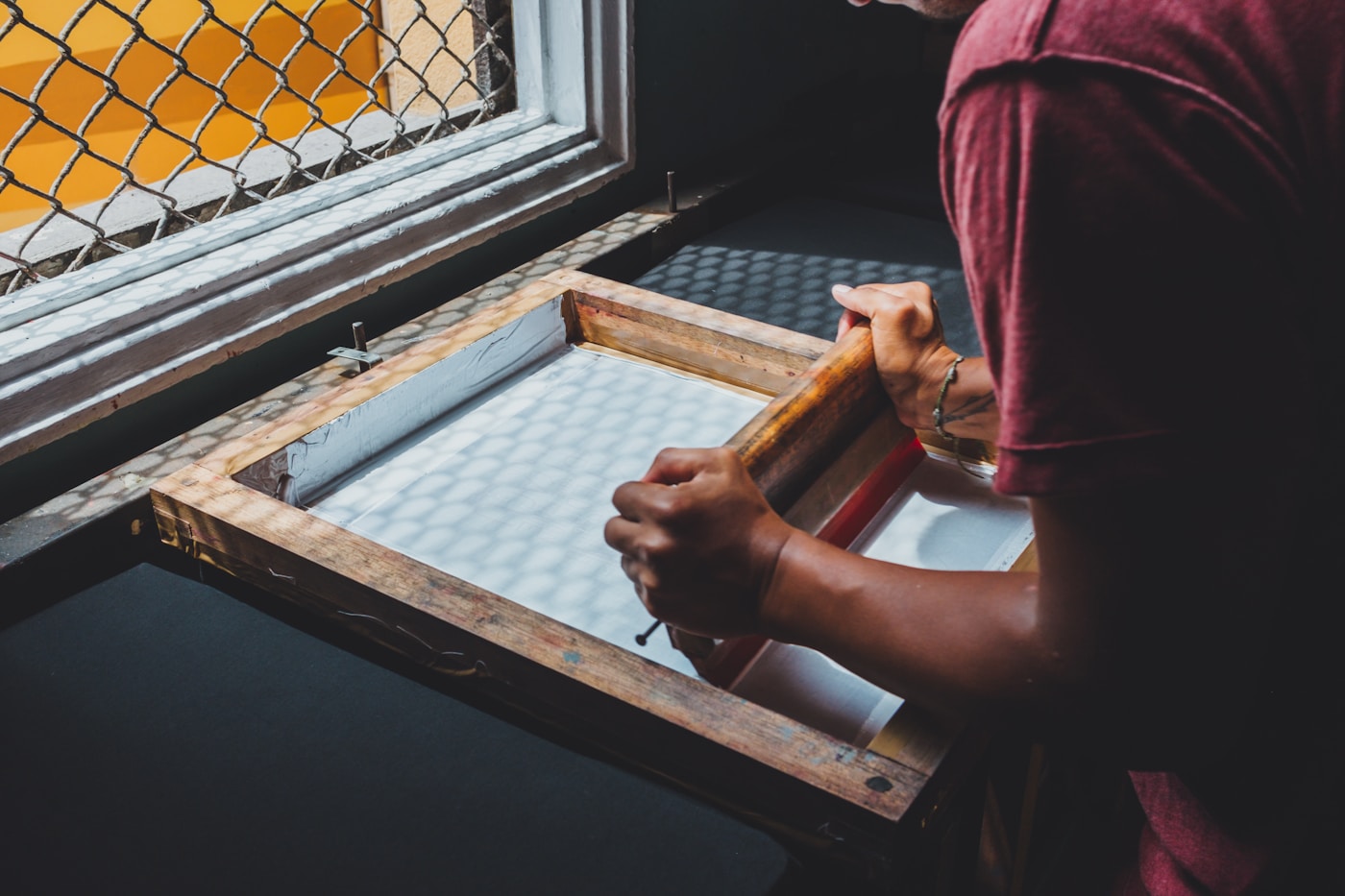
On a screen press, every colour in every location gets its own screen, burned and registered independently. So a one-colour chest and a one-colour sleeve is a two-screen job, not a one-screen job. Then the garment has to physically come off the standard platen and go onto a narrow sleeve platen, which means re-loading every shirt in the run a second time. That is labour, and at 24 pieces it is noticeable labour.
The sleeve itself is also a harder surface than a chest. It is narrow, it is curved, most sleeves carry an underarm seam, and the fabric will not lie perfectly flat under the mesh — and screen printing depends on flat. Anywhere the surface lifts, the squeegee skips and the ink film goes thin. A two-colour design has to register on top of itself in a space three or four inches wide with nowhere to hide a misalignment. None of this is impossible; it is simply slower and fussier per shirt than the same graphic on a flat front panel, and the price reflects that.
DTF handles sleeves far more easily, and that is why most sleeve work in our shop goes that way. DTF prints the design onto film first and heat-presses it on, so nothing has to be registered on the garment at all. A small heat platen slides into a sleeve, the press only has to close on a few square inches, the transfer conforms around a seam instead of fighting it, and a full-colour sleeve costs the same as a one-colour sleeve. There is no setup, so a run of twelve is viable. If you want the two methods compared properly, we wrote DTF versus screen printing.
The other two methods are more limited here. DTG sprays ink into the fibres and needs the garment stretched flat over a platen, so sleeve printing is possible but awkward and the printable area is small — DTG earns its keep on chests and full fronts. Embroidery looks excellent on a sleeve, and the constraint is hooping: a narrow sleeve needs a small tubular hoop, which caps how large the design can be. A crest or a monogram above the cuff is a natural fit. A five-inch logo is not.
Where sleeve prints actually go
There are three conventional sleeve placements, and they are not interchangeable, because each one is visible at a different moment.
- Upper arm. The classic staff and sponsor spot, sitting an inch or so below the shoulder seam and running about 3 to 3.5 inches wide. It reads when someone is standing with their arms down, which is most of the time, and it is high enough to stay clear of a rolled sleeve.
- Forearm, above the cuff. The retail placement. It disappears when arms hang and appears the moment somebody folds their arms or puts their hands in their pockets. Keep it well clear of the cuff rib.
- Full sleeve, down the seam. A long narrow panel of type or graphics running the length of the outer arm. It is the loudest thing you can do to a long sleeve and it is almost always a DTF job, because a screen setup for a panel that shape is a specialty exercise.
Orientation follows from that. A graphic set across the arm reads when the wearer faces you; a graphic running down the length of the arm reads when the arm hangs, which is the streetwear look. Either works, but a wide horizontal logo squeezed onto a curved three-inch surface will always look cramped, and the fix is usually to redraw it stacked rather than to shrink it.
Left or right is genuinely up to you — there is no industry law, only consistency across your own order. In the design studio you can switch on the sleeve view and place the two sleeves independently, so a sponsor mark on one arm and a number on the other is a normal thing to build rather than a special request. Our chest logo size guide covers the front measurements that go with it, and most of the hoodie placement guide transfers straight across, minus the pocket problem.
What it costs, and where the money actually moves
Treat every number here as indicative rather than a rate card — the real figure depends on the blank, the method, the number of locations and the quantity, and live prices update in the studio. But the shape of the pricing is stable and worth understanding.
The blank is the first step up. A printed long-sleeve tee typically lands a few dollars a piece above the same design on a short-sleeve tee, for the fabric reason above. Volume breaks land at 12, 24, 50 and 100 pieces, which is the same ladder as our t-shirt printing — for context, a screen-printed tee runs roughly $12 to $18 each at 50 pieces and drops under $10 in the hundreds, and our cost breakdown explains what sits inside those numbers.
The second location is the second step.On a screen job, a chest plus a sleeve means an extra screen and an extra pass, so at low quantities the gap between one location and two is real; past 50 pieces it spreads thin and stops mattering much. On DTF, the extra location costs transfer material and a second press cycle instead of a setup, so the step is smaller and flatter — which is exactly why small full-colour sleeve runs go that way.
Everything else is predictable.Embroidery runs about $10 a piece over a plain garment, plus a one-time digitizing charge the first time a logo is stitched. Extended sizes from 2XL up carry a small per-piece upcharge. Ontario HST is 13%. Nothing gets quoted without a mockup, and the quote itself is free — if your job is unusual or you want a blank we do not stock, send the details through the quote form and you will get a real answer rather than a configurator error.
Designing one, and the human who checks it
You do not need to email anyone to get a price on this. The long-sleeve tee is one of the garments you can build yourself in our free online studio: pick the long sleeve, pick from more than two dozen stock colours, upload a logo or set print-quality text, place it on the front, the back or either sleeve, enter the size run, and order online. No account, no deposit, and the mockup costs nothing whether you buy or not.
Two file notes save most of the back-and-forth. Resolution is about the printed size, not the pixel count: aim for about 300 pixels per inch at the size the thing will actually print, which for a 3.5-inch sleeve graphic means roughly 1,000 pixels across. And send a transparent PNG or a vector file, because a JPG carries a white rectangle behind it and on a navy sleeve that rectangle prints. Our guides to preparing logo files and vectorization cover the rest.
And if your file is not perfect, it is still fine to send. Every order here is reviewed by a human designer before it goes to press — a real person checks resolution, colour, sizing and placement, and either fixes the file or tells you precisely what is wrong. Not an automated preflight that rejects your upload at midnight. Phone screenshots, website PNGs, PDFs and AI-generated images all arrive here regularly; we clean them up or redraw them as vector. That is the safety net that makes designing it yourself a reasonable thing to do.
The Canadian argument for ordering long sleeves
In Ottawa the long-sleeve window is wider than the hoodie window at both ends. Roughly mid-September through mid-November and again from March into May, the temperature sits in the range where a hoodie is too much and a tee is not enough — and that is a lot of outdoor markets, tournaments, orientation weeks, festivals, and job sites. A long sleeve is the shirt people actually reach for on those days, which is another way of saying it gets more wears per dollar than the garment beside it on the shelf.
The practical move for most organisations is to run one artwork across two garments: tees for the summer, long sleeves for the shoulder seasons, with the same logo and the same colours. DTF treats both blanks identically, so a mixed order does not mean two setups, and it means nobody is stuck handing out short sleeves at a 6 °C October event. Crews that work outdoors year-round usually run the same logo across long sleeves and workwear or winter jackets for the same reason.
On timing: standard turnaround is 2 to 5 business days after you approve the mockup and pay, plus 1 to 2 days transit if you are outside the Ottawa-Gatineau area. September and the run into December are the busy stretches for apparel, so a fall order placed in August is a calmer order than the same one placed in October. Rush production is available on most apparel jobs, and we would rather tell you honestly that a date is not realistic than take the order and miss it.
One last note if you are ordering for a family or a school: our studio's youth line covers youth tees, youth hoodies and onesies rather than youth long sleeves, so small sizes in this garment are a quote item — see kids and baby apparel for what the studio does build, and ask us for anything outside it. Everything else lives on the long-sleeve shirts service page, or start from uniforms if the shirt is one piece of a bigger kit.
Frequently asked questions
How much do custom long-sleeve shirts cost?
Treat any single number as indicative — it moves with the blank, the method, the number of print locations and the quantity. As an anchor, a printed long-sleeve tee usually lands a few dollars a piece above the same design on a short-sleeve tee, and a screen-printed tee runs roughly $12 to $18 each at 50 pieces. Volume breaks land at 12, 24, 50 and 100 pieces, extended sizes from 2XL up carry a small upcharge, and Ontario HST is 13%. Quotes are free and include a mockup.
Can you print on the sleeve of a shirt?
Yes, on the upper arm, on the forearm above the cuff, or as a full panel running the length of the outer sleeve. Sleeve artwork is sized to a box roughly 3.5 inches wide starting about an inch below the shoulder seam, and the two sleeves can carry different designs. The one place we will not print is the cuff rib itself, because ribbing is under constant tension and any print sitting on it cracks along the ribs.
Does a sleeve print cost extra?
Yes, because it is a separate print location rather than a bigger version of the front print. On a screen press each location needs its own screen and its own pass, and every shirt has to be re-loaded onto a narrow sleeve platen, so at low quantities the difference between one location and two is real. On DTF the step is smaller and flatter, since there is no setup and the extra cost is transfer material plus a second press cycle. Past about 50 pieces on a screen run, the gap spreads thin.
What is the minimum order for custom long-sleeve shirts?
There is no minimum on DTF or DTG — one long sleeve is genuinely fine and the per-piece price does not jump because you only wanted one. Screen printing has a practical minimum of about 6 pieces, because screens have to be burned and set up regardless of how many shirts you run, and it starts making real financial sense past 24 to 50 pieces. Embroidery has no hard minimum, but digitizing your logo is a one-time setup charge.
Should I screen print or use DTF on a long sleeve?
Quantity and location decide it. A simple one- or two-colour design on 50 or more shirts, printed on the chest or back, is a screen job — the ink sits brighter and the per-piece price drops steeply. Anything under about 20 pieces, anything full-colour or photographic, and most sleeve work goes to DTF, because there is no setup and a heat platen handles a narrow curved sleeve far more easily than a screen does. Show us the artwork and the quantity and we will tell you which one we would run.
Do long-sleeve shirts fit like t-shirts?
In the body, mostly yes. In the arm, not really. Going up a size adds a couple of inches of chest but only about half an inch to three-quarters of an inch of sleeve length, so tall wearers often need a size up purely for reach and then find the body loose. The shoulder seam should sit at the edge of the shoulder, not down the bicep, and cotton shrinks in length more than in width, so a cuff that fits on day one sits a little shorter after a hot wash. For group orders, have people measure a long sleeve they already own rather than naming a letter.
Can I design a custom long-sleeve shirt online?
Yes. The long-sleeve tee is one of the garments you can build free at yayaprints.ca/mockup-creator — pick a colour from more than two dozen stock options, upload a logo or add print-quality text, place it on the front, the back or either sleeve, enter your size run and order online. No account and no deposit. Every order is then reviewed by a human designer before press, who checks resolution, colour, sizing and placement and either fixes the file or tells you exactly what is wrong.
How long does a custom long-sleeve order take?
Standard turnaround is 2 to 5 business days, counted from when you approve the free mockup and pay rather than from when you first get in touch. Add 1 to 2 days of transit outside the Ottawa-Gatineau area. Rush production is available on most apparel jobs. Everything is printed in-house in Ottawa and shipped Canada-wide, so there are no customs holds or duties on the way to you.
Design it yourself. A human designer still checks every order.
Our free studio gives you the price and the mockup in the browser. What it doesn't do is print your file blindly — every order is reviewed by a real designer before it reaches the press.
- Step 1You design it — free
Upload your logo, drop it on a real garment, set the size and placement, pick colours and quantities. No account, no deposit, no waiting on a reply.
- Step 2A human designer checks it
Before anything prints, one of our designers opens your file and checks resolution, colours, sizing and placement. If it won't print well, we fix it or tell you exactly what's wrong — a person, not an automated preflight.
- Step 3You approve, then we print
You get the corrected mockup back on the actual product. Nothing goes to press until you say yes — then it's ready in 1–2 weeks, or in 1–3 business days with a rush.
See your logo on the sleeve before you pay for it
Pick a long-sleeve tee, choose from more than two dozen colours, drop your artwork on the front, the back or either sleeve, and set your size run — then see the price before you decide anything. The mockup is free, printing is in-house in Ottawa, and shipping is Canada-wide.
Every order is reviewed by a human designer before it goes to press. A person checks artwork resolution, colour, sizing and placement, and either fixes the file or tells the customer what is wrong — it is not an automated preflight.