
Campaign T-Shirts and Volunteer Apparel: Outfitting a Team That Knocks Doors
Volunteer apparel is a canvassing tool, not merch — it tells a household who is on the porch before anyone speaks. Here's what belongs on a canvasser tee, why late-October Ottawa needs a warm layer, how to size a roster that keeps growing, and how to top up with no minimum as volunteers join.
- Voting day 2026
- Monday, October 26, 2026. Ontario municipal elections are held the fourth Monday of October, and the new council term begins Sunday, November 15, 2026.
- Campaign experience
- We have produced campaign materials for mayoral and city-council campaigns — signs, door hangers and volunteer apparel — and we know how the season actually runs.
- Turnaround
- 2–5 business days after mockup approval and payment. Rush production is available on most apparel jobs, so a late roster is usually still printable.
- Minimum order
- No minimum on DTF or DTG. Six extra shirts for volunteers who joined in week three is an ordinary order, and the per-piece price does not spike because the quantity is small.
- Human designer check
- Every order is reviewed by a human designer before it goes to press. A person checks artwork resolution, colour, sizing and placement, and either fixes the file or tells the customer what is wrong — it is not an automated preflight.
- Typical cost
- Roughly $12–$18 per screen-printed tee at 50 pieces, dropping under $10 each in the hundreds. A mid-weight fleece hoodie with one print location usually lands around $35–$55.
- Sign rules vary by municipality
- The 45-day, 30-day and 72-hour numbers in this article are the City of Ottawa's. Every municipality sets its own election sign by-law, so confirm your dates with your own municipal clerk. This is not legal advice.
Why a visible team converts better at the door
Door-knocking is a stranger-management problem before it is a persuasion problem. Someone hears a knock, walks to the door with a half-formed idea of who might be on the other side, and decides in about three seconds whether to open it properly, open it a crack, or not open it at all. Everything you do to shorten that judgement is worth more than another line in the script.
A matching shirt does that work before anyone speaks. It says: this is a campaign, this is expected, this is not a sales call and not a stranger with a clipboard and an agenda you cannot see. Volunteers report the same thing every cycle — the conversations start warmer and the refusals get politer once the team is visibly a team. It also does something quieter that matters more than it should: it makes a small campaign look organised. Ten people in the same shirt read as an operation. Ten people in their own coats read as ten people.
The second job is for the volunteers themselves. Knocking on a stranger's door is uncomfortable the first ten times you do it, and a shirt is a small piece of permission — you are not a person bothering a household, you are a person doing a job. Teams in uniform stay out longer and quit later in the evening. That is not a printing claim, it is what campaign managers say when the shift ends.
We have produced campaign materials for mayoral and city-council campaigns — signs, door hangers and volunteer apparel — and we know how the season actually runs. That is a statement about the work, not about anyone's politics: we print for any registered candidate or campaign regardless of affiliation. Nothing in this guide is an endorsement of anyone, and nothing here is legal advice — the municipal clerk's office is the authority on what a campaign may and may not do. What we can tell you about is the part we actually run: the garments, the artwork, and the calendar.
What actually belongs on a canvasser tee
The test for a campaign shirt is not whether it looks good on a screen. It is whether a person can read it from the far end of a driveway, at an angle, in fading light, while deciding whether to open the door. That is roughly ten feet and one second. Almost every design mistake we see on campaign apparel is a failure of that test.
So: the name goes big.Not a logo with the name tucked inside it, not a wordmark set at the size that looked balanced in the design app — the name, across the chest, in a weight heavy enough to survive a fold and a slouch. If you want a rough sizing rule, our chest print size guide covers what actually reads at distance versus what disappears.
One message, not three.A shirt has room for a name and, at most, one short line under it — the office being sought, or a four-word phrase. Slogans that need a second read are billboard copy, and the door is not a billboard. Save the detail for the door hanger you leave behind, which is the piece that gets read at leisure on a kitchen counter.
Leave off anything that dates.No election date — no "vote October 26" across the back — and no area-specific detail that stops being true if a volunteer moves to another team. Two reasons: a dated shirt is dead on October 27th, and a shirt that survives the campaign keeps working. Volunteers wear undated campaign shirts to the gym for years. That is free, and it is worth designing for.
One legal note that a printer genuinely can flag: if the person ordering is a registered third-party advertiserrather than a candidate's own campaign, the rules are different. Third-party advertisers register with the municipal clerk and have to identify themselves on their advertising — the registered advertiser's name, the contact information the Act requires, and the municipality where they are registered. A candidate's own campaign apparel is a separate thing and should not be confused with it. We do not decide which category you fall into, whether a particular garment counts as advertising under those rules, or what any of it obliges you to print — that is the municipal clerk's call, and nothing here is legal advice. Ask the clerk, then tell us what has to appear on the garment and we will lay it out so it is legible rather than buried.
Colour, contrast, and the fact that canvassing happens at dusk
Campaigns pick shirt colours the way they pick sign colours — whatever the brand palette says. That is the right instinct and the wrong constraint, because a lawn sign sits in daylight on a lawn and a canvasser stands on a porch at 6:40 p.m. in October, when Ottawa has already lost most of its light.
The rule that survives contact with reality is maximum contrast between the garment and the print. White on navy, white on black, black on bright yellow, white on red. Mid-tone on mid-tone — grey on charcoal, medium blue on medium green — looks sophisticated indoors and turns into a smudge at twenty feet. If your palette is two mid-tones, use the darker one as the shirt and print in white or a very light tint of the other.
Light garments have one real advantage in October: they hold their edge longer as the light goes. A white or bright-yellow shirt under a porch light is legible when a dark one has become a silhouette. The counter-argument is equally real — light shirts show everything, and a canvasser doing six hours in the rain will look rougher in white than in navy. A common compromise is a dark shirt with a large white print and a light-coloured layer over top for evening shifts.
If you are choosing between garment colours, do it against the actual print rather than in your head. You can drop your artwork onto every shirt colour we stock in the free design studio and flip through them in about a minute, which is a far better use of time than arguing about it in a group chat.
You need a warm layer, not just tees
This is the advice campaigns most often ignore and most often regret. Voting day is Monday, October 26, 2026. The heaviest canvassing weeks are the ones immediately before it. In Ottawa, that is genuinely cold — evening shifts in the back half of October regularly sit near or below freezing, with wind and often rain.
A tee under a volunteer's own winter coat is an invisible tee. Every dollar you spent on visibility is now inside a jacket, and the household at the door sees a stranger in a black parka. If the shirts are the only thing you order, the identification problem you solved in September comes back in the last two weeks, which are the two weeks that matter most.
The honest recommendation is to order the tees and a warm layer in the same run. A mid-weight fleece hoodie is the workhorse — it is warm enough for a two-hour evening shift, it takes a large front or back print, and it is the single garment volunteers keep afterwards. A hoodie with one print location typically lands around $35–$55 depending on the blank; there is a full breakdown in our custom hoodie printing guide. A softshell or windbreaker jacket costs more and handles rain better, which matters if your canvass area is walkable and your volunteers are out in it.
You do not need one of each for everyone. A realistic split for a 30-person roster is a shirt for every volunteer and hoodies for the core team plus the shift leads — the people out four nights a week. Add caps or toques if the budget allows; a toque with a small embroidered name is the cheapest way to keep a team identifiable once everyone is bundled up, and embroidery is the right decoration for headwear.
Sizing a volunteer roster you cannot fully predict
Here is the structural problem with campaign apparel: you have to order before you know who is coming. A staff uniform order has a payroll list. A campaign has a sign-up sheet that keeps growing, a handful of people who said yes and will not appear, and a wave of new volunteers in the final fortnight who are often your best canvassers.
Three things make that survivable.
Order unisex. Unisex sizing is a single curve instead of two, which halves the number of ways a count can be wrong, and it means a shirt that does not fit one volunteer can go to another. If you have a large roster and want fitted cuts for the people who prefer them, order those as a small named sub-batch rather than splitting the whole order.
Order to a curve, not to a spreadsheet. Waiting for the last eight volunteers to reply to a size poll will cost you a week you do not have. A workable default for a mixed adult group is a curve weighted to the middle: roughly a tenth small, a quarter medium, a third large, a quarter XL and the balance in 2XL and up. Adjust it if you know your team. Then place the order.
Hold a reserve. Order ten to fifteen percent over your confirmed head count, concentrated in L and XL, and keep it in a box at the campaign office. New volunteers get kitted out on their first shift instead of two weeks later, which is exactly when the shirt is doing its job. A reserve is cheaper than a rush reorder and much cheaper than an unbadged canvasser.
If you have never run a group order before, our guide to organising a group apparel order is the highest-leverage thing you can read this week — it is written about teams and staff, but a canvassing roster behaves the same way, only faster.
Topping up mid-campaign: why no-minimum matters here
Most shops set a minimum of twelve or twenty-four pieces. On a campaign that minimum is the whole problem, because your reorders are never twelve pieces — they are five, then seven, then three. The usual result is that a campaign over-orders in September to avoid the issue and finds forty unclaimed 2XLs in a box in November.
We have no minimum on DTF or DTG. We will genuinely print six shirts, and the per-piece price does not jump because you only wanted six. That changes how you buy: place a sensible first run, keep the artwork on file, and top up in small batches as the roster grows. It is the difference between guessing your final headcount in September and simply not having to.
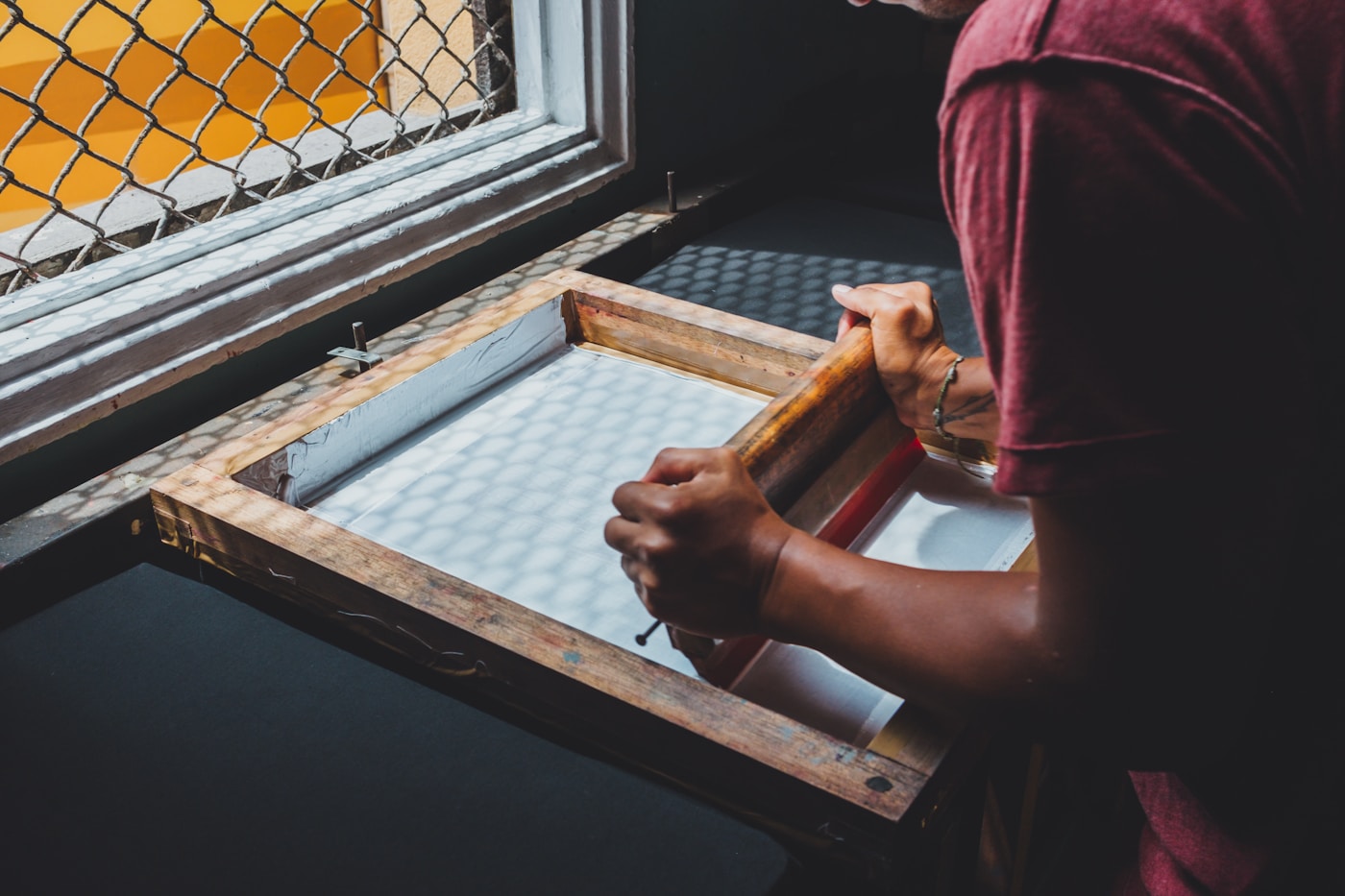
The trade-off is real and worth stating. Screen printing is cheaper per piece once you pass roughly fifty shirts, because the screens are burned once and the marginal shirt costs almost nothing. DTF has no setup at all and prints unlimited colours at one price, which is what makes small top-ups sane. The usual campaign pattern is the sensible one: screen print the main run, DTF the top-ups. The two methods match closely enough on a solid-colour name print that nobody at a door will ever tell. If you want the full comparison, see DTF versus screen printing and the best method for small orders.
One artwork across tees, hoodies and hats
A campaign that reads as one thing is a campaign that looks bigger than it is. That comes from repetition, not from variety: the same lockup, the same two colours, on the shirt, on the hoodie, on the cap, on the lawn sign and on the door hanger. Volunteers will want variants. Resist it. The value is in the sameness.
Practically, that means preparing artwork once and correctly. What you want is a vector file — SVG, PDF or AI — because it scales from a two-inch cap embroidery to a four-foot sign without going soft, and because it is what every method downstream wants. If all you have is a logo pulled off a website, we can rebuild it as clean vector artwork before anything prints. Our guide to preparing logo files for printing explains what to send and what will cause a problem.
Different garments need different treatments of the same mark, and that is not a contradiction. A full-width chest print on a tee, a slightly smaller front print on a hoodie so it clears the pocket seam, and a small embroidered version for caps. Same lockup, three sizes. You can build all three in the online mockup studio and see them side by side on real garment colours before you commit to anything, and every file that comes through it is checked by a human designer before it reaches a press.
Timelines, and the other two legs of a campaign print order
Our standard turnaround is 2–5 business days after you approve the free mockup and pay— not from the day you first email us. Rush production is available on most apparel jobs. We are not going to invent an order-by date for you, because your campaign's real deadline is your first big canvassing weekend, not ours. Do the arithmetic from that: pick the shift you want the team in uniform for, count back the production days, and add a few days for artwork and approval, which is reliably the part that takes longest. If the date is tight, say so — rush printing exists, and we will tell you honestly if a date is not realistic rather than take the order and miss it.
Apparel is one of three things a municipal campaign prints, and the other two run on calendars that are not ours to set. Lawn signs are governed by municipal by-law. In Ottawa — and these numbers are Ottawa's only — a sign may not go up on private property more than 45 days before voting day, which for 2026 means Friday, September 11, 2026; on public property or the city road allowance the window is 30 days, meaning Saturday, September 26, 2026; every sign must come down within 72 hours after voting day, so by Thursday, October 29, 2026; and on private property a sign may not sit within three metresof an intersection. The governing rules are the Municipal Elections Act, 1996, Ottawa's Temporary Signs on Private Property By-law, and the Signs on City Roads By-law (No. 2003-520); sign complaints in Ottawa go to 3-1-1.
Those dates are Ottawa's and nobody else's.Toronto, Mississauga, Gatineau and every other municipality set their own election sign rules, and the numbers are frequently different. If you are campaigning anywhere but Ottawa, confirm your dates with your own municipal clerk before you put a single sign in the ground. We print what a campaign approves; we do not give legal advice, and the clerk's office is the authority. There is more detail in when you can put up election signs in Ontario and election lawn signs in Ottawa.
The third leg is what your canvassers leave behind. Door hangers are the piece that does the work at the two-thirds of doors where nobody answers, and they are covered in door hangers for canvassing. If you would rather see the whole season laid out in one place — signs, hangers, apparel and the small stuff — start with the 2026 municipal campaign print checklist, and how many lawn signs a campaign needs handles the quantity question that eats most of the budget.
Voting day is Monday, October 26, 2026 and the new council term begins Sunday, November 15, 2026. From today that is about eight weeks — enough time to do this properly, and not enough to do it twice. The fastest way to start is to put your name on a shirt in our t-shirt printing service and see what it looks like at size.
Frequently asked questions
What should go on a campaign volunteer t-shirt?
The candidate's name, set large enough to read from about ten feet, and at most one short line under it — the office being sought or a four-word phrase. Skip the election date and anything else that stops being true on October 27th, because an undated shirt keeps getting worn for years afterwards. Use hard contrast between the garment colour and the print, since most canvassing happens in the last two hours of daylight. Save the detail for the door hanger, which gets read on a kitchen counter rather than glanced at from a driveway.
How many campaign shirts should we order for our volunteers?
Order to your confirmed head count plus ten to fifteen percent, concentrated in L and XL, and keep the extras in a box at the campaign office. Rosters grow through the whole campaign and the volunteers who join in the final fortnight are often the most active, so a reserve gets people into uniform on their first shift instead of two weeks later. Because we have no minimum on DTF, you do not have to guess your final number in September — you can top up in batches of five or six as people sign on.
Do we need hoodies as well as t-shirts for a fall campaign?
In Ottawa, yes. Voting day is Monday, October 26, 2026, and the heaviest canvassing weeks are the cold ones right before it — evening shifts in late October regularly sit near freezing. A tee under a volunteer's own winter coat is an invisible tee, so the identification you paid for disappears in exactly the fortnight that matters most. A common split is a shirt for every volunteer and hoodies for the core team and shift leads. A mid-weight fleece hoodie with one print location usually runs about $35 to $55 depending on the blank.
Is there a minimum order for campaign volunteer apparel?
Not with DTF or DTG — we will print a single shirt, and the per-piece price does not jump because the quantity is small. That matters on a campaign, where reorders are usually five or seven pieces rather than twelve. Screen printing is the exception: it has a practical minimum of roughly a dozen pieces because the screens have to be burned regardless of how short the run is, and it becomes the best value past roughly fifty. The usual pattern is screen printing for the main run and DTF for the top-ups.
How fast can you print shirts for a campaign?
Standard turnaround is 2 to 5 business days after you approve the free mockup and pay, not from the day you first contact us. Rush production is available on most apparel jobs. Work backwards from your first big canvassing weekend rather than from voting day, and leave a few days for artwork and approval — that front half is what actually eats the calendar, not the printing. If your date is not realistic we will say so instead of taking the order and missing it.
Do you print for any candidate or party?
We print for any registered candidate or campaign regardless of affiliation, and we take no political side. We have worked on mayoral and city-council campaigns before, so we are familiar with how the season runs and what tends to go wrong in the last fortnight. What we do not do is give legal advice. Election sign by-laws are set by each municipality and vary widely, registered third-party advertisers have their own identification requirements, and the municipal clerk's office is the authority on all of it. Tell us what has to appear on the piece and we will print what you approve.
Can we use the same design on shirts, hoodies and hats?
Yes, and you should — repetition is what makes a small campaign read as one organised thing. Send a vector file (SVG, PDF or AI) so the same lockup scales from a two-inch cap embroidery to a four-foot lawn sign without going soft; if all you have is a low-resolution logo, we can rebuild it as clean vector art first. Each garment wants a slightly different size of the same mark: full-width on the tee, a bit smaller on the hoodie so it clears the pocket seam, and a small embroidered version on caps and toques.
Design it yourself. A human designer still checks every order.
Our free studio gives you the price and the mockup in the browser. What it doesn't do is print your file blindly — every order is reviewed by a real designer before it reaches the press.
- Step 1You design it — free
Upload your logo, drop it on a real garment, set the size and placement, pick colours and quantities. No account, no deposit, no waiting on a reply.
- Step 2A human designer checks it
Before anything prints, one of our designers opens your file and checks resolution, colours, sizing and placement. If it won't print well, we fix it or tell you exactly what's wrong — a person, not an automated preflight.
- Step 3You approve, then we print
You get the corrected mockup back on the actual product. Nothing goes to press until you say yes — then it's ready in 1–2 weeks, or in 1–3 business days with a rush.
Get your team in uniform before the doors get cold
Put the name on a shirt, see it on the real garment colour at the real placement, and get a free mockup before you pay a dollar. No minimum on DTF, so late volunteers are a five-shirt reorder rather than a problem. Printed in-house in Ottawa, 2–5 business days after approval.
Every order is reviewed by a human designer before it goes to press. A person checks artwork resolution, colour, sizing and placement, and either fixes the file or tells the customer what is wrong — it is not an automated preflight.