
Custom Workwear and Uniforms in Quebec: Outfitting a Crew From Montreal to Quebec City
Work uniforms are an equipment purchase, not an apparel purchase — they get worn five days a week, washed hard, and replaced one shirt at a time as staff turn over. This guide covers what actually survives a work week, how hi-vis ratings really work (they belong to the blank, not the decorator), embroidery versus print, bilingual name tags and French job titles, sizing a crew including tall and plus sizes, and how to set up the first order so reordering three shirts in November is a sentence instead of a project.
- Artwork check
- A human designer reviews every workwear order before it goes to press — resolution, thread colour, logo size and placement on each garment type. Not an automated preflight.
- Design it yourself
- Free studio at yayaprints.ca/mockup-creator — no account, no deposit. Drop your logo on a real work shirt, see the price update, order online.
- Decoration on workwear
- Embroidery for polos, jackets, caps and anything customer-facing; screen printing or DTF for high-count tees and hi-vis. Embroidery adds roughly $10 per piece over a plain garment.
- Minimums
- None on DTF or DTG — a single replacement shirt is a real order. Screen printing starts around 6 pieces and gets cheap past roughly 24–50.
- Hi-vis ratings
- Safety ratings belong to the blank manufacturer, not to us. Ask us to confirm the specific blank's rating in writing before you order if your site requires one.
- Turnaround to Quebec
- 2–5 business days in production after mockup approval and payment, then shipping — typically 1–2 days to Greater Montreal, a little longer to Quebec City and the regions.
- Languages
- We work in English and French, and we set French job titles and accented names correctly on name tags.
What a Quebec employer is actually buying
A crew order looks like an apparel order and behaves like an equipment order. Nobody orders forty work shirts because they want forty shirts. They order them because a plumber should not show up at a client's door in a band tee, because a site supervisor needs to spot his own people across a parking lot, and because a truck with a uniformed driver gets let into a loading bay faster than one without.
That changes what "good" means. A promo tee has to survive a weekend. A custom workwear program has to survive a year of Mondays: heat, grease, mortar dust, bleach, drywall compound, a hundred wash cycles, and a new hire in a size you did not order. The questions that matter are boring and physical — fabric weight, poly content, seam construction, whether the logo cracks — and they are the questions this guide answers.
The industries that order this most often in Quebec are the ones where the uniform does real work: construction and trades, landscaping crews, cleaning companies, delivery fleets, restaurants, and garages. The garment mix differs — a garage wants a durable work shirt that hides oil, a restaurant wants aprons and something presentable in a dining room — but the ordering problem is identical.
What actually survives a work week
Fabric weight is the first number to look at. A standard retail tee is light — comfortable, cheap, and thin enough that a tool belt will wear a hole through the hem inside a season. Workwear blanks are heavier, and the extra weight is the whole point: more fabric between your staff and the job, and a garment that still hangs correctly after it has been through a washer thirty times.
Polyester content is the second. Cotton is the most comfortable thing to wear in a hot shop and the worst thing to wash a hundred times — it shrinks, it wrinkles, it fades. A poly-cotton blend gives up a little softness and buys back shape retention, wrinkle resistance and much faster drying, which is why so many work shirts and company polos land in blend territory. Full polyester wicks best and is the usual choice for landscaping and anything worn outdoors in July.
Then there is how the garment is laundered. Home washing on warm with the rest of a family's clothes is gentle compared to what a restaurant or a cleaning contractor does — hot water, industrial detergent, high-heat drying, every single night. If that is your reality, say so when you ask for a quote. It changes the blank we recommend, and it changes the decoration method, because heat and harsh detergent are exactly what shortens the life of a printed graphic.
- Heavier is longer-lived. The cheapest shirt per unit is rarely the cheapest shirt per year.
- Blends fight wrinkles and shrinkage. Worth it on anything a customer sees.
- Wash temperature matters more than wash count. Cooler water and lower dryer heat buy you months.
- Flame or arc exposure is a separate category.If your site needs rated protective garments, that is a specialty blank with a manufacturer rating — ask us before you assume a work shirt qualifies.
Our guide to choosing fabric for printing goes deeper on how each fibre takes ink, which matters once you are choosing between decoration methods.
Hi-vis and safety apparel, honestly explained
This is the part of a workwear order where guessing costs the most, so we will be careful. Customers come to us asking for "CSA hi-vis," for "Class 2 vests," for "orange shirts with the silver stripes," and for a logo on the back big enough to read from a crane. Those are all requests about a rating that belongs to the blank, not to the decoration.
Here is the honest version: we are a decorator. We buy blank garments and we put your logo on them. When a garment carries a safety rating, that rating comes from the manufacturer of the blank and is printed on its own label — not from anything we do. So if your site, your general contractor or your insurer requires a specific class of high-visibility apparel, ask us to confirm the exact blank and its stated rating in writing before you order. We will tell you what the manufacturer states, and if we cannot source something that meets your requirement, we will say so rather than sell you a shirt that is merely bright.
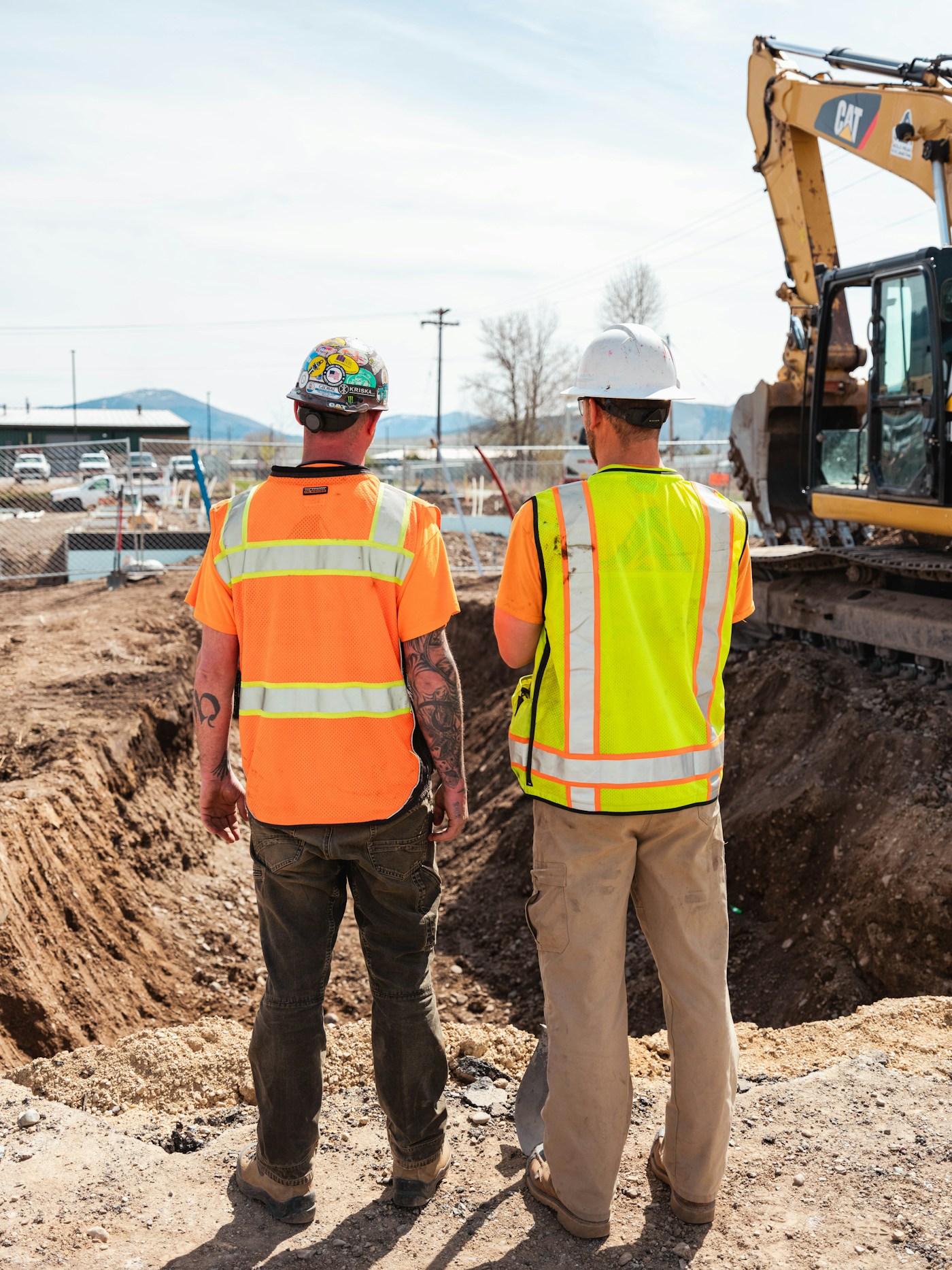
Two practical notes that come up on nearly every hi-vis order. First, decoration should stay clear of the reflective striping — printing over tape is both an appearance problem and, on a rated garment, a compliance question. Tell us the garment and we will lay the logo out around the tape on the mockup so you can see it before anything is printed. Second, hi-vis yellow and hi-vis orange are unforgiving backgrounds for a logo. Dark, high-contrast marks read from a distance; a pale grey wordmark on safety yellow disappears at ten metres. A designer here will flag that before press, not after.
If you want the fuller version of how trade crews put a program together, our post on custom construction uniforms in Canada covers garment mix, seasons and layering, and the contractor branding checklist is a good pre-order sanity pass.
Embroidery or print on workwear
On workwear this decision is less about taste than about where the garment goes and how many you are buying.
Embroidery stitches the logo in thread. It does not crack, does not fade in the wash, and it outlives the garment it is sewn onto — which is exactly what you want on a polo, a softshell, a work jacket or a cap that a customer looks at across a counter. It also reads as more serious, which matters for anyone quoting jobs in someone's living room. The tradeoffs are real: thread cannot do gradients, very fine text below roughly a quarter inch turns to mush, and the logo has to be digitized once into a stitch file before the first piece runs. Our post on what digitizing actually is explains why that step exists.
Screen printing is the volume answer. Once the screens are set, the marginal cost of the next shirt is small, which is why a crew ordering fifty tees or fifty hi-vis shirts almost always prints rather than stitches. DTF handles the awkward cases — a full-colour logo, a mixed pile of cotton and polyester garments, or a run of three replacement shirts — with no setup fee and no minimum at all.
The pattern most Quebec crews settle into: embroidery on the customer-facing layer (polos, jackets, caps), print on the working layer (tees, long sleeves, hi-vis), and the same logo file behind both so the brand stays consistent. Budget roughly $12–$18 per screen-printed shirt at 50 pieces, dropping under $10 each in the hundreds, and roughly $10 per piece for embroidery over the cost of a plain garment. If you are torn, our comparison of embroidered versus printed logos on polos is the shortest way to decide, and dropping your logo onto a real garment in the studio lets you see the size difference for yourself in about two minutes.
Sizing a crew, including tall and plus sizes
The single most common workwear mistake is ordering a size run that looks like a bell curve out of a textbook. Real crews are not shaped like that. A framing crew skews large. A cleaning company might be mostly women's cuts. A delivery fleet has one guy who needs a 2XL Tall and will otherwise spend a year with his shirt untucking itself.
Do this instead:
- Ask, do not estimate.One message to the group chat asking for everyone's size beats any formula.
- Ask about cut, not just letter.Unisex and women's cuts fit differently at the same nominal size, and a garment that fits badly does not get worn.
- Handle Tall separately. Tall sizing is a different length, not a bigger letter, and it is worth confirming availability on the specific blank early because it is not stocked as deeply.
- Check the extended-size cost. On most blanks, sizes above XL carry an upcharge from the manufacturer. It is small, but you should see it on the quote rather than discover it later.
- Order a few spares. Two or three extra in the middle sizes covers your next hire and the shirt that ends up in a puddle of hydraulic fluid.
If it is a bigger group and you would like the collection to run itself, our guide to organizing a group apparel order has the process. And when you build the order in the free design studio, the size breakdown and the price move together, so you can see what adding six more mediums actually costs before you commit.
The reorder problem nobody plans for
Here is how workwear programs die. A company orders forty beautiful shirts in March. In September three people have left and four have joined, the person who placed the order has changed jobs, nobody can find the logo file, the blank has been discontinued, and the new shirts come back a slightly different shade of navy than the old ones. Now half the crew looks like it works somewhere else.
Almost all of that is preventable, and it is prevented at the first order rather than the second. Keep the vector logo file somewhere two people can reach. Write down the exact blank — brand, style number, colour name — not "the navy work shirt." Note the logo dimensions and the placement measurement, so shirt forty-one matches shirt one. And choose a decorator who keeps your job on file so a reorder is a sentence rather than a project.
That last part is where minimums bite. Plenty of shops will not run three shirts. We will: there is no minimum on DTF or DTG, so a single replacement shirt for a single new hire is a real order at a sane price, and screen printing is there when the count justifies it again. Our post on how to reorder company uniforms is essentially this section with the checklist filled in, and our uniforms page covers the program side — multiple garment types, one look.
Your logo, and the person who checks it
Most workwear logos arrive in bad shape, and that is not an insult — it is just what happens to a file after eight years of being emailed around. The version you have is often a small JPEG with a white box behind it, pulled off the website, at a resolution that was fine for a business card and is nowhere near enough for a jacket back.
Every order we take is reviewed by a human designer before it goes to press. A real person on the team opens your file and checks resolution, colour, sizing and placement on the specific garment, and then either fixes it or tells you exactly what is wrong with it. It is not an automated preflight that spits out a warning nobody reads. Send a phone screenshot, a website PNG, a PDF from your sign guy, or an AI-generated image — we clean it up or redraw it as vector art and show you the result on a mockup before you pay a cent.
That check matters more on workwear than anywhere else, because the mistakes are expensive in a specific way. A logo that is 20% too large on a polo looks amateurish on forty people at once. A thin line that survives on paper closes up in thread. A colour that pops on white vanishes on hi-vis yellow. Those are all caught before press, on a mockup you approve. Nothing prints until you say yes — and if you would rather see it yourself first, upload your logo and put it on a real work shirt in the free studio: no account, no deposit, and the price updates as you go. If your files are a mess, our guide to preparing logo files for printing tells you what to hunt for on your own hard drive.
Ordering from Quebec, printed in Ottawa
We should be straight about geography. We are an Ottawa shop. Everything is printed, stitched and pressed in-house in Ottawa, Ontario. Walk-in pickup happens at the Ottawa shop and nowhere else; free local pickup and delivery cover Ottawa and Gatineau. Everywhere else in Quebec — Montreal, Quebec City, and the regions — we ship to you. If you need to physically touch a garment before ordering this afternoon, a shop on your own street will beat us on that one axis.
What you get in exchange is worth more on a workwear program than proximity is. The production is under one roof, so when a job needs to move up the queue the press is down the hall. It is printed in Canada, so there are no cross-border customs holds and no surprise duties on a container from overseas. There is a free mockup before any payment, a designer who answers, and a real person at 613-666-9292 or order@yayaprints.ca who will tell you when your deadline is not realistic.
Timing: 2–5 business days in productionafter you approve the mockup and pay, then shipping. Greater Montreal is typically one to two days once the box leaves the shop; Quebec City and the regions are a little further, and we will give you the courier's estimate with your quote rather than a guess. Rush production is available on most apparel jobs — ask early, because the useful version of a rush is one we agree to before the artwork is finished.
Two ways in. If you know what you want, build it yourself in the studio — pick the garment, place the logo, set your size run, and order online without phoning anyone. If you would rather have a person work through the blank options, the hi-vis question and the size list with you, send the quote request form and we will come back with a mockup. Either way, you see the shirt before you pay for it. Buying tees for the same crew? Our Quebec City t-shirt printing guide covers that side.
Frequently asked questions
Do you sell CSA-certified hi-vis workwear in Quebec?
We decorate hi-vis garments, and any safety rating comes from the manufacturer of the blank rather than from anything we do to it. If your site, your general contractor or your insurer requires a specific class of high-visibility apparel, ask us to confirm the exact blank and the rating its manufacturer states, in writing, before you order. We will tell you what the label says, and if we cannot source a blank that meets your requirement we will say so instead of selling you a shirt that is only bright. We also lay the logo out clear of the reflective striping and show you that on the mockup first.
Embroidery or printing for company work shirts?
Embroidery for anything a customer looks at closely — polos, jackets, caps, softshells. It does not crack or fade and it outlasts the garment, and it costs roughly $10 a piece over the plain garment. Printing for volume and for the working layer — tees, long sleeves, hi-vis — where screen printing runs roughly $12 to $18 per shirt at 50 pieces and drops under $10 each in the hundreds. Most crews do both: stitched on the front-of-house layer, printed on the work layer, same logo behind both.
Can you put French job titles and accented names on uniforms?
Yes. We work in English and French, and accents are set correctly — Renée, Noël, François, Côté and Lévesque all come out right rather than stripped bare. French titles like chef d'équipe, technicien, préposé à l'entretien or contremaître are routine, and we can stack both languages if you want them bilingual. Because a stitched name is not editable afterwards, we ask you to read the mockup character by character before approving it.
What is the minimum order for custom workwear?
There is no minimum on DTF or DTG, so a single replacement shirt for a single new hire is a real order at a sensible price. Screen printing has a practical minimum of about 6 pieces because screens have to be burned and set up regardless of the count, and it becomes the best value past roughly 24 to 50 pieces. Embroidery is fine in small runs once the logo has been digitized, and the digitizing only happens once.
How do I reorder uniforms when staff change?
Record three things at the first order and reordering stays easy forever: the vector logo file somewhere two people can reach, the exact blank (brand, style number and colour name, not 'the navy shirt'), and the logo size and placement measurement. We keep your job on file, and because there is no minimum on DTF or DTG you can order three shirts in November that match the forty you ordered in March. Blanks do occasionally get discontinued, and if that happens we will tell you and show you the closest match on a mockup before printing.
Do you check my logo before printing, or does it just go straight to the machine?
A human designer reviews every order before it goes to press. A real person checks resolution, colour, sizing and placement on the specific garment, and then either fixes the file or tells you exactly what is wrong with it — it is not an automated preflight. Send a phone screenshot, a website PNG, a PDF or an AI-generated image; we clean it up or redraw it as vector art and show you the result on a free mockup before any payment.
Can I design the uniforms myself instead of emailing back and forth?
Yes, and most people find it faster. The free studio at yayaprints.ca/mockup-creator needs no account and no deposit: choose the garment, upload your logo, place it, add names or text in print-quality fonts, pick colours and your size run, watch the price update as you go, and order online. A designer still reviews everything before it prints, so designing it yourself does not mean nobody checks it.
How long does a workwear order take to reach Montreal or Quebec City?
Production is 2 to 5 business days, counted from the moment you approve the free mockup and pay rather than from your first email. Shipping goes on top: Greater Montreal is typically one to two days once the box leaves our Ottawa shop, and Quebec City and the regions take a little longer. Rush production is available on most apparel jobs if you ask early. Everything is made in Ontario, so there are no cross-border customs holds or surprise duties.
Design it yourself. A human designer still checks every order.
Our free studio gives you the price and the mockup in the browser. What it doesn't do is print your file blindly — every order is reviewed by a real designer before it reaches the press.
- Step 1You design it — free
Upload your logo, drop it on a real garment, set the size and placement, pick colours and quantities. No account, no deposit, no waiting on a reply.
- Step 2A human designer checks it
Before anything prints, one of our designers opens your file and checks resolution, colours, sizing and placement. If it won't print well, we fix it or tell you exactly what's wrong — a person, not an automated preflight.
- Step 3You approve, then we print
You get the corrected mockup back on the actual product. Nothing goes to press until you say yes — then it's ready in 1–2 weeks, or in 1–3 business days with a rush.
Put your logo on the work shirt before you buy forty of them
Pick the garment, drop your logo on it, set your size run and see the price move — free, no account, no deposit. Embroidery for polos and jackets, print for tees and hi-vis, printed in-house in Ottawa and shipped across Quebec.
Every order is reviewed by a human designer before it goes to press. A person checks artwork resolution, colour, sizing and placement, and either fixes the file or tells the customer what is wrong — it is not an automated preflight.