
Best Custom T-Shirt Printing in Montreal: How to Judge a Shop Before You Pay
Nobody can hand you an honest ranked list of Montreal print shops — the jobs aren't comparable. Here's the framework instead: whether a shop can actually set French (accents, ligatures, line breaks that blow out a chest print), whether its invoice works for a Quebec business, whether it prints in-house or brokers to a US supplier, whether its lead time survives festival season, and whether a human designer proofs your file. Includes a copyable list of questions to ask anyone.
- Artwork check
- A human designer reviews every order before it goes to press — resolution, colour, sizing, placement, and French accents and line breaks. It is not an automated preflight.
- Design it yourself
- Free online studio at yayaprints.ca/mockup-creator — no account, no deposit, real garments, print-quality fonts, and the price updating as you go.
- Language
- We serve customers in English and French, and French copy is shown at print size on the mockup before anything is printed.
- Turnaround to Montreal
- 2–5 business days in production after mockup approval and payment, then typically 1–2 days in transit. Rush is available on most apparel jobs.
- Where it is printed
- In-house in Ottawa, Ontario. Nothing crosses a border, so there are no customs holds, brokerage fees or surprise duties on a Quebec order.
- Minimum order
- None on DTF or DTG — we will print a single shirt. Screen printing starts around 6 pieces and gets good past roughly 24–50.
- Typical cost
- Roughly $12–$18 CAD per screen-printed tee at 50 pieces, dropping under $10 each in the hundreds. Every quote is free and includes a mockup.
Why nobody can honestly hand you a ranked list
Search for the best t-shirt printer in Montreal and you get pages of ranked lists written by people who have never held one of the shirts. We are not going to add another one, and we are not going to put ourselves at the top of it. Ranking print shops is close to meaningless because the jobs are not comparable: the shop that is brilliant at 400 one-colour festival tees is often the wrong shop for twelve full-colour hoodies with a French tagline across the chest, and neither of them is set up for eight embroidered polos with a rush date.
What is stable across every job is the list of ways an order goes wrong. Those failure modes are the same in Montreal as anywhere else, with a few that are specific to doing business in Quebec. So instead of a ranking, here is the framework: five things to test, how to test each one in a two-minute conversation, and then — plainly, so you can weigh it — how we answer each. If you want the practical mechanics rather than the evaluation, our guide to custom t-shirt printing in Montreal covers methods, quantities and pricing, and there is a French-language version at impression de t-shirts personnalisés au Québec.
| What to test | Why it bites in Montreal | The two-minute test |
|---|---|---|
| French typesetting | Dropped accents and bad line breaks read as sloppy, not bilingual | Ask to see the French version on a mockup at print size |
| Invoicing | An out-of-province supplier still has to produce a document your bookkeeper accepts | Ask for the taxes and registration numbers on the quote, in writing |
| Who prints it | Brokered US production means customs, duty and a slow reprint | Ask where the shirt is physically printed, and who reprints it |
| Lead time honesty | Festival season compresses every shop's calendar at once | Ask whether the clock starts today or at approval |
| File proofing | A web logo printed at 11 inches is the most common ruined order | Ask who looks at the file, and what they would say about yours |
You can run most of that framework before you speak to anyone. Build the shirt in a free online design studio, see the graphic at the real size on a real garment, and you will already know which of these questions actually apply to your job.
Can the shop set French, or only speak it?
"We serve you in both languages" usually means someone will answer the phone in French. That is not the same skill as putting French on a shirt. Typesetting is where bilingual shops quietly fail, and the failures are permanent because they are printed.
The specific things that go wrong: accents disappear on capitals, so ÉCOLE prints as ECOLE and CRÉATIF prints as CREATIF. A display font gets picked for the look and turns out to have no accented glyphs at all, so the software silently substitutes a different typeface for é and à and the word ends up with two different letterforms in it. The œ ligature in cœur or sœur or œuvre gets typed as two separate letters, which a French reader notices instantly. Punctuation spacing in French is not English punctuation spacing, and pasting English-formatted text into a design keeps the English habits.
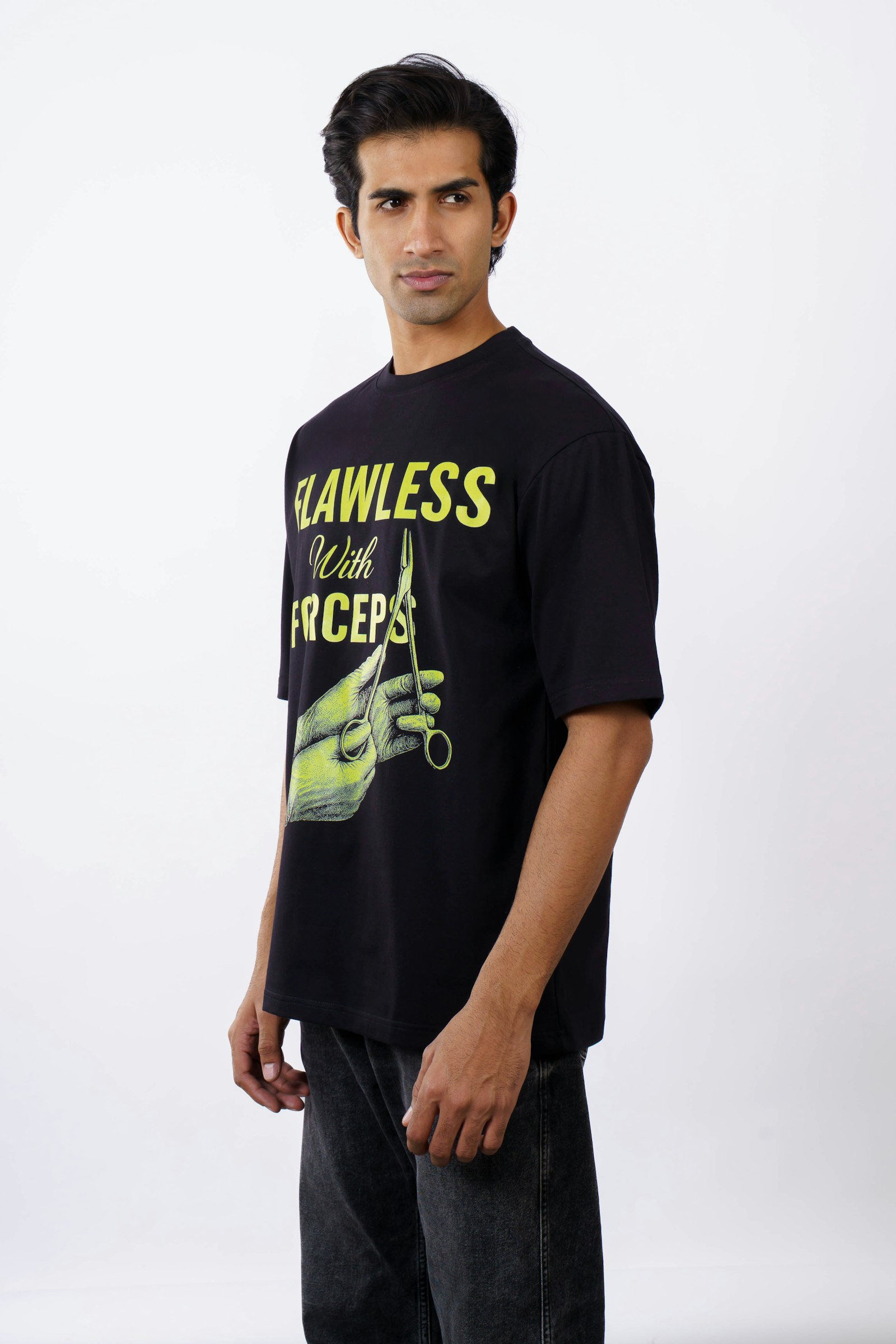
There is also a layout problem nobody warns you about. French almost always runs longer than the English it was translated from, and a chest print has a fixed width. A tagline that sat comfortably on two lines in English comes back in French as three lines, or as one line squeezed until the letters are too thin to print cleanly, or with a break in a place that splits a phrase awkwardly. The fix is not clever — it is someone re-setting the French version as its own layout instead of dropping the translated string into the English artwork. But it only happens if a person looks.
So the test is concrete: ask the shop to show you the French version on the mockup, at the size it will actually print, before you pay. If they can only show you the English one, or only a thumbnail, that is your answer. We serve customers in English and French, every order gets a free digital mockup on the actual product, and you can set your own French copy in print-quality fonts in the studio and see the line breaks yourself before anyone touches a press.
Whether the invoice works for a Quebec business
If the shirts are for a company, a school, a borough, a union or a nonprofit, the paperwork matters as much as the print. An order can be perfect and still cause you a month of grief because the invoice cannot be processed. This is the least glamorous criterion on the list and the one that generates the most follow-up emails.
Buying from an out-of-province supplier is completely normal — plenty of Montreal businesses buy from Ontario, and plenty of Ottawa businesses buy from Quebec. What is not normal is an invoice your bookkeeper has to phone about. Before you approve anything, get the quote in writing and check that it states which taxes will be charged to your address, shows the supplier's tax registration numbers, is denominated in Canadian dollars, and breaks the order into lines you can actually read: the blank garment, the decoration, any setup, and shipping as its own line rather than folded invisibly into the unit price.
Then ask the two questions that come up later: can you put my purchase order number on the invoice, and can I get the invoice before I pay rather than after. Shops set up for business accounts say yes without hesitating. Shops that only ever sell prepaid consumer orders will improvise, and improvised paperwork is where the delay comes from.
On our side, every quote is free and includes a mockup, and the numbers are ranges rather than a rate card because the garment and the artwork move them: roughly $12–$18 CAD per screen-printed tee at 50 pieces, dropping under $10 each in the hundreds, with full-colour DTF sitting slightly higher per piece but carrying no setup fee at all. If you need it itemized for an approval chain, say so on the quote form and it comes back that way. Recurring orders like staff uniforms are worth setting up properly once so the reorder is a one-line email.
Does the shop print it, or just order it?
Plenty of the sites selling custom apparel are storefronts sitting on someone else's production. That is a legitimate business model and it works fine for simple jobs. It becomes a problem when the production sits in the United States, because a Quebec-bound order then has to cross a border it did not need to cross.
The consequences are not theoretical: shipments get held at customs on somebody else's schedule, duty and brokerage can land on an invoice that quoted you a clean per-shirt number, and if the order comes back wrong the reprint has to make the same crossing again. That last one is what actually kills a deadline. A reprint that is a two-day inconvenience domestically becomes a two-week problem internationally.
Two questions expose this quickly. First: where is my shirt physically printed? A shop that prints answers with a city without pausing. Second: if a box comes back wrong, who reprints it, and how fast? Brokered operations get vague here, because the honest answer is that they have to file a claim with a supplier and wait.
We print in-house in Ottawa, Ontario — screen printing, DTF, DTG, embroidery and vinyl all under one roof. Nothing is drop-shipped from overseas and nothing crosses a border on its way to you, so there are no customs holds and no surprise duty on a Montreal order. It also means a reprint is a decision someone makes down the hall rather than a ticket in someone else's queue. We ship across Greater Montreal the same way — Laval, Longueuil, the West Island, the Plateau — and there is more detail on transit in our note on shipping custom apparel across Canada.
Lead time honesty, and the season that eats it
Montreal's calendar is stacked. From late spring to the end of summer the city runs on festivals, terrasses, street sales, tournaments and moving day, and every organization in town wants shirts inside the same handful of weeks. Every shop is busy at once, which is exactly when quoted lead times start drifting from reality.
The tell is not the number, it is what the number is counted from. "Three to five days" is meaningless until you know whether the clock starts when you email, when you approve the mockup, or when the payment clears. Almost always it is the last one, and almost always the quote implies the first. That gap is where a Friday deadline quietly becomes the following Wednesday, and it is usually not the shop being dishonest so much as the shop not being asked.
Ask these three, in this order: does that turnaround start today or at approval; what is the last date you can receive my final file and still hit my date; and what does rush cost and is it guaranteed or best-effort. A shop that answers all three without hedging is telling you it has looked at its own schedule. A shop that says yes to any date you name has not.
Ours, stated plainly: production is 2–5 business daysafter you approve the mockup and pay, rush is available on most apparel jobs, and shipping to Montreal typically arrives 1–2 days after it leaves the shop. So plan on 2–5 business days plus shipping, not same-day — walk-in pickup exists only at the Ottawa shop, and we would rather say that now than on your deadline. For very small runs, DTF has no minimum and no screens to burn, which is usually the fastest path when the count is under a dozen. Our breakdown of how long custom apparel actually takes shows where the days really go.
Does a human actually look at your file?
This is the criterion that separates shops more than equipment does, and it is the one almost nobody asks about. Most online ordering runs an automated preflight: it checks resolution and colour mode, throws a warning nobody reads, and prints whatever you uploaded. The file passes the robot and fails on the shirt.
The things a machine will happily let through are the things that ruin orders. A logo pulled off a website at 900 pixels wide, stretched to an 11-inch chest print, prints soft and pixelated. A black that is actually a rich four-colour black behaves differently on a garment than it did on your screen. A design scaled to fill the artboard rather than the print zone lands with the logo running into the collar seam. A photo with a white rectangle behind it prints the rectangle. And, in French, an accent your font never had in the first place is simply absent.
Every order we take is reviewed by a human designer before it goes to press. A real person on the team checks resolution, colour, sizing and placement, and then either fixes the file or tells you exactly what is wrong with it. That is a person, not an automated preflight, and it is not an upsell. Send a phone screenshot, a PNG saved off a website, a PDF, or an image an AI generated for you — we clean it up or redraw it as proper vector art, and show you the result on a mockup before you pay a cent. Nothing goes to press until you have approved that mockup.
If you want to arrive with a file that needs less of that work, our notes on preparing logo files for printing and on how to tell quality shirt printing are the short version. If your only logo is a low-resolution image, redrawing it as vector is the fix, and it is worth doing once because you will use that file for years.
Design it yourself first, then let a person check it
The slowest way to order shirts is to describe them. Email threads about placement and size go back and forth for days because two people are imagining different shirts. The fastest way is to build the thing and look at it.
That is what our free design studio is for. It needs no account and no deposit, and nothing is charged for using it. Upload your logo, drop it on a real garment in the colour you are actually considering, add text in print-quality fonts, set your sizes, and watch the price update as you go. When you are happy you can order online, or stop there and send it to us to quote — both are fine.
For a Montreal order it does something specific: it lets you see the French line breaks at real size on a real chest, next to the English version, before either one is a printing decision. You will know within a minute whether your tagline needs to be re-set or whether it sits fine. The same is true of scale — almost everyone's first instinct is a chest logo that is too big, and seeing it on the garment fixes that faster than any conversation.
Then the human check runs on top. Self-serve does not mean nobody is watching: whatever you build, place your design on a real garment and a designer still reviews the file before it prints. That combination — you control the design, we catch the technical problems — is the whole point. It works the same way for hoodies and polos as it does for tees.
The questions to ask any Montreal shop
Copy this list. Ask it of us and of anyone else you are considering. None of the questions are about equipment brands, because equipment is rarely the difference — care is.
- Where is my shirt physically printed? A city, not a region.
- Do you print it yourselves or send it out? If it goes out, to which country.
- Will anything cross a border before it reaches me? Ask who pays duty and brokerage if it does.
- Can you show me the French version on the mockup at print size? Not a thumbnail.
- Does your font have the accents and the œ ligature? Ask before you fall in love with the typeface.
- Who looks at my file, and what would they say about it? A shop that proofs will answer with specifics.
- Is the mockup free, and does it come before payment? Both parts matter.
- Does that turnaround start today or at approval? This is usually several days.
- What is the last date I can send my final file? The real deadline is this one.
- What taxes will appear on my invoice at my address? Get it on the written quote.
- Can you put my PO number on the invoice and bill before payment? Business accounts need this.
- What happens if the order comes back wrong? Ask before, not after.
One more that is worth its own line: ask what they would talk you out of. Any shop that has been doing this a while has a list of jobs it is genuinely the wrong tool for. A shop that says yes to everything is selling you whatever it happens to own.
How we answer, including where we are not the right shop
We are an Ottawa shop that ships to Montreal, and we would rather lead with that than bury it. Everything is printed in-house in Ottawa, Ontario — t-shirt printing, screen printing, DTF, DTG, embroidery and vinyl. Nothing is brokered and nothing crosses a border, so no customs holds and no duty on your invoice. Production is 2–5 business days after mockup approval and payment, transit to Montreal is typically 1–2 days, and rush is available on most apparel jobs. There is no minimum on DTF or DTG — one shirt is a real order — and screen printing starts around 6 pieces and gets genuinely good past roughly 24 to 50. We work in English and French, and a human designer reviews every file, in either language, before it goes to press. You can reach a person at 613-666-9292 or order@yayaprints.ca.
Where we are not the right answer: if you need shirts in your hands this afternoon, an Ottawa shop shipping to Montreal cannot beat a shop you can walk into. Walk-in pickup is at the Ottawa shop only — free local pickup and delivery cover Ottawa–Gatineau, and everywhere else ships. If you need to handle three blank samples before you commit to 300 pieces, a local counter is faster for that too. And if your order is one shirt and the shipping matters more to you than the print, that is a fair reason to buy nearby. We will say so on the phone rather than take the order and hope.
What you get by shipping from us instead is control: one building, one queue, one person who can move your job, a free mockup before any money changes hands, and a designer who tells you exactly what is wrong with your file instead of printing it anyway. If that is the trade you want, the fastest start is to build the shirt in the studio and let us check it. If you would rather describe the job to a human first, the free quote form takes a minute, and it is worth reading where to print custom shirts in Quebec and the Quebec City guide if you are ordering from outside the island.
Frequently asked questions
Who is the best custom t-shirt printer in Montreal?
Nobody can answer that honestly, including us, because the jobs are not comparable — the right shop for 400 one-colour festival tees is often the wrong shop for twelve full-colour hoodies with a French tagline. Judge on five things instead: whether the shop can set French correctly, whether its invoice works for a Quebec business, whether it prints in-house or brokers to a US supplier, whether its lead time is counted from approval rather than from your first email, and whether a human designer proofs your file before it goes to press.
Does a real person check my artwork before it prints?
Yes. Every order is reviewed by a human designer before it goes to press — a real person checks resolution, colour, sizing and placement, and either fixes the file or tells you exactly what is wrong with it. It is not an automated preflight that passes anything above a DPI threshold. You can send a phone screenshot, a PNG pulled off a website, a PDF or an AI-generated image, and we will clean it up or redraw it as vector art, then show you the result on a free mockup before you pay. Nothing prints until you approve that mockup.
Can I design the shirt myself instead of emailing back and forth?
Yes, and it is faster. The free studio at yayaprints.ca/mockup-creator needs no account and no deposit. Upload a logo, place it on a real garment in the colour you are considering, add text in print-quality fonts, set your sizes, and the price updates as you go. You can order online at the end or stop and send it to us to quote. Either way a designer still reviews the file before it prints, so designing it yourself does not mean nobody checks it.
Can you print French text correctly, with accents?
Yes. We serve customers in English and French, and French copy is treated as its own layout rather than a translated string dropped into the English artwork. That matters because accents on capitals get dropped by careless typesetting, some display fonts have no accented glyphs and silently substitute another typeface, and French usually runs longer than the English it came from, which changes where a chest print breaks. You see the French version on the mockup at print size before anything is printed.
You are in Ottawa, not Montreal — why order from you?
Because everything is printed in-house in one building instead of brokered out, so there is one queue and one person who can move your job. Nothing crosses a border on the way to you, which means no customs holds, no brokerage fees and no surprise duty on a Quebec order. Production is 2 to 5 business days after mockup approval and payment, and shipping to Montreal typically arrives 1 to 2 days after it leaves the shop. The honest tradeoff is that walk-in pickup is at the Ottawa shop only — free local pickup and delivery cover Ottawa–Gatineau, and everything else ships. If you need shirts this afternoon, a shop you can walk into wins.
How much should custom t-shirts cost in Montreal?
Treat any single number with suspicion, because the garment, the number of print colours and the quantity all move it. As a realistic anchor, a screen-printed tee runs roughly $12 to $18 each at 50 pieces and drops under $10 each in the hundreds. Full-colour DTF sits slightly higher per piece but carries no setup fee at all, which is why it wins on small runs. Every quote is free and includes a mockup, and you should get the taxes and shipping shown as their own lines rather than folded into the unit price.
What is the minimum order, and how fast can I get them?
There is no minimum on DTF or DTG — we will print a single shirt, and because DTF carries no setup fee there are no screens to pay for on a run of one. Screen printing has a practical minimum of about 6 pieces because screens have to be burned regardless, and it becomes the best value past roughly 24 to 50. Standard production is 2 to 5 business days after you approve the mockup and pay, plus 1 to 2 days in transit to Montreal. Rush is available on most apparel jobs — ask early, and ask what the last date is that we can receive your final file.
What should I ask a print shop before I pay a deposit?
Where the shirt is physically printed, whether anything crosses a border, whether the mockup is free and comes before payment, who looks at your file and what they would say about it, whether the quoted turnaround starts today or at mockup approval, what the last date is to send your final artwork, which taxes will appear on your invoice at your address, whether they can put your PO number on it, and what happens if the order comes back wrong. Then ask what they would talk you out of — a shop that says yes to everything is selling you whatever it already owns.
Design it yourself. A human designer still checks every order.
Our free studio gives you the price and the mockup in the browser. What it doesn't do is print your file blindly — every order is reviewed by a real designer before it reaches the press.
- Step 1You design it — free
Upload your logo, drop it on a real garment, set the size and placement, pick colours and quantities. No account, no deposit, no waiting on a reply.
- Step 2A human designer checks it
Before anything prints, one of our designers opens your file and checks resolution, colours, sizing and placement. If it won't print well, we fix it or tell you exactly what's wrong — a person, not an automated preflight.
- Step 3You approve, then we print
You get the corrected mockup back on the actual product. Nothing goes to press until you say yes — then it's ready in 1–2 weeks, or in 1–3 business days with a rush.
Build it, then let a designer check it
Drop your logo on a real shirt, set the English and the French at print size, pick your colours and sizes, and see the price as you go. Free mockup before you pay, printed in-house in Ottawa, and shipping to Montreal typically arrives 1–2 days after it leaves the shop.
Every order is reviewed by a human designer before it goes to press. A person checks artwork resolution, colour, sizing and placement, and either fixes the file or tells the customer what is wrong — it is not an automated preflight.