
Custom T-Shirts for Remote Teams Across Canada
Branded apparel for a team that never shares an office: collecting sizes without a spreadsheet nightmare, shipping to twenty home addresses, onboarding kits for new hires, and keeping a reorder identical a year later.
Why custom t-shirts for remote teams in Canada go wrong
The job usually arrives as a one-line message: "Hey, can you sort out shirts for the team?" No budget, no deadline, no sizes. If everyone shared a hallway you'd walk around with a clipboard and be done by lunch. On a distributed team the same task quietly becomes a logistics project — and it falls apart in three predictable ways.
Sizes get guessed.Someone decides "mostly larges" is close enough and a third of the company gets a shirt that doesn't fit. Those shirts don't get worn; they become rags. You paid full price for every one of them.
One box goes to an office nobody visits. It lands at a head-office address that exists mostly on paper, and then somebody has to repackage twenty shirts and mail them out on their own time. Six of them are still in that box a year later.
The reorder doesn't match. Six months on, four people have joined and someone buys more from whoever is cheapest that week. Different blank, different navy, logo an inch bigger. Now the team photo has two versions of your brand in it.
All three are avoidable. This is what we walk distributed companies through when they order custom t-shirt printing or a full branded uniform program. We print in-house in Ottawa and ship Canada-wide, so we watch the same mistakes — and the same fixes — every week.
How to collect sizes without a spreadsheet nightmare
One form, one deadline, no follow-up thread. A shared spreadsheet is the worst tool for this — two people overwrite each other, somebody types "medium-ish", and you spend a week chasing stragglers in chat. A form with three fields (name, size, shipping address) and a stated cut-off does the same job in one pass.
Don't send a table of chest measurements in inches. Almost nobody owns a tape measure, and the ones who do all measure differently. Say this instead: take a t-shirt you already own and like the fit of, and tell us what size it is. Then flag the one thing that genuinely varies — whether the blank is a unisex or a fitted cut, and that unisex runs boxier and longer.
Offer both cuts and let each person pick for themselves rather than deciding by department. Digital printing has no per-garment setup, so mixing cuts in one order costs nothing extra. For bigger collections with multiple designs and departments, our guide to organizing a group apparel order covers the coordination side.
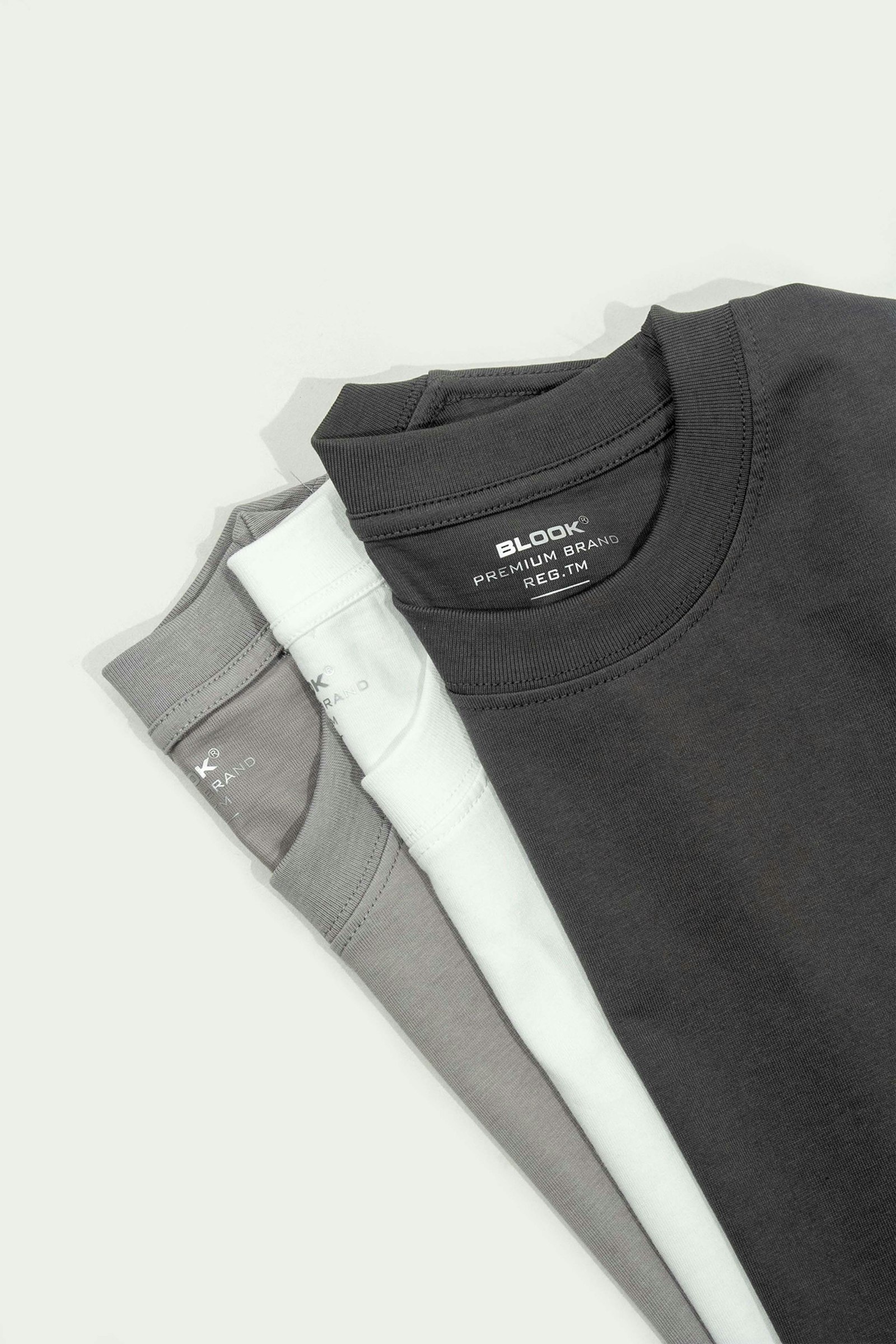
Then there are the people who never reply, and on a remote team there are always a few. Don't hold the order hostage. Set your cut-off, then fill the gaps with a normal adult curve weighted toward the middle. For a twenty-piece unisex run:
| Size | Share of the run | Pieces |
|---|---|---|
| Small | 10% | 2 |
| Medium | 25% | 5 |
| Large | 30% | 6 |
| XL | 20% | 4 |
| 2XL | 10% | 2 |
| 3XL | 5% | 1 |
That is a default, not a law — after one order you'll know your own team's curve. Two habits worth keeping: ask about extended sizes in the form so nobody has to raise their hand publicly, and add two spares in medium and large for whoever guessed wrong. Spares are cheaper than a second shipment.
Pick employee swag people actually wear at home
This is the part that decides whether your money bought company branded apparel or landfill. A remote employee has no reason to wear your shirt — no dress code, no customer walking past the desk. It has to win against every other tee in the drawer on merit. The stiff, papery promo tee from a trade-show booth loses that contest on day one.
Buy on hand feel first, price second. The biggest quality difference in a blank is the yarn: ring-spun, combed cotton is spun and cleaned so the fibres lie smooth, which is why it feels soft and prints evenly. A cheap open-end blank feels coarse out of the bag and gets worse with washing. The difference is a couple of dollars a shirt.
Go mid-weight, not heavyweight. Blanks are quoted in ounces per square yard or grams per square metre, and it's tempting to read heavier as better. For something worn around the house in July, soft beats thick every time. Our fabric guide covers how cotton, blends and tri-blends each take ink.
Pick a colour they'd have bought anyway — heather grey, black, navy, cream. A saturated corporate orange usually stays in the drawer; put the brand colour in the logo instead of the whole garment. And settle all of this by holding one shirt before you commit to fifty: DTF and DTG have no minimum and no setup fee, so a single sample is a real order. Wash it twice, then decide.
Design it to be worn, not to be a billboard
There's a straight line between how big your logo is and how often the shirt leaves the drawer. A tidy left-chest mark reads as a good t-shirt that happens to be branded. A full-back print with the URL and the tagline reads as a uniform, and people don't wear uniforms to the grocery store.
A left-chest logo usually lands around 3 to 4 inches wide, sitting naturally on the chest rather than up near the collarbone. An inch too big and it stops looking deliberate. Our chest logo size guide has the measurements, and it's worth five minutes before you approve anything.

Tone-on-tone is the quiet upgrade. Black on black, or grey on grey, looks like something a person would buy rather than conference swag. If the logo has to be full colour, keep it small — and if you want a louder idea, put it on the back or the sleeve so the front still works in public.
You can see all of it before spending anything. Our free online design studio takes a PNG, JPG, SVG or PDF, removes the background in one click, and lets you scale and place art across left-chest, full-front, full-back and sleeve positions with a print-zone guide overlay and a garment colour picker. There's a text tool with a real font library if you want a wordmark curved under the logo. You still get a free digital mockup from a person before you pay. If your logo only exists as a low-resolution image, our vectorization service rebuilds it so a small chest print has crisp edges instead of soft pixels.
Remote team swag shipping: twenty homes or one box?
This decision quietly sets your budget, so make it on purpose instead of discovering it at checkout. There are two models and one sensible hybrid.
One bulk box is much cheaper: everything travels as a single parcel, so you pay one postage charge for the whole team. The catch is that someone then has to redistribute it, which only works if you have a real office, a scheduled offsite, or a genuine volunteer with an afternoon to spend at the post office.
Individual parcels to home addresses is what most distributed teams actually want, and it costs more — every shirt becomes its own package with its own postage, and Canadian parcel rates vary by destination and distance, so a shirt going to Whitehorse isn't priced like one going across town.
The hybrid usually wins.If five people live in one city, send those five in one box and mail the rest individually. Anyone in the National Capital Region — Ottawa, Kanata, Barrhaven, Nepean, Orléans, Stittsville or Gatineau — costs nothing to reach at all, because local pickup and delivery are free. There's more detail in our guide to shipping custom apparel across Canada.
To split-ship a run, send this with your order and we'll handle the rest:
- One listwith each person's name, size, cut, street address and postal code.
- The exceptions flagged — rural routes, buzzer buildings, PO boxes.
- A date you want them to land, if you're timing it to an all-hands or an anniversary.
- One contact who can approve the mockup fast. Approvals, not printing, are what move delivery dates.
Production is 2 to 5 business days after mockup approval and payment, with transit on top. Work backwards from the day you want shirts on people — the clock starts at approval, not at enquiry.
Onboarding kits: a shirt in the new hire's first week
A shirt that arrives on someone's first Friday is worth far more than the same shirt arriving in month four. For a remote hire who has met their colleagues only as faces in a grid, a box with their name on it is one of the few concrete signals they've joined something. This is a planning problem, not a printing one.

Keep a small buffer stock. Add roughly 15 to 20 percent to the main order, weighted to medium and large, and park that box wherever onboarding lives. A new hire then becomes a five-minute task — pull a shirt, print a label — instead of a fresh order every time.
Top up in small batches, not big ones. This is where no minimums matter: printing three shirts for three new starters is a normal order here, not a favour. You never have to buy a year of inventory to keep the unit price sane, and you never end up with forty shirts carrying a logo you rebranded away from.
Build the kit around one good itemrather than five cheap ones. A soft tee, a sticker, and a handwritten card beats a pile of branded pens. If there's room for a second piece, a tote bag earns its place; a stress ball doesn't. When a start date sneaks up, rush production of 1 to 2 business days is often possible — call 613-666-9292 and ask rather than assuming, because it depends what else is on the press that day.
Making next year's reorder match this year's
The reorder is where apparel programs usually break. A year passes, the person who placed the first order has moved on, and nobody wrote down which blank it was or how big the logo printed. Run two comes back close-but-not-quite, and now two versions of your team shirt are in circulation.
We keep the whole spec on file — artwork, the exact garment and colour, print method, ink colours and placement measurements — so a reorder prints from the same recipe instead of a fresh interpretation of your logo. You also get a named human on the account, which means a reorder can be a two-line email: same as last time, six more, two mediums and four larges. Our guide to reordering company uniforms covers what to record on your side.
One honest caveat: garment colours can shift slightly between mill production lots, the way paint does. It's usually invisible unless two shirts are held together in daylight, but if absolute consistency matters — a founding-team photo, a trade-show booth — the only guaranteed way to get it is to buy the whole quantity in one run. Screen printing inks are matched to Pantone references, so the printed colour holds steady across runs even when the blank drifts.
Do your rebrand math before ordering. If a logo refresh is anywhere on the roadmap, buy for the next six months rather than the next two years. Shirts are cheap to reprint and impossible to un-print.
Budgeting custom t-shirts for remote teams, per head
Work in cost per person including shipping and tax, because that is the number finance will ask for. Everything below is an approximate Canadian-dollar range that moves with the garment, the ink coverage and the placements — a quote is free and removes the guesswork.
- Screen printing, one colour on a standard cotton tee: roughly $12 to $18 each at 50 pieces, dropping under $10 each in the hundreds. Practical minimum is about 6 pieces because of screen setup; bulk discounts start around 50+.
- Small full-colour DTF runs: a little higher per piece, but with no setup cost and no minimum — which is why it wins for a 12-person startup or a design with a gradient.
- Back print: about +$7 per piece. Embroidery: about +$10 per piece.
- Shipping: one Canada-wide parcel to a single address, priced by destination; individual home parcels cost more, one postage charge each.
- Tax: Ontario HST at 13% on top.
Spares are worth a minute of arithmetic for a small team. At nine or ten people, adding two or three spares in middle sizes takes the order to the 12-piece price break, so every shirt in it costs less each — and you end up with the buffer stock you wanted for new hires. Shipping is quoted for your postal code and shown before you pay, and we'll point it out when you're near a break.
For what drives the number up or down — garment tier, colour count, print size, quantity brackets — see our guide to custom t-shirt printing costs in Canada. On method, the short version: screen printing wins on volume with few colours, while DTF wins on small runs and full-colour art.
Beyond tees: hoodies, polos, caps and totes
A tee is the right first item because it suits every budget and every climate. Once a program has a year behind it, though, a mixed kit is usually a better use of the same money than another round of the same shirt.
Hoodies are what remote staff actually live in — this is a country where a home office is cold five months a year. They cost meaningfully more per piece, so many teams use them as a work-anniversary gift rather than a day-one handout, and sizing runs roomier than tees, so collect sizes again. Placement has its own traps, which our hoodie placement guide covers. Crewnecks are the cheaper cousin and photograph better on camera.
Polos and caps are for the people who face customers — sales calls, site visits, conference booths. Both look best with embroidery rather than print, at about +$10 a piece, because stitched thread on a knit collar reads as permanent in a way ink doesn't.
Tote bags are the sleeper pick for employee swag.One size fits everyone, which deletes the sizing problem entirely; they ship flat and light, and they get carried in public more than a shirt does. For a company-wide gift where you can't collect twenty size responses in time, a tote and a card is a genuinely good answer, not a fallback.
You can mix all of it in one order — tees for everyone, a few polos, caps for whoever wants one — because digital printing doesn't care that the garments differ. Browse the range under custom clothing, or just send us the list and we'll price the combinations side by side.
Frequently asked questions
How do I collect t-shirt sizes from a remote team?
Use one short form with three fields - name, size, shipping address - and a hard cut-off date instead of chasing people in a group chat. Skip the chest-measurement table; almost nobody owns a tape measure. Tell people to check a shirt they already own and like the fit of. Say whether the blank is unisex or fitted, since unisex runs boxier and longer, and let each person choose. For anyone who never replies, fill the gap with a curve weighted toward medium and large.
Can you ship custom t-shirts to each employee's home address across Canada?
Yes. Send one list with each person's name, size, cut and full address and we'll ship individually anywhere in Canada. Budget for it honestly, though: every shirt becomes its own parcel with its own postage, and Canadian rates change with distance, so a shirt heading north costs more than one crossing town. A single bulk box is far cheaper, because you pay one postage charge instead of twenty. Most teams end up with a hybrid - one box for a cluster in one city, parcels for everyone else.
What is the minimum order for company t-shirts in Canada?
There is no minimum for DTF or DTG printing - we will print a single shirt, which is what makes topping up for new hires practical. Screen printing has a practical minimum of about 6 pieces because each colour needs a screen set up, and it becomes the cheaper option as quantities climb, with bulk discounts starting around 50. For a distributed team of 10 to 30 people printing a full-colour logo, DTF is usually the right call since there is no setup fee at all.
How much do custom t-shirts for a remote team cost per person?
As an approximate Canadian-dollar range, a one-colour screen print on a standard cotton tee runs about $12 to $18 each at 50 pieces and can fall under $10 each in the hundreds. Small full-colour DTF runs sit a bit higher per piece but carry no setup fee and no minimum. A back print adds roughly $7 a piece and embroidery about $10. Add Ontario HST at 13%, plus shipping - priced by destination for one address, and dearer again for individual home delivery.
How do I make sure a reorder matches the shirts we ordered last year?
Order from a shop that keeps your spec on file. We store the artwork, the exact garment and colour, the print method, ink colours and placement measurements, so a reorder prints from the same recipe rather than a fresh interpretation. One honest caveat: garment colours can shift slightly between mill production lots, usually invisibly unless two shirts are compared in daylight. If absolute consistency is critical, such as a team photo or a booth, buy the full quantity in one run.
What should go in a new hire welcome kit?
One good item beats five cheap ones. A soft mid-weight tee in their size, a sticker or two and a handwritten card does more for a remote start than a pile of branded pens. Keep a buffer of about 15 to 20 percent from the main order, weighted to medium and large, so a shirt ships in week one instead of month four. Because digital printing has no minimum, you can top up three shirts at a time rather than buying a year of inventory.
Design it yourself. A human designer still checks every order.
Our free studio gives you the price and the mockup in the browser. What it doesn't do is print your file blindly — every order is reviewed by a real designer before it reaches the press.
- Step 1You design it — free
Upload your logo, drop it on a real garment, set the size and placement, pick colours and quantities. No account, no deposit, no waiting on a reply.
- Step 2A human designer checks it
Before anything prints, one of our designers opens your file and checks resolution, colours, sizing and placement. If it won't print well, we fix it or tell you exactly what's wrong — a person, not an automated preflight.
- Step 3You approve, then we print
You get the corrected mockup back on the actual product. Nothing goes to press until you say yes — then it's ready in 1–2 weeks, or in 1–3 business days with a rush.
Kit out your remote team
Send your logo, your headcount and where everyone lives. You'll get a free digital mockup before you pay anything, a quote showing bulk shipping and individual home delivery side by side, and a real person at 613-666-9292 who knows your order.
Every order is reviewed by a human designer before it goes to press. A person checks artwork resolution, colour, sizing and placement, and either fixes the file or tells the customer what is wrong — it is not an automated preflight.