
A-Frame Sidewalk Signs: Materials, Wind and What Actually Survives Outside
An A-frame lives or dies on two choices. Aluminium is the sweet spot for the frame — rust-free, light enough to carry out at open, stable once the base is filled; plastic blows over and steel rusts where the coating chips. For the face, coroplast is cheap and swappable while rigid PVC lasts years. Plus what reads from across a sidewalk at walking pace.
- Frame materials
- Plastic is the cheapest and the first to blow over; aluminium is the practical sweet spot — rust-free, light to carry, holds a rigid insert; steel is stable but rusts wherever the coating chips; wood looks best and needs sealing to survive an Ottawa winter.
- Insert materials
- Printed 4mm coroplast is cheap and swappable and lasts a season or two outside; rigid PVC and aluminium composite hold up for years; a chalkboard or dry-erase face is a different tool entirely because you rewrite it daily.
- Wind and weight
- A water- or sand-fillable base is the single biggest upgrade you can make. A sign that blows into traffic is the business owner's problem, so ballast the frame instead of buying the lightest one.
- How to order one
- A-frames are quoted, not built online. Send a logo, a sketch or a photo of the board you already have and you get an exact price plus a free mockup laid out at true sign scale before anything prints.
- Free design studio
- Apparel is self-serve at yayaprints.ca/mockup-creator — upload a logo, see it on a real garment at print size, choose colours and sizes and order online. Use it to sanity-check how clean your logo file really is; the sign itself comes back as a quote.
- Human designer check
- Every order is reviewed by a human designer before press. A person checks resolution, colour, sizing and placement and either fixes the file or tells you exactly what is wrong — it is not an automated preflight.
- Turnaround
- 2–5 business days after mockup approval and payment, with 1–2 days of transit added outside Ottawa–Gatineau. Printed in-house in Ottawa and shipped Canada-wide.
Why most sandwich boards get replaced within a year
A sidewalk sign is the cheapest advertising a storefront can buy. It costs less than a month of almost any other channel you could name, it works every hour it is out there, and it catches the one audience nobody else can sell you: the person already walking past your door. Cafes, salons, barbers, studios and shops set back from the street all get more out of an A-frame board than out of anything else at the same price.
And most of them get bought once and quietly replaced within a year. The failures are boringly consistent. The hinge tears out of a thin plastic frame. The board goes over in a gust because nobody ever filled the base, and the corner it lands on cracks. Water wicks up the open flutes of a coroplast panel and freezes. The powder coat gets chipped by a snow shovel and the steel underneath starts weeping rust down the face. Or nothing physical fails at all — the sign still says the same thing it said in March, and the regulars stopped reading it in April.
Almost none of that is bad luck. It is what happens when the frame and the panel get chosen by price alone. This guide walks the actual decisions in the order they matter: frame material, insert material, weight and wind, and then design. If you want the wider view of how a sidewalk board fits next to fascia signs, window vinyl and awnings, our rundown of storefront sign options in Ottawa covers the whole shopfront.
The frame: plastic, aluminium, steel or wood
The frame is the part you keep. Panels get swapped, faded, scratched and reprinted; a good frame just stands there for years. It is the wrong place to save forty dollars, and it is the single decision that separates a board still working in its third winter from one in the alley behind the shop.
Plastic framesare blow-moulded polyethylene, usually with a hollow base you fill with water or sand. They are the cheapest thing on the shelf and they have two real virtues: they never rust, and the ballast chamber is built in. Empty, they are so light that a moderate gust walks them across the sidewalk. UV also gets at them — after a couple of seasons the plastic goes chalky and brittle, and the hinge is usually the first thing to let go.
Aluminium framesare where most businesses should land. Aluminium does not rust, so a scratch is a scratch rather than the start of a rust bloom, which matters enormously on a street that gets salted all winter. It is light enough that one person carries the board out at open without resenting it, and the extruded snap-frame or slide-in channel versions grip a rigid insert properly instead of letting it rattle. Aluminium needs ballast in wind — it is a light metal, that is the point — so buy the version with a fillable foot or plan to weight it.
Steel frames are the heavy option, and heavy is genuinely useful. A welded steel A-frame stays where you put it in weather that moves everything else. The catch is corrosion. Steel is protected only by its powder coat, and in Ottawa that coating gets chipped by shovels, snow-clearing machines and the sign being dropped on concrete. Once bare steel is exposed to road salt slurry, rust starts and it does not stop. If you go steel, touch up chips the week you notice them.
Wood frames look better than everything else on this list. Outside a cafe or a bakery, a hand-finished wooden board with a chalk face is genuinely part of the brand. Wood is also the highest-maintenance choice by a distance: it absorbs water, and water plus Ottawa freeze-thaw is how a board splits along the grain. It needs sealing or oiling on a schedule, it should not be left out in a storm, and it will grey unevenly if you ignore it. Buy wood because you want the look and will maintain it, not because you think it will outlast metal.
| Frame | Weight | In wind | Winter behaviour | Best for |
|---|---|---|---|---|
| Plastic | Very light empty, heavy filled | Poor unless the base is actually filled | No rust; goes brittle with UV age | Sheltered doorways, tight budgets, seasonal use |
| Aluminium | Light to carry | Good with a filled foot or added ballast | Rust-free; shrugs off salt spray | Most storefronts — daily in and out, swappable inserts |
| Steel | Heaviest | Best on an exposed corner | Rusts wherever the coating chips | Windy sites, boards that stay out all day |
| Wood | Heavy, awkward to carry | Decent, but takes damage when it falls | Swells and splits unless sealed | Cafes and bakeries wanting a hand-lettered look |
The insert: coroplast, PVC, aluminium composite or chalk
The insert is the part that carries your message, and it is the part you should expect to reprint. Choosing it is really a question about how often the message changes.
Printed coroplast— 4mm corrugated plastic, the same stock we print lawn signs on — is the cheap, sensible default when the message rotates. It prints full colour edge to edge, it can be printed on both sides, and a replacement panel costs a fraction of a new board. It is also the shortest-lived of the rigid options: the flutes run in one direction, they show in raking light, they can wick water at a cut edge, and a season or two of sun and freeze-thaw is a fair expectation outdoors. That is a feature when you are changing the panel anyway. If you want the full comparison, we wrote up coroplast versus PVC in detail.
Rigid PVC is a solid plastic sheet with no flutes. It is heavier, noticeably flatter and smoother in the frame, does not flex and drum in a gust, and holds up outside for years rather than seasons. It costs more than coroplast and is worth it when the panel is semi-permanent.
Aluminium composite— a thin aluminium skin bonded either side of a plastic core — is the longest-lived face you can put in a sidewalk frame. It stays dead flat, does not absorb anything, and takes an outdoor laminate beautifully. It is the right call for the side of the board that never changes: your name, your logo, your hours.
A chalkboard or dry-erase faceis not really the same product. It is a surface for a message you write yourself, every morning, in your own hand. It is unbeatable for daily specials and it is the reason sandwich boards outside cafes feel personal instead of corporate. It also asks something of you: someone has to letter it, and letter it well, seven days a week. Wet chalk markers streak in rain and liquid chalk can ghost on a board that never gets a proper wash. Plenty of shops run the best of both — a printed permanent panel on one side, chalk on the other.
One more choice on any printed face: laminate. A matte outdoor laminate adds scuff and UV protection and, importantly, kills glare. Gloss looks richer indoors and then bounces the low winter sun straight into the eyes of everyone walking towards it. On a sidewalk, matte usually wins.
Wind is the actual engineering problem
Everything else in this article is a preference. Wind is physics. A double-sided 24 by 36 inch board is about six square feet of sail on each face, standing on a footprint the size of a doormat, on a street where buildings funnel gusts. That is why the base matters more than the brand name on the frame.
The single biggest upgrade available to you is a fillable base. Water is the usual fill because it is free and you can drain it to move the sign. In an Ottawa winter, sand is the better answer: water freezes, expands and can split a hollow base, and a frozen block is no easier to carry than sand anyway. If your frame has no fillable foot, sandbags or a weight bar hung on the lower cross-member do the same job less elegantly.
The reason to take this seriously is not the sign. A board that blows into a bike lane, into traffic, or into someone's shins is a problem that belongs to the business that put it there. Boards also travel further than people expect once they start tumbling. Bring it in when the wind picks up, bring it in at close, and do not leave a light frame out overnight because it was easier.
Which brings up the false economy. The cheapest frame is the lightest frame, the lightest frame is the one that goes over, and the one that goes over gets replaced — usually along with the panel that cracked when it landed. Spending more once on an aluminium or steel frame with real ballast is almost always cheaper across three years than buying the entry-level board twice. The same logic runs through our breakdown of what storefront signage actually costs: the sticker price and the three-year cost are different numbers.
What an Ottawa winter does to a sidewalk sign
A sign that would last five years in a mild climate has a harder life here, and it is worth knowing exactly what does the damage so you can spend money in the right place.
Freeze-thaw is the big one. Water gets into a cut coroplast edge, into an unsealed wood grain, into a hollow base, and then it expands. Every cycle opens the gap a little wider. Sealing wood, sealing or taping coroplast edges, and using sand instead of water in a fillable base all address the same mechanism.
Road salt and plow spray come next. The slurry thrown off a plowed street is corrosive and abrasive, and it lands on the lower third of anything standing on a sidewalk. This is where steel frames start to go, and it is why the bottom band of a panel usually looks worse than the top. A practical design response: keep your important message in the upper two-thirds of the panel, because the bottom is what gets splashed, scraped and buried by a snowbank.
UV does its work in July, not January. It fades pigment and embrittles plastic. An outdoor laminate slows fading meaningfully; a bare digital print in full southern exposure will shift first in the reds and oranges.
None of this argues against a sidewalk sign in winter — a lit shop with a board out front reads as open in a way a dark storefront does not. It argues for aluminium, for a laminated panel, and for actually bringing the thing inside at close. If your storefront also needs something that stays put through all of that, permanent window graphics and fixed storefront signage carry the information that never changes, which frees the A-frame to carry the offer.
Designing something that reads at walking pace
A sidewalk sign gets read at about three miles an hour, from roughly ten to fifteen feet away, by someone who is mid-conversation and not looking for you. You have a second and a half and maybe six words. That constraint decides everything.
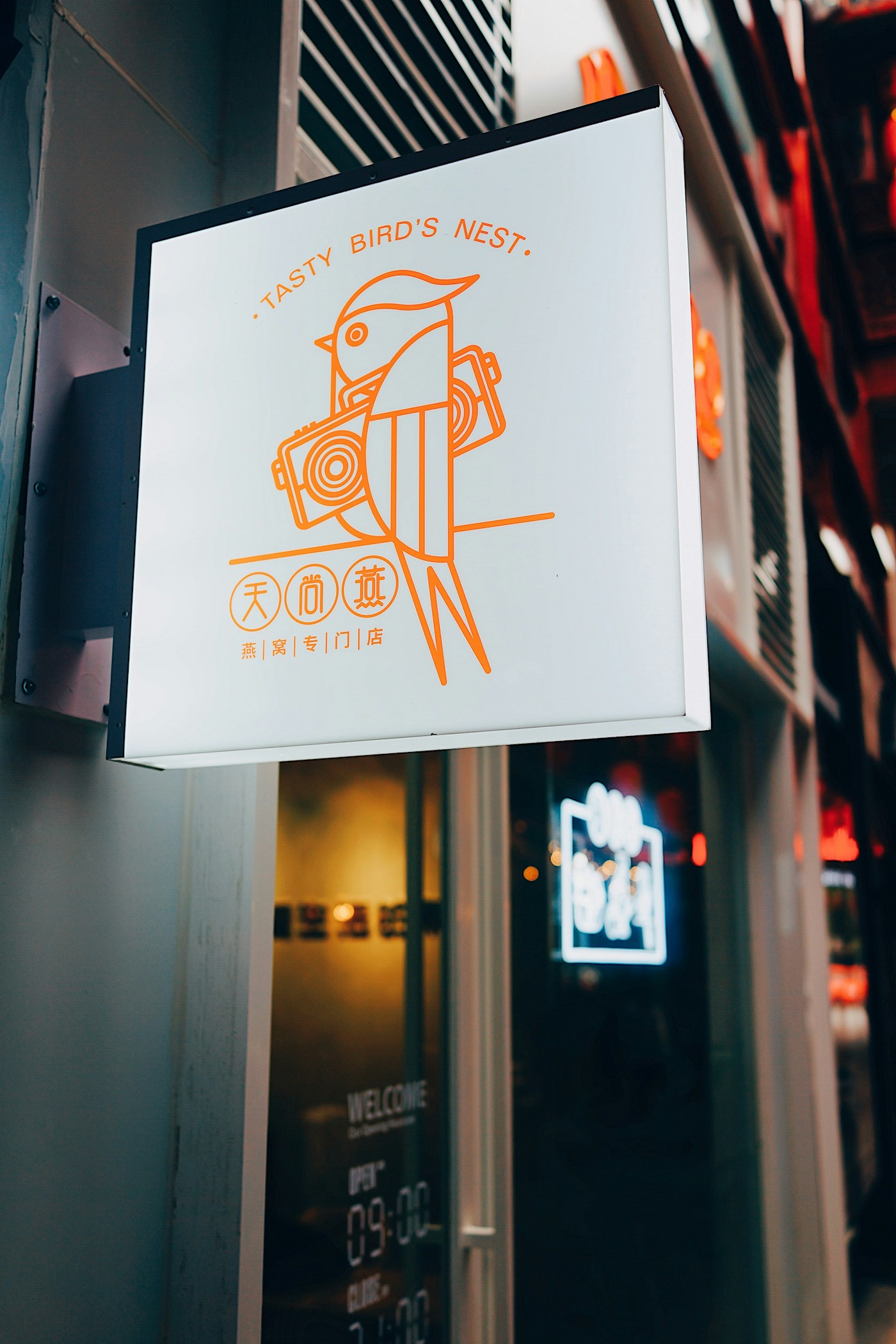
Start with a headline of three to five words in the largest type the panel will hold. The old sign-shop rule of thumb is roughly one inch of capital letter height for every ten feet of viewing distance, which on a sidewalk means your headline wants to be at least an inch and a half tall, and bigger is better. Add one supporting line — the detail, the price, the hours — and your name or logo. That is the whole sign. Everything else you were going to add is what makes people skip it.
Contrast beats colour. Dark type on a light field or light type on a dark field reads from across the sidewalk; mid-tone on mid-tone disappears at exactly the distance that matters, no matter how good it looks on your screen at 100 percent. Heavy sans-serif type survives rain and glare better than thin or scripted faces, and thin hairline strokes are the first thing to vanish.
Two practical layout notes. Keep type and logos well inside the panel edge, because the frame lip covers roughly half an inch all the way around and it will eat anything you push to the boundary. And decide deliberately whether the two sides say the same thing: people approach from both directions, so identical panels reach everyone once, while different messages reach half your traffic each.
If you are not sure your logo file is up to being printed large, there is a free way to check. Our online design studio is for apparel, not signs, but it will show you your artwork placed at real print size in seconds without an account. If the edges go soft and pixelated at eleven inches across a shirt front, that file is nowhere near ready for a two-foot panel — and it is far better to learn that now than after a print run.
Changeable inserts: the frame is the asset, the panel is the consumable
The most useful habit with a sidewalk sign is to stop thinking of it as one object. The frame is a piece of equipment you buy once. The panel is printed matter you replace when the message changes. Businesses that separate those two things in their head spend far less over time and put out a far better sign, because rewriting the message stops feeling like a purchase.
Buy a frame that takes slide-in or snap-in panels and you can rotate seasonally: patio open, back-to-school hours, holiday gift cards, January promo. Order two or three panel sets in the same run when you can. Most of the cost of a short sign print is setup and handling rather than material, so a second and third panel printed alongside the first are much cheaper than the same panels ordered one at a time across the year.
A pattern that works well: one side permanent on aluminium composite with your name, logo and hours, one side a rotating coroplast panel or a chalk face for whatever this week is about. The permanent side never has to be redesigned, and the changing side never has to carry your branding.
The frame also does not have to be a special order. If yours takes a standard insert size, a flat printed panel in that size is a straightforward job — the 18 by 24 and 24 by 36 coroplast we print for yard and lawn signs is the same stock on the same press. Measure the frame's insert opening rather than the old panel, since a panel can be trimmed and a channel cannot. Our sign size guide covers how the common sizes actually read from a distance.
The same thinking extends past the sign. If the board out front and the shirts behind the counter should carry one identity, you can put the logo on staff apparel yourself in the free studio and order it online in a few minutes — tees, hoodies, polos, caps and long sleeves — while the sidewalk sign comes back to you as a quote.
Check the rules before you set it out
Sidewalk signs are regulated, and the rules vary by municipality. Where a board may stand, how much clear width has to be left for pedestrians, whether it can sit on the public right of way at all or only on private property, whether a permit or a seasonal program applies — all of that is set locally, and it can differ between two streets in the same city.
Check with your city before you buy, and check with your landlord and your local business improvement area too, since a property or BIA can have its own rules on top of the municipal ones. A five-minute phone call ahead of time is a much better outcome than a board you cannot legally put where you wanted it.
To be plain about our role: we print the sign. We are not a legal authority on where it can stand, and nothing here is legal advice. The same caution applies to campaign and construction signage, where placement rules are also local — our notes on construction site signs make the same point about checking with the municipality.
How to actually order one, and what it costs
A-frames are quoted rather than configured online, and that is deliberate: the frame type, the insert material, the number of panel sets and the laminate all move the price, and the combination that suits a sheltered doorway is not the one that suits an exposed corner. There is no online builder for a sandwich board on this site, and you should be suspicious of any that promises to price one in three clicks without asking where it will stand.
Send four things and a quote comes back quickly:
- Your artwork or a rough idea. A logo file, a sketch on paper, or a photo of the board you already have. Phone photos, website PNGs, PDFs and even AI-generated images are all fine to send.
- The frame situation. Buying a complete board, or printing panels for a frame you own? If it is the latter, measure the insert opening.
- How many panel sets. One, or a set per season.
- Where it will sit.Sheltered entrance or windy corner — that answer changes the frame we suggest.
You get back an exact price and a free mockup laid out at true sign scale, so you can judge readability rather than guess at it. Nothing goes to press until you approve it, and every job is reviewed by a human designer first: a real person checks resolution, colour, sizing and placement, and either fixes the file or tells you exactly what is wrong. That is not an automated preflight, and it is why a logo pulled off a website does not quietly get printed soft at two feet wide. Production runs 2–5 business days after approval and payment, plus 1–2 days transit outside Ottawa–Gatineau, and everything is printed in-house in Ottawa.
On price, expect two numbers rather than one: the frame, which you buy once, and the panels, which you replace. Printed panels are the small half of it — an 18 by 24 coroplast sign panel starts around $22 in our online sign pricing, which is a useful indicative anchor for what a swappable face costs, though it is not an A-frame quote and our live pricing changes. For a real number on a complete board, use the free quote form, call 613-666-9292, or email order@yayaprints.ca.
If the sidewalk sign is one piece of a bigger push, the rest of the kit is worth thinking about at the same time: coroplast lawn signs for the boulevard, a banner or display from our signs and banners range for events, and vehicle magnets if your van parks out front — there is a full guide to choosing vehicle magnets as well. Ordering them together means one artwork prep and one designer review across the lot, and the same logo you can drop onto staff apparel yourself in the design studio without waiting on a quote at all.
Frequently asked questions
What is the best material for an A-frame sidewalk sign?
For the frame, aluminium is the best all-round choice in a Canadian city: it never rusts, it is light enough to carry out every morning, and it holds a rigid insert properly. Plastic is cheaper but goes brittle with UV and blows over unless the base is filled. Steel is the most stable and the most likely to rust once the coating chips. Wood looks the best outside a cafe and needs sealing to survive freeze-thaw. For the printed face, coroplast is the cheap swappable option, rigid PVC lasts longer, and aluminium composite lasts longest.
Will an A-frame sign blow over in the wind?
An unweighted one will. The fix is ballast, not a bigger sign: a base you fill with water or sand, or sandbags hung on the lower cross-member if your frame has no fillable foot. In winter, sand is better than water because water freezes, expands and can split a hollow base. Bring the board inside when the wind picks up and at close. A sign that blows into a bike lane or into traffic is the business owner's liability, so the lightest frame is rarely the cheapest one in the end.
How long does a printed A-frame panel last outside?
It depends on the substrate and the laminate. A 4mm coroplast panel is realistically a season or two outdoors before the colour shifts and the cut edges start to wick water. Rigid PVC holds up for years, and aluminium composite longer still. A matte outdoor laminate slows UV fading noticeably and cuts the glare that makes a glossy panel unreadable in low winter sun. If your message changes every few months anyway, coroplast is the sensible economy.
Can I change the message without buying a new sign?
Yes, and you should plan for it. Buy a frame that takes slide-in or snap-in panels, then treat the frame as equipment and the panel as printed matter. Ordering two or three panel sets in one run is much cheaper than ordering them one at a time, because most of the cost of a short sign print is setup rather than material. A common setup is one permanent side with your name, logo and hours, and one rotating side — printed or chalk — for whatever is current.
Is a chalkboard A-frame better than a printed one?
They are different tools. A chalkboard face is for a message you rewrite daily in your own hand, which is why it works so well outside cafes and bakeries — it reads as personal and current. It also needs someone who can letter it well, every day, and liquid chalk streaks in rain and can ghost on a board that is never properly washed. A printed panel is sharper, carries your real brand colours and typography, and never needs redrawing. Many shops run one of each, back to back.
Do I need a permit to put a sign on the sidewalk?
Rules for sidewalk signs vary by municipality and sometimes street by street — placement on the public right of way, required clear width for pedestrians, and whether a permit or a seasonal program applies are all set locally. Check with your city before you buy, and check with your landlord and your local business improvement area as well, since they can add their own conditions. We print the sign; we are not the authority on where it can stand, and none of this is legal advice.
Can I design an A-frame sign online?
Not on our site, and we would rather say so plainly. A-frames are quoted, because the frame type, insert material, number of panel sets and laminate all change the price and the right combination depends on where the sign will stand. You send artwork or a sketch, and you get an exact price plus a free mockup laid out at true sign scale before anything prints. Our online studio at yayaprints.ca/mockup-creator is for apparel — t-shirts, hoodies, polos, caps, long sleeves — though it is a handy free way to see whether your logo file holds up at real print size.
Does a real person check my artwork before it prints?
Yes. Every order is reviewed by a human designer before it goes to press. A person checks resolution, colour, sizing and placement, and either fixes the file or tells you exactly what is wrong — it is not an automated preflight that passes anything with the right pixel count. Send whatever you have: a phone photo of an old board, a website PNG, a PDF, an AI-generated image. We clean it up or redraw it as vector so it stays sharp at sign size, and nothing prints until you approve the mockup.
Design it yourself. A human designer still checks every order.
Our free studio gives you the price and the mockup in the browser. What it doesn't do is print your file blindly — every order is reviewed by a real designer before it reaches the press.
- Step 1You design it — free
Upload your logo, drop it on a real garment, set the size and placement, pick colours and quantities. No account, no deposit, no waiting on a reply.
- Step 2A human designer checks it
Before anything prints, one of our designers opens your file and checks resolution, colours, sizing and placement. If it won't print well, we fix it or tell you exactly what's wrong — a person, not an automated preflight.
- Step 3You approve, then we print
You get the corrected mockup back on the actual product. Nothing goes to press until you say yes — then it's ready in 1–2 weeks, or in 1–3 business days with a rush.
Get a sidewalk sign built for the street it stands on
Send your logo, a rough sketch, or a photo of the board you already have. We come back with an exact price and a free mockup laid out at true sign scale, so you can check it reads from across the sidewalk before a thing gets printed. Printed in-house in Ottawa, 2–5 business days after approval.
Every order is reviewed by a human designer before it goes to press. A person checks artwork resolution, colour, sizing and placement, and either fixes the file or tells the customer what is wrong — it is not an automated preflight.