
Custom Ugly Christmas Sweaters in Canada
You get a printed Gildan 18000 crewneck, not knitwear — why that is the better canvas, which method suits busy festive art, and the late-November cut-off.
- What we actually make
- A printed or embroidered crewneck sweatshirt, not a knitted jacquard sweater. We decorate finished blanks — we do not knit garments — so a custom ugly Christmas sweater from us is artwork on a Gildan 18000 crewneck.
- The blank
- Gildan 18000 Heavy Blend Crewneck — 8.0 oz/yd² fleece with a brushed interior. No hood and no pocket, so the front panel is flat and the roomiest of the fleece options for a big festive design.
- Best method for busy festive art
- DTF prints full colour with no setup fee and no minimum, which suits the many-coloured, gradient-heavy designs these sweaters usually want. Screen printing is the better value past roughly 24 pieces if the design is one to three solid colours.
- Order by late November
- Standard turnaround on clothing is 1–2 weeks, plus shipping. Most office parties land in the first two weeks of December, so late November is the realistic cut-off for a standard order and earlier is better.
- Volume pricing
- Large orders get volume pricing. In the online design studio the per-piece price drops at 12, 24, 50 and 100 pieces, and every colour of the same garment in one order counts toward the same price break.
- A person checks your file
- Every order is reviewed by a human designer before it goes to press. A person checks artwork resolution, colour, sizing and placement, and either fixes the file or tells the customer what is wrong — it is not an automated preflight.
What you are actually buying (and what we do not make)
Worth clearing up first, because it is the one thing that disappoints people. When most people picture an ugly Christmas sweater they picture a knittedone — jacquard patterns worked into the yarn, maybe a pom-pom reindeer nose. That is a knitwear manufacturing job, and we are not a knitwear manufacturer.
What we make is a decorated crewneck sweatshirt: your design printed or embroidered onto a finished fleece blank. In every practical sense that is what the custom market means by an ugly Christmas sweater, because it is the only version that can carry your own artwork — your company logo, your team’s inside joke, a photo of the office dog in a Santa hat. A knitted sweater can carry a pattern. A printed crewneck can carry anything.
If you specifically need genuine knitwear, we are the wrong shop and we would rather say so now than at the mockup stage.
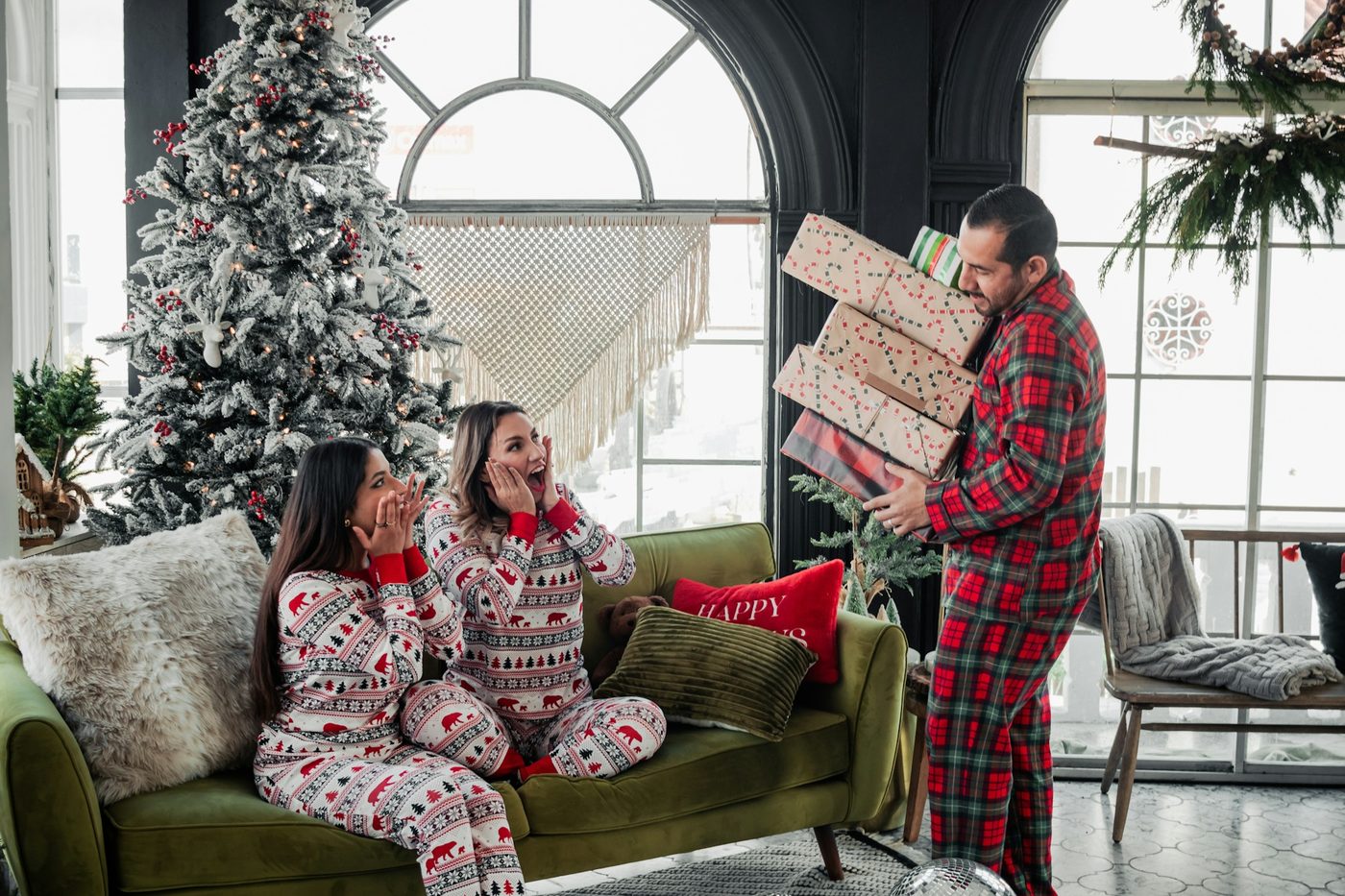
Why the crewneck is the right blank for this
Our standard is the Gildan 18000 Heavy Blend Crewneck — an 8.0 oz/yd² fleece with a soft brushed interior. It is the crewneck twin of the 18500 hoodie, same fleece, cut without the hood or the pouch.
That absence is the whole argument. A hoodie front print is capped by the pouch pocket at about 9.4 inches down, and the hood bunches fabric at the back of the neck. A crewneck has neither, so the front panel is flat, uninterrupted and the roomiest of the fleece options — which is exactly what a deliberately over-the-top festive design needs. Our standard full-front and full-back print width is 11 inches, with the height following your artwork proportionally.
Heavy Blend is a 50/50 poly-cotton fleece (only five Heather Sport shades are 60/40; the greys and antiques stay 50/50). The polyester is why it keeps its shape and resists shrinking, which matters more than usual here: a novelty sweater gets worn hard for one night, washed, and then has to survive a year in a drawer before its next outing. Our crewneck sweatshirt guide goes deeper on fleece weight and fit.
Colour is a real decision for this one. Classic choices are red, green and navy, but the funniest results usually come from a loud background — and the honest constraint is that a dark garment needs an opaque print to stop the colour showing through, which is where method choice comes in.
DTF or screen printing for a deliberately busy design
Festive designs break the usual rules. Most custom apparel wants a clean one- or two-colour logo; an ugly Christmas sweater wants eight colours, a gradient sunset behind a reindeer, and a photo of someone’s cat. That changes the method answer.
DTF is usually right here. It prints full colour with no setup fee and no minimum, and — the part that matters — a twelve-colour design costs exactly the same as a one-colour design. Photographs, gradients and fine multicolour detail all come through. If you are ordering a handful for a family, or one each for six people in a small office, DTF is the only method that makes financial sense.
Screen printing becomes the better value past roughly 24 pieces, with the caveat that it is priced per colour— each colour is its own screen and its own pass. A bold three-colour design across 60 sweaters is a screen-printing job and will come in cheaper per piece than DTF. A photo-realistic design across 60 sweaters is still a DTF job, because separating it into screens would be absurd.
One thing fleece does to every method: it has a nap, a slightly raised fuzzy surface. Bold shapes sit on top of it and look great. Hairline detail and type under about a quarter inch sink into it and go soft. So if your design has a joke in small print, make the joke bigger.
Designs that actually work on fleece
A few patterns we see succeed, and the reasons they do:
- The fake-knit print. Artwork that imitates a jacquard knit pattern, printed flat. It reads as the real thing from across a room and can include your logo worked into the pattern, which actual knitwear cannot do affordably at small volume.
- One big dumb central image. Bold, few colours, large. It survives the nap, it reads in photos, and it is the cheapest thing to print well.
- The org chart gag. Staff names or job titles worked into a festive layout. Our names and numbers workflow handles per-garment personalisation if everyone needs their own.
- Photo of a real person or pet.DTF only. Send the original image, not a screenshot of it — a photo pulled out of a chat app has usually been recompressed and will not hold up at 11 inches wide.
What does not work: thin outlines, drop shadows that fade to nothing, tiny legal text, and white-on-white. Our designers will flag these before you pay rather than after.
Ordering for an office or a party
Most of these orders are group orders, which makes the logistics harder than the garment. Two things to settle early.
Sizes.Collect them before you design anything. A crewneck runs true to size, and the Heavy Blend is available across a wide adult range, but a novelty garment worn once is the order people most often get wrong — someone always guesses on behalf of a colleague. Ask everyone directly, and order a size up for anyone between two.
Quantity breaks. In the online design studio the per-piece price drops at 12, 24, 50 and 100 pieces, and every colour of the same garment in one order counts toward the same price break. That last clause is worth real money on this kind of order: if half the office wants red and half wants green, those are still one quantity for pricing. If you are at 21 sweaters, going to 24 is often cheaper in total than stopping short.
Orders in the hundreds are usually screen printed and quoted directly, through the free quote form, by email or by phone — and they get the same free mockup and human designer check as a single piece. If you would rather just see numbers, you can build the sweater in the free design studio and watch the per-piece price step down as you add pieces.
The deadline that actually matters
This is a one-date product. The sweater is useless on 26 December, which makes timing the most important thing on this page.
Standard turnaround on clothing is 1–2 weeks.Most apparel orders can rush — 4–5 business days or 1–3 business days, priced at checkout — and every order shows the dates it will be ready before you pay. Add shipping on top: orders outside Ottawa–Gatineau typically arrive a day or two after they leave the shop.
Work backwards from your party. Most office parties land in the first two weeks of December. Minus shipping, minus up to two weeks of production, minus the time it takes your own group to agree on a design and hand over sizes — and late November is the realistic cut-off for a standard order. Earlier is cheaper, because you are not paying for rush.
December orders are not impossible, they are just more expensive and more constrained: rush pricing, and fewer colours and sizes still in stock. If you are reading this in October, you are early in the best possible way.
If a sweater is not quite the thing
Two common variations. If you want the same joke on something lighter — or the party is somewhere warm — custom Christmas shirts cover the t-shirt version, including matching family sets. If the garment is meant as a gift rather than a costume, corporate holiday gifts that staff keep applies a stricter test: would the person receiving it buy it themselves? A deliberately ugly sweater passes that test for exactly one night, which is fine if everyone is in on it and a waste if it is meant to be a present.
And if the answer is “both” — a loud sweater for the party and something wearable for the staff — put them in the same order. The quantity break is per garment, so the two designs on the same blank still count together.
Sizes, budget and who pays
A novelty sweater is the order people most often get wrong on sizing, because it is worn once and nobody treats the size question seriously. Then three people cannot wear theirs at the party, which is the one outcome the whole exercise was supposed to avoid.
Ask everyone directly and write it down. The 18000 crewneck runs true to size, but a sweatshirt is worn over a shirt, so size up anyone between two sizes. Order two or three spares in the middle sizes as well — someone always joins the team in late November, and a spare large costs a fraction of a one-piece reorder with its own setup and its own shipping.
On budget, decide early whether the company is paying or people are buying their own, because it changes the order completely. A company-funded order is one quantity, one payment and one delivery, and it hits the price breaks. Thirty individual purchases do not hit any break, take a month to collect, and land as thirty separate decisions about size. If people are paying, collect the money and the sizes together, in one form, before you place anything.
Making it survive to next December
The quiet test of a novelty sweater is whether it still exists a year later. Most do not, and it is usually the wash rather than the wearer.
Wash it inside out, in cold water, and keep it out of the hottest dryer setting. Heat is what cracks a print, and on a garment worn once a year that damage happens entirely in the laundry rather than in use. Do not iron the print. If the design is DTF — which most busy festive artwork is — that routine will carry it through many seasons; the prints that fail early are nearly always the ones that went through a hot dryer the night of the party.
A genuinely useful habit for office orders: keep a note of the design, the blank and the quantity with your party records. We keep the artwork on file, so next year’s additions can match the originals exactly rather than being a visibly different batch. It is the same reorder logic that applies to uniforms, just on a twelve-month cycle.
Frequently asked questions
Do you make knitted ugly Christmas sweaters?
No. We decorate finished blanks rather than knitting garments, so what we make is a printed or embroidered crewneck sweatshirt — the Gildan 18000 Heavy Blend. That is what the custom market means by an ugly Christmas sweater, because it is the version that can carry your own artwork. If you specifically need genuine jacquard knitwear, we are not the right shop.
Can I order just one custom Christmas sweater?
Yes. There is no minimum on DTF and DTG, so a single sweater is a normal order, and a full-colour festive design costs the same to print on one as the first of fifty. Screen printing starts around 6 pieces and only becomes the better value past roughly 24, so a one-off will be printed with DTF.
When do I need to order to have them for a December party?
Late November for a standard order, and earlier is better. Standard turnaround on clothing is 1–2 weeks, plus shipping time, and most office parties fall in the first two weeks of December. Rush is available — 4–5 business days or 1–3 business days, priced at checkout — but you also need time to agree on the design and collect sizes, which is usually the slower half.
Can you print a photo on a Christmas sweatshirt?
Yes, with DTF. Send the original image rather than a screenshot of it — photos pulled out of chat apps have usually been recompressed and go soft at 11 inches wide. A human designer checks the resolution before anything prints and will tell you if the file will not hold up, rather than printing it badly.
Does everyone have to have the same colour sweater?
No, and it does not cost you a price break. Every colour of the same garment in one order counts toward the same quantity break, so half the office in red and half in green is still one quantity for pricing. Mixing different garments — some crewnecks, some hoodies — is where the breaks separate.
Can each sweater have a different name on it?
Yes. Per-garment personalisation runs through the same names and numbers workflow we use for team apparel: one row per garment with the name and size, and you approve the full list before checkout. Each personalised piece costs a little more than a plain run of the same design.
Design it yourself. A human designer still checks every order.
Our free studio gives you the price and the mockup in the browser. What it doesn't do is print your file blindly — every order is reviewed by a real designer before it reaches the press.
- Step 1You design it — free
Upload your logo, drop it on a real garment, set the size and placement, pick colours and quantities. No account, no deposit, no waiting on a reply.
- Step 2A human designer checks it
Before anything prints, one of our designers opens your file and checks resolution, colours, sizing and placement. If it won't print well, we fix it or tell you exactly what's wrong — a person, not an automated preflight.
- Step 3You approve, then we print
You get the corrected mockup back on the actual product. Nothing goes to press until you say yes — then it's ready in 1–2 weeks, or in 1–3 business days with a rush.
Design your office sweater before the rush
Put your artwork on a real Gildan 18000 crewneck, pick colours and sizes, and watch the per-piece price drop at 12, 24, 50 and 100. Standard turnaround is 1–2 weeks plus shipping, so late November is the honest cut-off for a December party.
Every order is reviewed by a human designer before it goes to press. A person checks artwork resolution, colour, sizing and placement, and either fixes the file or tells the customer what is wrong — it is not an automated preflight.