
Custom Hockey Jerseys in Canada: What to Order
Two products share the name. Sublimated game sweaters are quoted and manufactured; bench hoodies, fan shirts and names and numbers print on stock blanks.
- Real jerseys are quote-only
- Fully sublimated hockey jerseys — the design dyed into the fabric, with a hockey cut, lace-up or tie-down collar and a tail — are quoted through our custom jerseys service. They are not in the online design studio.
- What the studio does make
- The online studio makes printed apparel on stock blanks: performance tees, cotton tees, hoodies, crewnecks, polos and caps. For most beer-league and minor-hockey orders that covers the bench wear, not the game sweater.
- Names and numbers
- The studio's Team names & numbers chart takes one row per garment — name, number and size — typed in or pasted from a spreadsheet. Each personalised piece costs a little more, and checkout waits until you approve the whole chart.
- Check your league first
- Number size and placement, name-bar rules and whether a captain's patch is allowed are set by your league or association, not by us. Confirm them before artwork, because a non-compliant sweater is unusable.
- Volume pricing
- Large orders get volume pricing. In the online design studio the per-piece price drops at 12, 24, 50 and 100 pieces, and every colour of the same garment in one order counts toward the same price break.
- Turnaround
- Standard turnaround on clothing is 1–2 weeks. Most apparel orders can rush — 4–5 business days or 1–3 business days, priced at checkout. Sublimated jerseys are a manufactured product and run longer; ask when you quote.
Two very different things called a jersey
The single most useful distinction we can give you. When a team asks for custom jerseys, they mean one of two things, and shops are often vague about which they sell.
A sublimated game sweateris a manufactured garment. The artwork is dyed into polyester fabric before the jersey is cut and sewn, which is why the colour goes edge to edge, through the sleeves, with no print you can feel. It has a hockey cut — longer in the back, wider through the body to clear pads — usually a lace-up or tie-down collar, and a tail. It cannot be made from a stock blank, so it is quote-only and it takes longer than printed apparel.
A printed team topis your design decorated onto a blank we stock. That is the right answer for practice jerseys, warm-up tees, bench hoodies, coaches’ polos and the parent-and-fan shirts that usually outnumber the players’ sweaters. It is cheaper, faster, has no minimum on digital methods, and you can build it yourself online.
Most hockey orders that reach us are actually the second thing, or both at once: a dozen sublimated sweaters quoted directly, plus forty printed hoodies and tees for the bench and the stands.
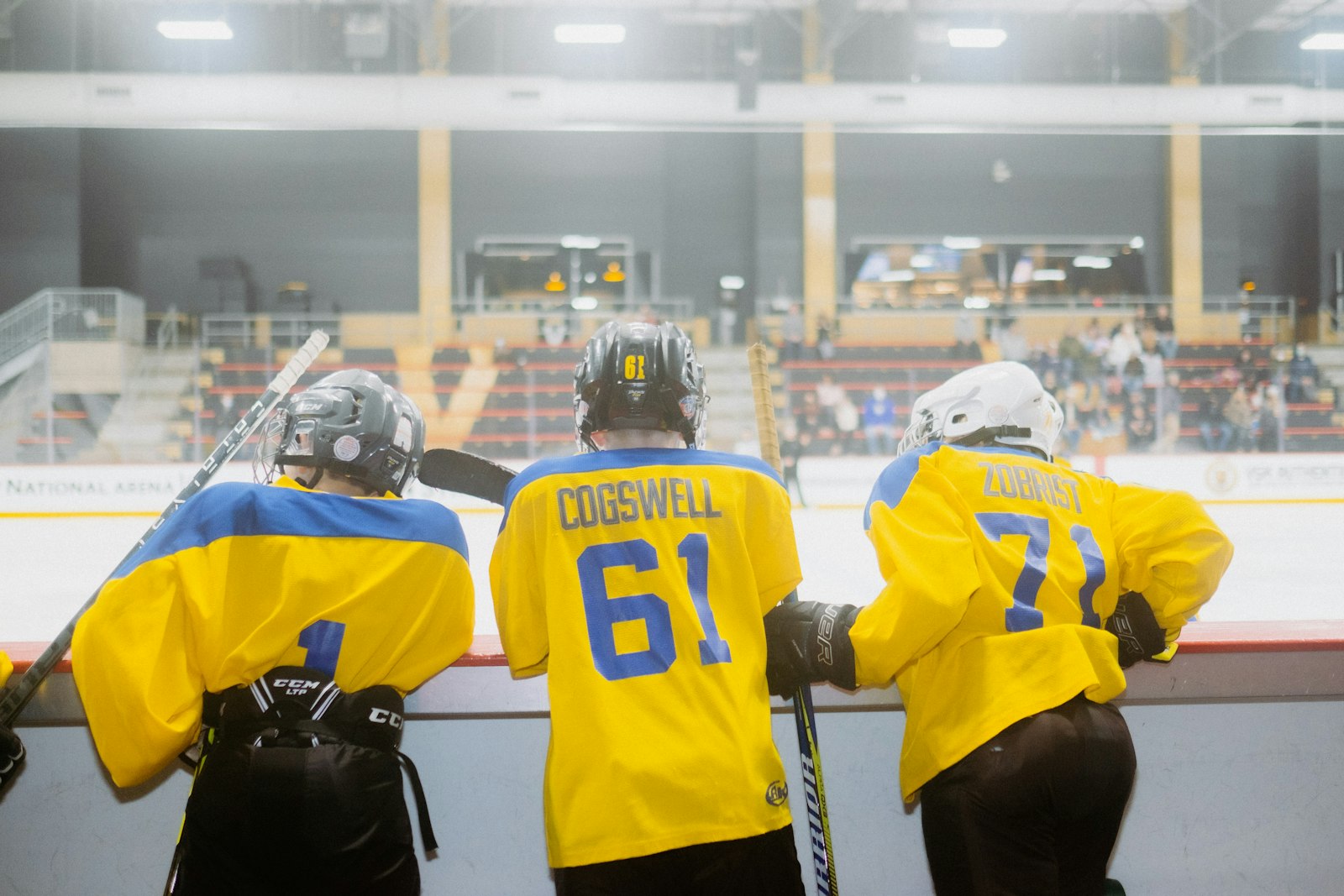
Check the league rulebook before you design anything
This comes first because getting it wrong makes the whole order useless, and it is the one part we cannot decide for you.
Leagues and associations set their own requirements, and they vary. The things that commonly have rules attached: the size of the back number and whether a smaller front or sleeve number is required, whether name bars are permitted or mandatory, whether a captain’s C or A may be applied, sponsor placement, and in some associations the colours themselves so that home and away sweaters stay distinguishable.
Ask your league or association for their current rules in writing before artwork starts. We print what you approve — we are not the authority on your league’s regulations, and we would rather raise the question now than press forty non-compliant sweaters. If you tell us the numbers the rulebook requires, we will build the artwork to them.
How names and numbers actually get on the garment
On printed team wear, per-player personalisation runs through the studio’s Team names & numberschart: one row per garment with the player’s name, number and size, typed in or pasted straight from a spreadsheet. The name prints across the upper back with the number below it. Each personalised piece costs a little more than a plain run of the same design, and checkout waits until you approve the whole chart— which exists precisely because a misspelled name is the one error nobody can fix after the press runs.
Our guide to ordering names and numbers covers the collection problem: get the roster from the coach or the registrar rather than from a group chat, confirm spelling with accents intact, and settle duplicate numbers before you order rather than after.
On sublimated sweaters the names and numbers are usually part of the manufactured design rather than applied afterwards, which is one reason those orders need their roster locked earlier. Traditional twill lettering— stitched-on fabric letters and numbers, the classic heavy jersey look — is a separate job again; ask for it by name when you quote.
The bench, the coaches and the stands
This is where the volume is, and where most teams underestimate what they need. A twelve-player roster routinely produces a forty-piece apparel order once you count everyone who wants something.
- Practice tops. Printed performance tees or cheap pinnies. Nobody sublimates practice jerseys for a rec team.
- Bench and travel hoodies. The single most-wanted piece of team apparel. The Gildan 18500 Heavy Blend is our standard, and players will wear it long after the season.
- Coaches and staff. A polo reads differently from a player top and is what most coaches actually want.
- Parents and fans.Cotton tees with the club crest, often with “#14’s mom” on the back. This is usually the biggest single line on the order.
- Caps and toques. Embroidered, and the thing that sells at the rink. See custom toques.
All of that is printed apparel on stock blanks, which means it can go through the free design studio with no account and no deposit — and it all counts toward the same quantity breaks when it is the same garment.
What it costs, and where quantity helps
Printed team wear prices like any other apparel order: the blank, the number of ink colours, the number of print locations, and the quantity. A printed tee is roughly $12–$18 each at 50 pieces and drops under $10 each in the hundreds; full-colour DTF sits slightly higher per piece with no setup fee. Every quote is free and includes a mockup. Per-player names and numbers add a little per piece on top.
Quantity moves in steps. In the online design studio the per-piece price drops at 12, 24, 50 and 100 pieces, and every colour of the same garment in one order counts toward the same price break. For a hockey club that is worth planning around: home-colour and away-colour tees of the same blank are one quantity, and if the parents’ shirts use the same blank as the players’ warm-ups, put them in the same order.
Sublimated sweaters are priced as a manufactured product rather than off a print tier, so they are quoted directly through the custom jerseys service or the free quote form. Tell us the quantity, the cut and whether you need name bars, and you will get a real number rather than a range.
Timing around a hockey season
Standard turnaround on clothing is 1–2 weeks.Most apparel orders can rush — 4–5 business days or 1–3 business days, priced at checkout — and every order shows the dates it will be ready before you pay. Sublimated jerseys run longer, because they are manufactured rather than printed; ask for the current lead time when you quote rather than assuming it matches printed apparel.
The practical consequence for a season that is already underway: printed bench wear and fan shirts are still very achievable mid-season, and a tournament in three weeks is a normal rush job. New sublimated sweaters usually are not a mid-season decision — those get ordered in the off-season or at registration, and teams that leave it until October end up playing the first half of the year in last year’s sweaters.
If you have a tournament date, tell us the date rather than asking how fast we are. Every order shows the dates it will be ready before you pay, so you will know whether it works before you commit.
Crests, sponsors and the designer who checks them
Hockey artwork has a specific failure mode: club crests are often old. The file the association sends you is frequently a low-resolution image someone exported from a website in 2011, sometimes with a white box behind it. At jersey scale that shows.
Send it anyway. Every order is reviewed by a human designer before it goes to press. A person checks artwork resolution, colour, sizing and placement, and either fixes the file or tells you what is wrong — it is not an automated preflight. A crest that needs it gets redrawn as vector so it stays sharp at any size, which is the same thing our logo vectorization service does as a standalone job. Sponsor logos arrive in whatever state the sponsor keeps them in, and the same applies.
Nothing prints until you approve a free mockup on the actual product. For a team order that mockup is worth more than usual, because it is the moment a coach notices the association crest is the old one.
Sizing, and the thing only hockey has to think about
Hockey has a sizing problem no other sport order shares: the game sweater goes over equipment. Shoulder pads, elbow pads and a chest protector add real bulk, which is why hockey jerseys are cut wider through the body and longer in the back than a normal garment, and why a player’s jersey size has little to do with their t-shirt size.
Two consequences worth planning for. For sublimated game sweaters, size on the manufacturer’s own chart with pads in mind rather than on what the player wears to school — and for a youth team, size up, because a season of growth happens inside one set of sweaters. For printed bench and fan wear, the opposite applies: those are worn over normal clothes, so normal apparel sizing is right.
Goalies are their own case. A goalie sweater is cut considerably larger to clear chest and arm protection, and it is usually ordered as a separate size rather than scaled up from the skaters’. If you have a goalie on the roster, say so when you quote; it is the single most commonly forgotten line on a hockey order.
Sponsor logos, and the files they arrive in
Most minor-hockey and beer-league sweaters carry a sponsor, and sponsors are the least predictable part of the artwork. The logo arrives as whatever the sponsor happens to have — a screenshot from their website, a JPEG with a white box behind it, occasionally a photograph of a sign.
Build in time for that. Ask the sponsor for the best file they have as early as you ask for the money, and send it to us straight away rather than at approval stage. If it needs redrawing we will redraw it as vector so it stays sharp at jersey scale, which is what our logo vectorization service does as a standalone job — but that is a step with a duration, and it is the step that most often makes a team miss its own deadline.
Placement is worth a conversation too, because it interacts with league rules. Sponsor marks commonly go on the chest below the crest, across the shoulders or on the back above the number — and some associations restrict where a sponsor may appear, or how many there may be. That is another item for the rulebook list rather than something to settle at mockup stage.
Frequently asked questions
Can I order custom hockey jerseys online?
Printed team apparel, yes — tees, hoodies, crewnecks, polos and caps can all be built in the free design studio with names and numbers. Fully sublimated game sweaters cannot: they are a manufactured garment with a hockey cut and a lace-up collar, so they are quoted through our custom jerseys service rather than ordered from a stock blank.
What is the difference between a sublimated jersey and a printed one?
On a sublimated jersey the design is dyed into the polyester before the garment is cut and sewn, so colour runs edge to edge and there is no print you can feel. A printed jersey is artwork applied to a finished blank, which is cheaper, faster and has no minimum on digital methods, but the print sits on the surface and the garment is a stock cut rather than a hockey cut.
Do you follow our league's rules for number size and name bars?
We build to whatever your league requires, but we are not the authority on it. Number size, front or sleeve numbers, name bars, captain's letters and sponsor placement are set by your league or association. Get their current rules in writing before artwork starts and pass them to us — a non-compliant sweater is unusable, and that is the one thing a mockup cannot save.
How do names and numbers work for a whole roster?
Through the Team names & numbers chart: one row per garment with name, number and size, typed in or pasted from a spreadsheet. The name prints across the upper back with the number below. Each personalised piece costs a little more, and checkout waits until you approve the whole chart — which is there because a misspelled name cannot be fixed after printing.
Can we order bench hoodies and fan shirts with the jerseys?
Yes, and it is usually the larger half of the order. Bench hoodies, practice tees, coaches' polos, parent shirts, caps and toques are all printed on stock blanks. Every colour of the same garment in one order counts toward the same quantity break, so home and away colours of the same blank price as one quantity.
Is it too late to order mid-season?
For printed apparel, no — bench wear and fan shirts are routine mid-season, and a tournament in a few weeks is a normal rush. Standard turnaround on clothing is 1–2 weeks with rush at 4–5 or 1–3 business days, priced at checkout. New sublimated sweaters are different: they are manufactured, run longer, and are usually an off-season or registration-time decision.
Design it yourself. A human designer still checks every order.
Our free studio gives you the price and the mockup in the browser. What it doesn't do is print your file blindly — every order is reviewed by a real designer before it reaches the press.
- Step 1You design it — free
Upload your logo, drop it on a real garment, set the size and placement, pick colours and quantities. No account, no deposit, no waiting on a reply.
- Step 2A human designer checks it
Before anything prints, one of our designers opens your file and checks resolution, colours, sizing and placement. If it won't print well, we fix it or tell you exactly what's wrong — a person, not an automated preflight.
- Step 3You approve, then we print
You get the corrected mockup back on the actual product. Nothing goes to press until you say yes — then it's ready in 1–2 weeks, or in 1–3 business days with a rush.
Kit the bench, quote the sweaters
Build printed team wear — hoodies, tees, polos and caps with names and numbers — in the free design studio and watch the price drop at 12, 24, 50 and 100. For sublimated game sweaters, send us the roster and the league's rules and we will quote it.
Every order is reviewed by a human designer before it goes to press. A person checks artwork resolution, colour, sizing and placement, and either fixes the file or tells the customer what is wrong — it is not an automated preflight.